Introduction: A Window into the Deep Past
Long before the first terrestrial plants had claimed the continents and nearly a quarter-billion years before the rise of the dinosaurs, the Earth’s oceans were teeming with a strange, alien beauty. Among the most successful inhabitants of these primordial seas were the crinoids—echinoderms that resembled delicate, feathery flowers anchored to the seafloor by long, calcified stalks. While their stony skeletons are abundant in the fossil record, the soft tissues that once allowed them to breathe, feed, and interact with their environment have almost universally vanished, lost to the relentless entropy of decay.
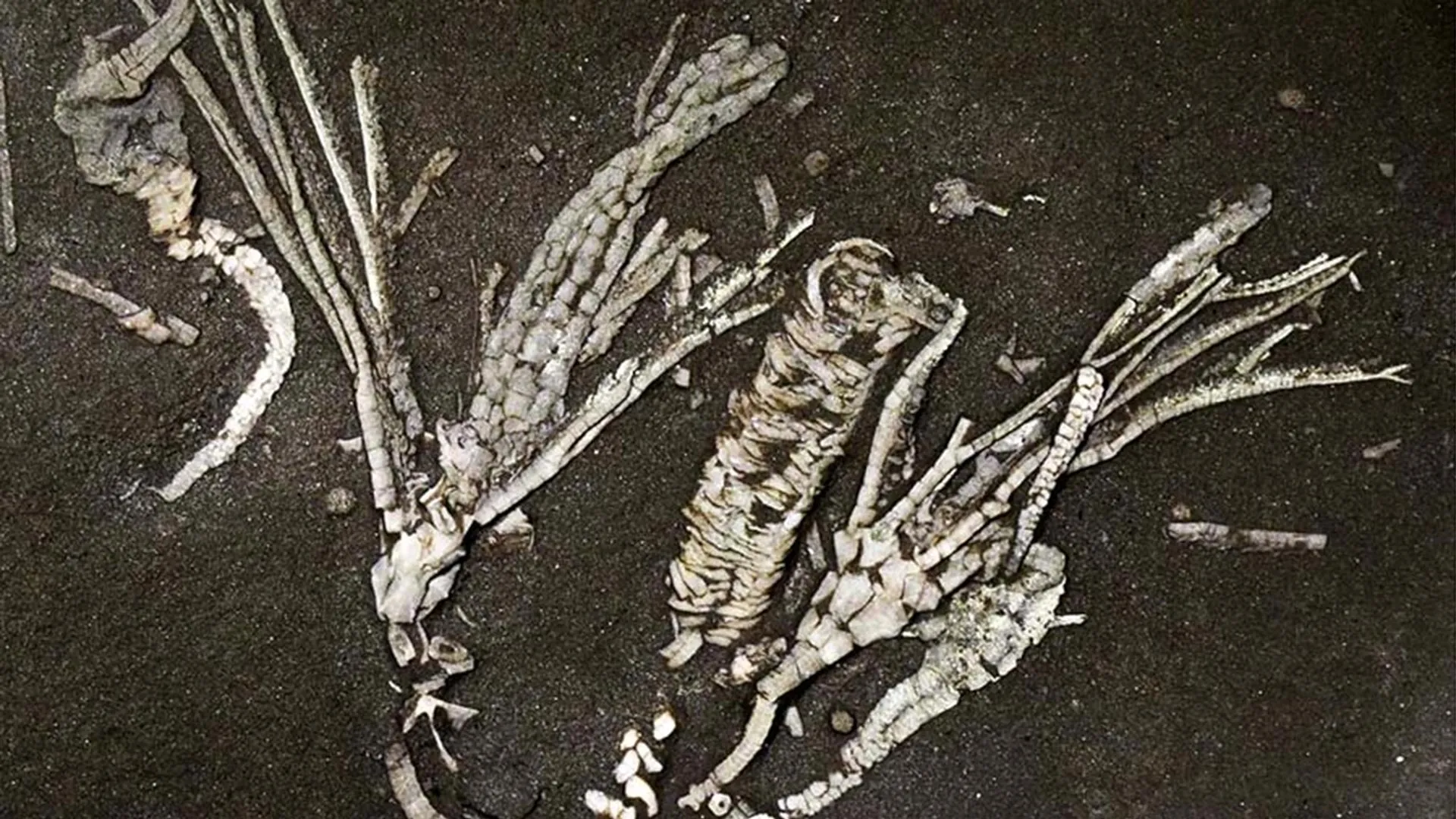
However, a groundbreaking discovery recently analyzed by paleontologists at the University of Oklahoma has pulled back the curtain on this lost world. By examining a rare, long-overlooked specimen of Dendrocrinus simcoensis, researchers have identified the oldest known preserved soft tissue in a crinoid, dating back more than 450 million years. This discovery, hidden in plain sight within a community museum collection, is now providing an unprecedented look at how early life navigated the Paleozoic oceans.
The Chronology of a Discovery
The journey of this fossil is a testament to the enduring value of museum curation. Unlike high-profile expeditions that dominate headlines, this discovery did not occur in a remote canyon or a newly excavated site. Instead, it unfolded within the quiet, climate-controlled aisles of the Musée de paléontologie et de l’évolution in Montréal.
The Sleeper Specimen
For years, the fossil of Dendrocrinus simcoensis sat in the museum’s drawers, cataloged but largely unexamined for the specific microscopic details it held. It was only when Dr. Lena Cole and Dr. David Wright—paleontologists specializing in invertebrate history at the Sam Noble Oklahoma Museum of Natural History—visited the institution that the true significance of the specimen became apparent.
As they scrutinized the fossil, they realized that the specimen preserved not just the standard skeletal plates, but the delicate tube feet—structures that usually disintegrate within days of an animal’s death. This "one-in-a-million" preservation event effectively froze a moment in the Ordovician Period, creating a biological time capsule that has survived for over 450 million years.
A Timeline of Rare Preservation
To grasp the rarity of this find, one must understand the "taphonomic" barriers to fossilization. When an organism dies, soft tissues—skin, eyes, internal organs, and sensory appendages—are the first to succumb to bacterial decay. For these tissues to persist, the animal must be buried rapidly in an environment that acts as a natural "refrigerator" or vacuum seal, preventing oxygen from reaching the carcass and stalling decomposition.
This particular Dendrocrinus specimen is only the second crinoid fossil ever discovered with such soft tissue preserved. It holds the distinction of being the oldest example by a significant margin, predating the earliest known dinosaur fossils by more than 200 million years.
The Anatomy of Survival: Feeding in the Ordovician
The "tube feet" preserved in the Dendrocrinus specimen are more than just a biological curiosity; they are the key to understanding the creature’s ecological niche. In modern echinoderms, such as starfish and sea urchins, tube feet are multifunctional, used for locomotion, sensory perception, and the capture of food particles from the water column.
Teeth of the Sea
Dr. David Wright notes that the tube feet of a crinoid are functionally analogous to the teeth of a mammal. Just as the shape, wear patterns, and structure of a mammal’s molars can reveal whether it was an herbivore, carnivore, or omnivore, the tube feet of a crinoid reveal the "lifestyle" of the animal.
"Differences in their structure tell us about what kinds of environments a species lived in and how it fed," Wright explains. "By examining the spacing and form of these delicate structures, we can reconstruct the feeding strategies that allowed these animals to thrive in the ancient, competitive reef ecosystems of the early Paleozoic."
Evolutionary Divergence
When Cole and Wright compared the 450-million-year-old tube feet to those of modern crinoids, they were struck by the stark anatomical differences. These variations suggest that the evolutionary path of crinoids was not a linear progression, but a complex shifting of strategies. Over the last half-billion years, these animals have radically altered their feeding mechanisms to adapt to changing ocean chemistry, shifting currents, and the emergence of new predators. This specimen acts as a critical "baseline" for researchers to measure just how much, and how quickly, these evolutionary changes occurred.
Official Perspectives: The Value of Museum Stewardship
The discovery has sparked a renewed conversation about the importance of small, community-funded museums. The Musée de paléontologie et de l’évolution in Montréal, which houses the specimen, operates on limited resources, yet its collection has proven to be a treasure trove of scientific significance.
Dr. Lena Cole on the "Natural Refrigerator"
Dr. Lena Cole emphasizes the serendipity of the find. "After an animal dies, soft tissues are the first things to decay," she states. "Most fossils are only made up of hard parts. Soft tissues are only preserved when the environment acts almost like a natural refrigerator—conditions that are incredibly rare. To find this level of detail in a specimen that has been sitting in a museum drawer for years is a reminder that the most significant discoveries are often waiting for the right pair of eyes."
Dr. David Wright on the Future of Research
Dr. Wright echoes this sentiment, highlighting the "integrative" nature of modern paleontology. "We don’t always know the full significance of the specimens we collect," he notes. "New technologies, ideas, or expertise often find surprising ways to utilize existing specimens. This is why we work to make our collections accessible to researchers around the world. There are simply too many fossils to study over one person’s career. There’s more than a lifetime’s worth of discoveries waiting to be found in our existing collections."
Broader Implications: Reconstructing Ancient Ecosystems
The discovery of the Dendrocrinus soft tissue does not merely add a footnote to the history of crinoids; it provides a structural framework for understanding early Paleozoic ecology.
Mapping the Paleozoic Biosphere
During the Ordovician, the world’s oceans were undergoing a massive diversification of life. Crinoids were foundational members of these reef ecosystems, acting as filters that maintained the water column and provided habitat for smaller organisms. By reconstructing their feeding habits, paleontologists can better understand the flow of energy through these ancient food webs.
Adaptive Evolution
"Fossilized remains of long-extinct species can show features well outside the range of variation we see in living species," Wright explains. By bridging the gap between extinct forms and modern descendants, researchers are developing a more nuanced view of "adaptive evolution"—the process by which life forms shift their survival strategies in response to environmental pressures. Understanding how these animals coped with the challenges of the Paleozoic helps scientists better predict how modern ecosystems might react to the current, rapid shifts in the Earth’s climate and ocean acidity.
Conclusion: The Unfinished Story
The Dendrocrinus simcoensis fossil serves as a powerful bridge between the deep past and the modern day. It challenges the conventional view that the fossil record is merely a collection of "bones and shells," proving instead that with the right combination of patience, technology, and access, even the most fragile aspects of ancient life can be brought back into the light.
As Dr. Cole and Dr. Wright continue their work at the Sam Noble Oklahoma Museum of Natural History, they are overseeing a collection of over one million specimens. Every year, thousands of new fossils are added to the global inventory, each one a potential key to a mystery that has remained locked for millions of years. This discovery is not just about a single animal; it is about the infinite potential hidden within our museums, waiting for the next generation of scientists to ask the right questions.
In the silence of the museum vaults, the story of the ancient oceans is still being written—one fossil, one tissue sample, and one breakthrough at a time.