As the 2026 midterm election season approaches its final stretch, the American political landscape faces structural debates over voting systems, key primary shakeups, and shifting dynamics across critical House and Senate battlegrounds.
Central to current election reform discourse is the push for nonpartisan primaries—a system where all candidates, regardless of party affiliation, appear on a single ballot. Proponents argue this mechanism disenfranchises fewer independent voters and forces candidates to appeal to a broader electorate rather than a ideological base. Currently, Alaska utilizes a top-four primary with general elections decided by ranked-choice voting, while California and Washington implement top-two systems. Voters in Massachusetts will decide a ballot initiative this November to adopt a similar nonpartisan format.
However, recent primary outcomes have provided critics with key arguments. In Alaska’s 15-candidate primary field for its at-large congressional seat, federal prisoner Eric Hafner—a perennial candidate living in a New York federal penitentiary—climbed into fourth place, bolstered by outside financial campaigns. Meanwhile, California’s top-two system has resulted in several intra-party November general elections, leaving partisan factions without representation in key races like the redrawn 40th Congressional District between Republican Reps. Young Kim and Ken Calvert. These arguments contributed to the defeat of nonpartisan primary measures in six states—Arizona, Colorado, Idaho, Montana, Nevada, and South Dakota—during the 2024 cycle, while Alaska voters will reconsider their own system on the November ballot.
Beyond election mechanics, recent primary elections delivered major political shifts:
Florida: Embattled Republican Rep. Cory Mills lost his primary in the Sunshine State to former television news anchor Ryan Elijah. Former President Donald Trump shifted his endorsement from Mills to Elijah prior to the election, revealing he had previously urged Mills to withdraw following mounting scandals.
Wyoming: Secretary of State Chuck Gray emerged victorious from a nine-candidate Republican primary for the state’s at-large House seat, positioned to replace GOP Rep. Harriet M. Hageman, who won her primary for the U.S. Senate. However, Trump’s endorsed gubernatorial candidate fell short in the primary.
California’s 14th District: An all-Democratic special election to replace former Rep. Eric Swalwell remains unresolved. State Sen. Aisha Wahab holds a narrow lead over Bay Area Rapid Transit Board President Melissa Hernandez amid an ongoing federal investigation into sexual misconduct allegations against Swalwell.
National Outlook: Campaign ratings firm Inside Elections shifted 10 out of 11 recently updated midterm race ratings toward Democrats, signaling ongoing vulnerabilities for House and Senate Republicans less than three months from Election Day.
Chronology of Key Political Events
The mid-August primary stretch brought critical developments across several states:
[August 12–13]
New England Campaign Trail
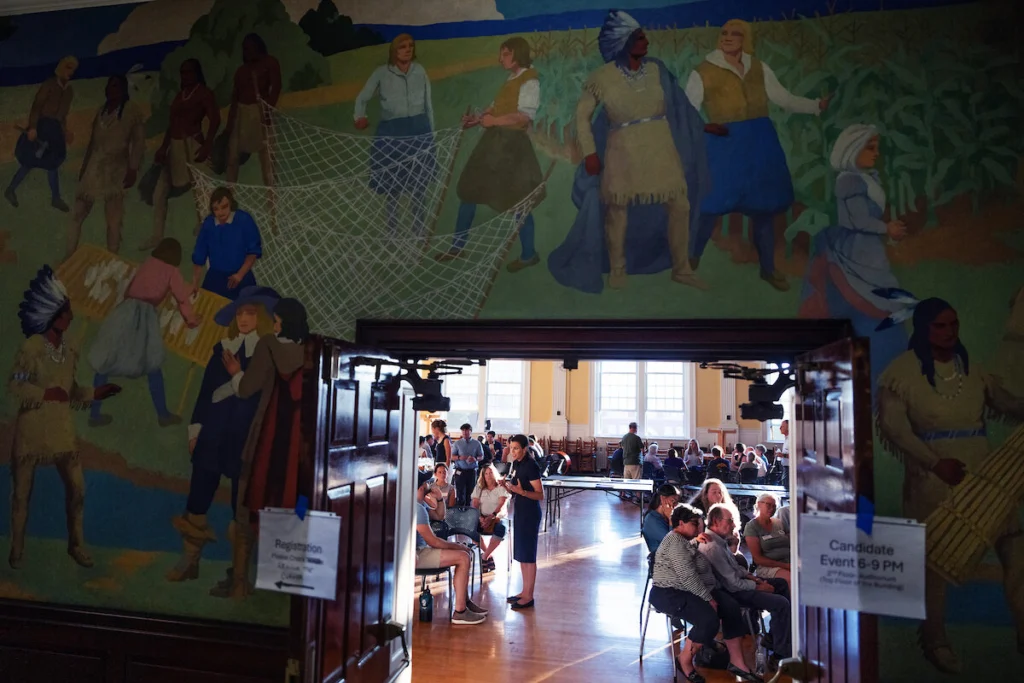
Candidates in NH and MA participate in campaign forums, including "speed dating" voter events in Dover, NH.

[August 18]
Florida & Wyoming Primaries
- Rep. Cory Mills (R-FL) defeated by Ryan Elijah.
- Chuck Gray wins GOP primary for WY At-Large House seat.
- Charlie Crist advances to St. Petersburg mayoral runoff.

[August 19–20]
Federal Probes & National Strategy
- Federal agents seize devices from former Rep. Eric Swalwell.
- DCCC expands "Red to Blue" program adding 5 challengers.
- Missouri court clears new congressional map for 2026 midterms.

[Late August / Upcoming]
Runoff Elections
- South Carolina GOP Senate runoff (Darline Graham vs. Rep. Ralph Norman).
- Runoff primaries set for Oklahoma and Georgia.
Mid-August Primary Waves
Florida Developments: Beyond Mills’ defeat, state Rep. Angie Nixon secured an upset win in the Democratic Senate primary, while incumbent Democratic Reps. Jared Moskowitz and Debbie Wasserman Schultz successfully defended their seats against primary challengers. In Florida’s 9th District, Navy veteran Dan Green secured the GOP nomination to challenge Democratic Rep. Darren Soto in a redrawn district that backed Trump by 18 points in 2024.
Connecticut to Massachusetts Ripples: Following the primary defeat of veteran Connecticut Rep. John B. Larson, national attention turned to Massachusetts’ 1st District, where 77-year-old Democratic Rep. Richard E. Neal faces a primary challenge from 39-year-old public school teacher Jeromie Whalen.
South Carolina: A Republican runoff to select a nominee for the late Sen. Lindsey Graham’s seat pits interim Sen. Darline Graham against Rep. Ralph Norman.
Oklahoma and Georgia: Oklahoma candidates face runoffs for governor and Senate, while Georgia Democrats select a candidate to succeed the late Rep. David Scott.
Supporting Data and Financial Breakdown
Federal Campaign Spending and District Metrics
New Hampshire’s 1st Congressional District
With Democratic Rep. Chris Pappas vacating his seat to run for U.S. Senate, NH-01 represents a key battleground. The district, which covers Manchester and eastern New Hampshire, supported Kamala Harris by 2 percentage points in 2024, while Republican Gov. Kelly Ayotte carried it by 10 points in her gubernatorial victory.
Candidate Fundraising Overview (NH-01)
============================================================
Candidate            Party     Total Raised    Cash on Hand
------------------------------------------------------------
Maura Sullivan       (D)       $3.3 Million    $1.6 Million
Stefany Shaheen      (D)       $2.2 Million    $1.2 Million
Anthony DiLorenzo    (R)       $2.3 Million*   $1.2 Million
Christian Urrutia    (D)       $1.0 Million    $220,000
Hollie Noveletsky    (R)       $551,000        $292,000
Brian Cole           (R)       $483,000        $126,000
============================================================
* Includes a personal loan of under $1.7 million.
Outside spending has accelerated in NH-01:
For Sullivan (D): Over $1 million from VoteVets, alongside additional expenditures from the Servant-Leader Fund Inc.
For Shaheen (D): Financial backing from Article One PAC, LCV Victory Fund, and No Kings PAC.
Democratic Campaign Committee ("Red to Blue") Expansion
The Democratic Congressional Campaign Committee (DCCC) added five candidates to its "Red to Blue" priority program:
Leela Gray: Florida’s 13th District
Zach Dembo: Kentucky’s 6th District
Matt Dunlap: Maine’s 2nd District
Nancy Lacore: South Carolina’s 1st District
Tom Perriello: Virginia’s 5th District (former U.S. Representative)
Financial Spotlight: Former Sen. Kyrsten Sinema’s Security Expenditures
Federal filings detail an increase in official Senate account and campaign security spending by former Arizona Sen. Kyrsten Sinema over a nearly four-year period beginning in October 2021.
Sinema Campaign/Office Security Spending
----------------------------------------
Pre-October 2021 (4-Year Total):    $1,175
Oct 2021 – Mid 2025 Total:         $1,800,000
The spend coincided with the hiring of Vrindavan Gabbard Bellord to Sinema’s staff. Subsequent payments exceeding $1 million went to Kinsaker Security Group—a firm founded by former Senate staffer Shawn Kinsey—and its employee Matthew J. Ammel, following legal depositions stemming from civil litigation in North Carolina.
Official Responses and Statements
On Presidential Term Limits and Strategy
Former President Donald Trump publicly addressed the 22nd Amendment and potential third-term discussions:
"Everybody wants me to do it, but the law is very strong."
— Donald Trump, on floating a potential third presidential term.
Campaign Statements from New Hampshire’s 1st District
Candidates in New Hampshire’s open primary framed their platforms around healthcare, military service, and economic policy:
Stefany Shaheen (D):
"Trump is slashing your health care to pay for his ballrooms, bombs, and tax breaks for billionaires."
Shaheen also focused on candidate funding sources, running advertisements highlighting her opponent’s reliance on out-of-state donations.
Maura Sullivan (D):
"I’ll be damned if I’m going to sit by while Trump gets us into another costly foreign war."
Sullivan, a Marine Corps veteran, emphasized her military experience in Iraq during campaign stops with New Jersey Gov. Mikie Sherrill.
Hollie Noveletsky (R):
"We need to focus on expanding domestic manufacturing jobs and protecting American steel production."
Noveletsky highlighted her background managing her family’s steel fabrication firm during recent candidate debates.
Broader Political Implications
Systemic Impact of Electoral Reform
The debate surrounding nonpartisan primaries highlights a rift over American voting systems. Proponents argue that open top-two or top-four primaries mitigate political polarization by forcing candidates to build broader coalitions beyond party bases. Conversely, opponents contend that these systems allow well-funded independent groups to alter outcomes in crowded fields, risking anomalous general election match-ups—such as single-party contests or high placements for fringe candidates.
Incumbent Vulnerabilities and Generational Turnover
Defeats of long-serving lawmakers—such as Rep. John B. Larson in Connecticut and Rep. Cory Mills in Florida—point to heightened voter volatility during the 2026 midterm cycle. Combined with challenges faced by veteran incumbents like Rep. Richard Neal in Massachusetts, both parties face internal pressure driven by voter demand for generational change and ethical accountability.
Factional Dynamics in Key Senate Contests
Primary results across the Midwest present strategic considerations for party leaders. In Michigan, the primary victory of progressive candidate Abdul El-Sayed has raised concerns among Democratic strategists regarding coalition cohesion—specifically among pro-Israel Jewish voters critical of his foreign policy stances. As parties finalize their slates for the general election, navigating internal ideological divisions will remain vital to securing majorities in both the House and Senate.