The global financial markets faced a punishing Tuesday, as major U.S. stock indices suffered their third consecutive day of losses. Investors, already on edge due to a volatile macroeconomic environment, were rattled by a spike in long-term bond yields and persistent geopolitical anxiety stemming from the ongoing conflict involving Iran. The retreat was broad-based, with the technology sector—long the engine of market growth—bearing the brunt of the sell-off as high borrowing costs continued to erode risk appetite.
At the closing bell, the Dow Jones Industrial Average finished 0.2% lower at 53,343. The broader S&P 500 slipped 0.7% to 7,691, while the tech-heavy Nasdaq Composite bore the heaviest weight, dropping 1.3% to close at 26,289. The day’s price action underscored a growing disconnect between equity valuations and the reality of a tightening credit environment.
Chronology of a Volatile Trading Session
The Tuesday session was characterized by a sharp intraday reversal in the bond market. Early in the morning, the yield on the 30-year Treasury bond spiked to a staggering 19-year intraday high, a move that sent immediate shockwaves through the equity markets. While yields eventually moderated by the end of the day, the damage to investor confidence had already been done.
The morning hours were dominated by the release of disappointing housing data, which served as a reminder that the "higher-for-longer" interest rate environment is exerting significant downward pressure on the real economy. By midday, the focus shifted to earnings reports, specifically Home Depot’s cautious outlook and Klarna’s dramatic double-digit collapse. As traders weighed these variables, the selling pressure intensified, particularly in semiconductor stocks, which led the decline throughout the afternoon. By the time the closing bell rang, the trend of three straight days of declines had firmly solidified, leaving market participants to wonder if a deeper correction is on the horizon.
Supporting Data: The Anatomy of the Sell-Off
The primary catalyst for Tuesday’s market malaise was the persistent strength in Treasury yields. Daniela Hathorn, a senior market analyst at Capital.com, noted that the current environment is particularly hostile for equities. "The long end of the curve is responding to persistent inflation risks, heavy government borrowing, and growing competition for capital," Hathorn explained. "This includes debt issuance associated with the AI investment boom. That creates an uncomfortable environment for equities because financial conditions can tighten even without the Federal Reserve raising rates."
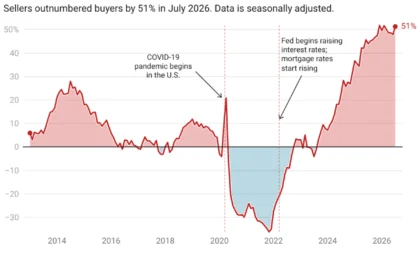
This tightening effect was clearly visible in the housing sector. According to the U.S. Census Bureau, housing starts plummeted 12.5% from June to July, settling at a lower-than-expected 1.24 million units—a 13.5% decline on a year-over-year basis. Simultaneously, the National Association of Realtors reported that pending home sales fell 2.3% during the same period, marking the lowest level of activity since January.
Geopolitical risks also played a tangible role in the day’s volatility. Crude oil prices, which serve as a primary indicator of inflationary pressure, saw West Texas Intermediate (WTI) crude futures rise 0.5% to $84.94 per barrel. This uptick followed statements from President Donald Trump, who confirmed that there are currently no active negotiations between the United States and Iran, and no immediate plans to initiate them, fueling fears of a potential supply chain disruption in the Middle East.
Official Responses and Corporate Strategy
The earnings season provided a window into how major corporations are navigating this precarious landscape. Home Depot (HD) offered a candid assessment of the current environment. During the company’s earnings call, CFO Richard McPhail explicitly cited "frozen housing conditions" as a primary drag on demand for major home improvement projects. Despite this, Home Depot managed to beat Wall Street’s revenue and earnings expectations, with comparable store sales rising 1.7%—the strongest showing since 2022.
However, the headline of the day for Home Depot was its strategic pivot toward speed. The retailer announced a nationwide rollout of three-hour express delivery. David Wagner, head of equity and portfolio manager at Aptus Capital Advisors, interpreted this as a tactical strike against e-commerce giants. "It’s a direct shot at Amazon and Walmart-style speed competition," Wagner noted. "Home Depot is leaning hard into speed and convenience to win the smaller, more frequent project spend that’s currently driving growth."
Conversely, the fintech sector saw a massive contraction. Klarna (KLAR) shares plummeted 22.8% after the firm issued a cautious forward-looking statement. Despite beating consensus estimates for its second-quarter top and bottom lines, the company slashed its full-year outlook for gross merchandise volume (GMV). Management attributed this downgrade to a "more measured view of European volumes," specifically citing weakness in Germany. The announcement that both the CFO and CMO will step down early next year further spooked investors, who interpreted the leadership exodus as a sign of underlying instability.
Implications for the Broader Market
The broader market implications are becoming increasingly clear: the era of easy money is firmly in the rearview mirror. Even as inflation and jobs data suggest that the Federal Reserve may refrain from further rate hikes in September, the market is finding that "no hikes" does not equate to "easy conditions."
The Semiconductor Sensitivity
The 5.0% slump in the iShares Semiconductor ETF (SOXX) highlights how vulnerable high-growth tech stocks are to rising bond yields. As the cost of capital increases, the future cash flows of high-multiple growth companies are discounted more heavily, leading to sharp price corrections. Industry leaders like Nvidia (-2.3%), Micron Technology (-7.0%), and Advanced Micro Devices (-4.3%) saw significant outflows on Tuesday. This is particularly notable given that the sector had recently experienced a rebound, with SOXX having risen nearly 11% month-to-date following a bruising 21% decline in July.
The Housing Headwinds
The housing sector’s struggles are expected to persist well into 2027. Bill Adams, chief U.S. economist at Fifth Third Commercial Bank, suggests that the market is currently in a "new normal." While homeowners who were previously "locked in" by low mortgage rates are slowly beginning to list their properties, the persistent high-interest-rate environment continues to dampen buyer demand. This structural bottleneck suggests that the housing market will remain a drag on economic growth for the foreseeable future.
Strategic Shifts in Consumer Spending
The shift in consumer behavior is forcing retail giants to adapt. As large-ticket renovations—such as kitchen remodels or structural home additions—are shelved due to high borrowing costs, companies are pivoting toward smaller, frequent-purchase models. Home Depot’s strategy is emblematic of this trend: capturing the "I need this part now" consumer to hedge against the volatility of the real estate cycle.
Conclusion: A Market in Search of Direction
As we move through the remainder of the week, the primary focus for investors will remain the interplay between the bond market and equity volatility. With geopolitical tensions in the Middle East showing no signs of easing and Treasury yields hovering at multi-decade highs, the environment remains defensive.
Investors are advised to look past top-line growth and focus on companies with strong cash positions and the operational agility to adapt to a tightening credit cycle. As the market digests these developments, the consensus among analysts is one of extreme caution. The "soft landing" narrative remains a possibility, but as Tuesday’s sell-off clearly demonstrated, the path to that outcome is likely to be characterized by significant turbulence and frequent re-pricing of risk across all asset classes.