In the high-stakes world of Silicon Valley, the most critical negotiations often happen far from the sterile confines of glass-walled boardrooms. For Nvidia CEO Jensen Huang, the future of artificial intelligence—and the trillions of dollars in market valuation tied to it—is frequently hammered out over Korean fried chicken in Seoul, yellowtail sashimi in Palo Alto, or Mapo tofu in Taipei.
As Nvidia continues its unprecedented ascent as a global economic powerhouse, a curious phenomenon has emerged: the "Jensen Huang Effect." It is a reality where a simple dinner outing can send the stock prices of partner companies soaring and where the world’s most powerful billionaires, including Elon Musk and Larry Ellison, find themselves "begging" for a seat at the table. This intersection of culinary leisure and cutthroat commerce was a focal point during Nvidia’s blockbuster second-quarter earnings call this week, revealing a CEO who is as much a cultural icon as he is a semiconductor titan.
Main Facts: A Blowout Quarter Amidst Global Scarcity
Nvidia’s second-quarter earnings report, released on Wednesday, was nothing short of a financial earthquake. The company posted a staggering $96.2 billion in revenue, obliterating the consensus analyst estimate of $92.2 billion. Even more shocking to Wall Street was Nvidia’s forward-looking guidance: the company projects revenue growth of 70% for the next fiscal year. This forecast suggests that Nvidia’s revenue could soar more than $100 billion above what most analysts had modeled just months ago.
Following the announcement, Nvidia’s stock rallied more than 4% in after-hours trading, further cementing its status as one of the world’s most valuable companies, with a market cap hovering around $5 trillion. However, the numbers only tell half the story. The central theme of the earnings call was not just demand, which Huang described as "insatiable," but the acute supply constraints that continue to throttle the AI revolution.
Huang revealed that Nvidia currently only has enough supply to meet approximately 70% of the demand from its existing customers. "The demand is much higher than that," Huang noted, emphasizing that the entire global supply chain—from wafer foundries to memory manufacturers—is "running flat out."
Chronology: From Palo Alto Begging to Seoul Barbecue
The fascination with Huang’s whereabouts has reached such a fever pitch that a dedicated blog, "Jensen Eats," tracks his movements and meals across the globe. This isn’t merely paparazzi-style gossip; for investors, Huang’s dinner companions serve as leading indicators of future partnerships and supply chain priorities.
The "Begging" at Nobu (2024)
One of the most storied meals in recent tech history took place at Nobu in Palo Alto. Oracle founder Larry Ellison recounted a dinner where he and SpaceX/Tesla CEO Elon Musk hosted Huang. The goal was simple: secure more Graphics Processing Units (GPUs), the lifeblood of AI development.
"I would describe the dinner as Oracle—me and Elon begging Jensen for GPUs," Ellison recalled earlier this year. "Please take our money. By the way, I got dinner. No, no, take more of it. We need you to take more of our money, please." The "begging" worked, according to Ellison, illustrating that in the current economy, capital is plentiful but Nvidia’s silicon is the ultimate scarce resource.
The Seoul Summit (June 2024)
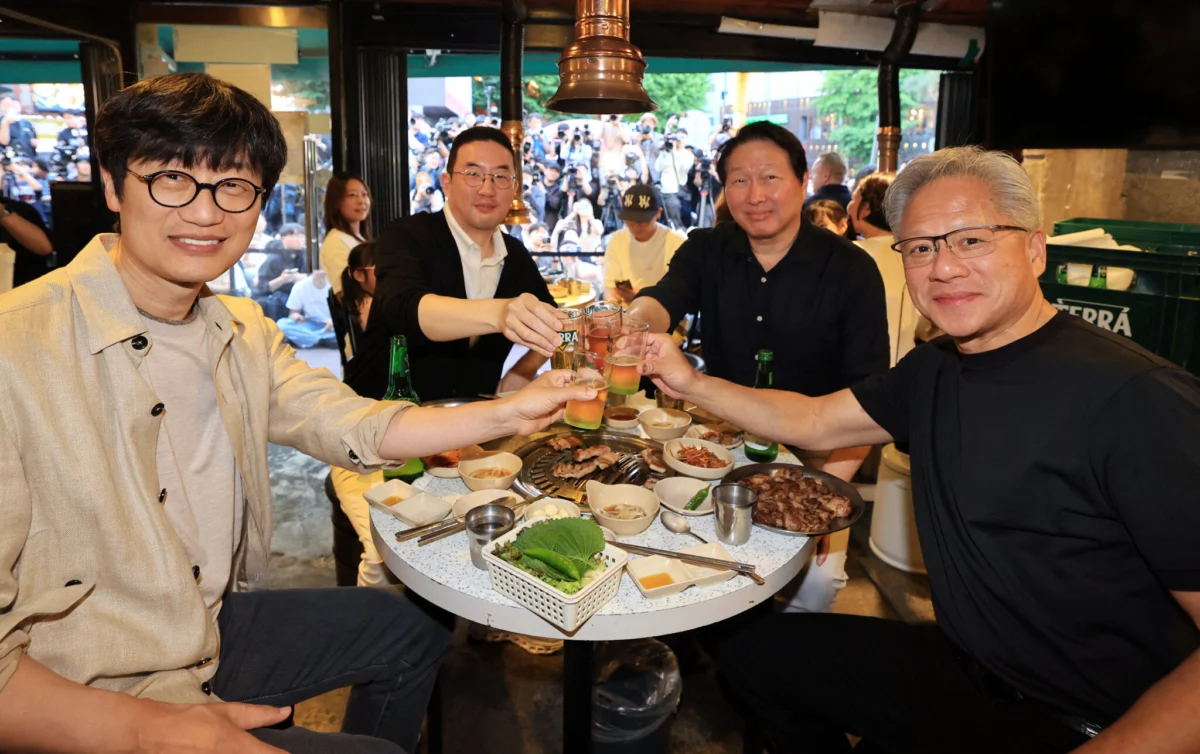
In June, Huang’s travels took him to South Korea, a critical hub for High Bandwidth Memory (HBM). He was spotted at a barbecue restaurant titled "Hey brother, it’s me!" in Seoul. His dining companions included SK Group Chairman Chey Tae-won, LG Group Chairman Koo Kwang-mo, and Naver founder Lee Hae-jin.
The group dined on ssam—grilled pork wrapped in perilla leaves. In a detail that delighted social media, Dan Liu, the author of the "Jensen Eats" blog, noted that because LG’s Koo was the youngest at the table, he took on the traditional role of grilling the meat for the group. The market reaction was immediate: LG’s stock surged by 30% on reports of the meeting, while various LG affiliates saw increases between 17% and 29%.
The Fried Chicken Halo (October 2023)
Perhaps the most eccentric example of the "Huang Effect" occurred in October 2023. Huang shared chicken and beers with Samsung Electronics Chairman Jay Y. Lee and Hyundai Motor Executive Chair Chung Euisun. While the meeting likely concerned automotive AI and memory chips, the "halo effect" extended to the poultry industry. Shares of Korean fried chicken companies like Kyochon F&B Co. and even the fried-chicken robot manufacturer Neuromeka Co. saw a notable spike in trading volume and price.
Supporting Data: The Economics of the Leather Jacket
The "Jensen Eats" phenomenon is backed by hard data that illustrates why the market reacts so violently to his presence. Nvidia’s growth is not just a company success; it is an ecosystem-wide uplift.
- Revenue Outperformance: The $96.2 billion quarterly revenue represents a massive leap from previous years, driven almost entirely by the Data Center segment.
- Supply vs. Demand Gap: With only 70% of demand being met, any company seen dining with Huang is perceived to be moving to the front of the "waitlist" for the upcoming Blackwell architecture chips.
- The Multiplier Effect: In the case of LG, the 30% stock jump represented billions of dollars in added market value, all triggered by a single dinner of grilled pork.
- Analyst Disconnect: Analysts had predicted 44% growth for the next year; Nvidia’s internal projection of 70% suggests the company has visibility into supply chain expansions that the market has yet to fully price in.
Official Responses: Addressing the Supply Chain Bottleneck
During the earnings call, Goldman Sachs analysts pressed Huang to rank the constraints currently limiting Nvidia’s growth. They cited factors such as data center power availability, physical shell space, memory pricing, and access to wafer foundries (specifically TSMC).
Huang’s response was characteristically coy yet firm. "There’s something funny I could say, but I’m going to just not," he quipped, likely referring to the desperate measures customers take to get his attention. "I think the answer is our entire supply chain is challenged, and everybody is really running flat out."
Nvidia CFO Colette Kress provided further context, noting that while supply is increasing every day, the transition to the new Blackwell chips—which offer significantly more AI compute power—is a complex logistical feat. She emphasized that the company is working to be "as transparent as possible" with customers who are anxious about delivery timelines.
Huang added that Nvidia does not like to "disappoint customers," but the sheer scale of the AI transition means that even with the help of the entire global supply chain, "more capacity is coming online all the time," but it is still not enough to satiate the market.
Implications: The CEO as a Sovereign Entity
The implications of Huang’s "dining diplomacy" suggest a shift in how corporate power is wielded in the 21st century. Jensen Huang has moved beyond the role of a traditional CEO; he has become a sovereign entity in the global tech landscape.
1. The Death of the Formal Pitch
When Larry Ellison and Elon Musk are "begging" over sushi, the traditional sales cycle is dead. In the AI era, the supplier holds more power than the buyer. Huang’s dinners are not about "selling" Nvidia; they are about "allocating" Nvidia. He is the ultimate arbiter of which companies will have the compute power to survive the AI revolution.
2. The Cultural Component of Corporate Strategy
Huang’s willingness to eat at local night markets and casual barbecue joints—often wearing his signature black leather jacket—humanizes a company that produces abstract, complex technology. This "everyman" persona creates a level of public goodwill and brand recognition that is rare for B2B (business-to-business) companies. It makes Nvidia a household name, which in turn fuels retail investor enthusiasm.
3. Supply Chain Interdependence
The meetings in Korea and Taiwan (with TSMC founder Morris Chang) highlight that Nvidia’s $5 trillion valuation is built on a foundation of deep, personal relationships. The "Jensen Eats" blog inadvertently documents the most important supply chain map in the world. If Huang is eating Mapo tofu with Morris Chang, it signifies that the bond between the designer (Nvidia) and the manufacturer (TSMC) remains unbreakable despite geopolitical tensions.
4. Market Volatility and "Vibe-Based" Investing
The fact that fried chicken stocks can rise because of a Huang sighting points to a new era of "vibe-based" investing. In a market where Nvidia is the primary driver of the S&P 500, investors are looking for any scrap of information—including what kind of beer the CEO is drinking—to gain an edge.
Conclusion: The Unending Appetite for AI
As the earnings call concluded, Huang remained tight-lipped about his dinner plans for the evening. However, the message to the market was clear: Nvidia is the kitchen of the AI world, and the menu is set for years of unprecedented growth.
While the supply chain remains "challenged" and the world’s most powerful men continue to vie for his attention over sashimi, Jensen Huang continues to navigate the global stage with a unique blend of technical genius and culinary curiosity. For now, the world will continue to watch—and the "Jensen Eats" blog will continue to post—because in the current economy, knowing where Jensen Huang is eating might just be the most valuable piece of financial intelligence on the planet.