For years, the American housing market has resembled a fortress: impenetrable for the average worker, defined by record-high prices and mortgage rates that turned the dream of homeownership into a financial strain. Since the pandemic, median sale prices have soared, frequently hovering above $400,000, while monthly mortgage payments have ballooned past the $2,600 mark. For the average American, securing a home meant dedicating roughly 37% of their monthly income to housing—a threshold that many financial experts consider the "danger zone" for personal fiscal health.
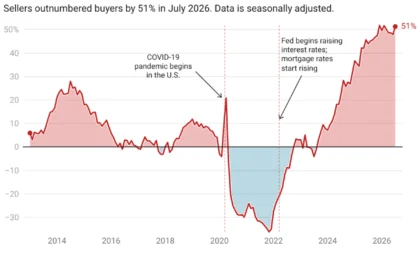
Yet, as we move through 2026, a quiet shift is occurring. According to the latest data from Redfin, the housing market is undergoing a structural, if slow, pivot toward improved affordability. While the headline figures remain daunting, the gap between what a home costs and what a household earns is finally beginning to narrow.
The Turning Tide: Why Affordability is Shifting
The primary catalyst for this shift is not necessarily a sudden collapse in home prices, but rather a surge in household income that is outpacing the growth of real estate costs. As inflation has stabilized and wage growth has persisted, the "income-to-housing-cost" ratio has begun to favor the consumer for the first time since the early 2020s.
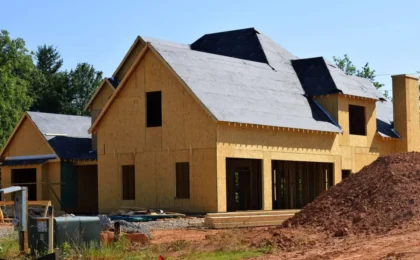
"Affordability is improving the most on the coasts and in the Sun Belt for two clear reasons," explains Daryl Fairweather, Redfin’s Chief Economist. "First, there aren’t enough buyers to sustain the rapid, unsustainable price growth that defined the pandemic era. Second, the massive wave of construction initiated during the pandemic has finally hit the market, boosting supply faster than demand can keep up."
This creates a paradox: while homes remain historically expensive, they are becoming "less unaffordable" than they were a year ago. In competitive markets like San Jose and Seattle, the cooling of hyper-aggressive bidding wars has allowed the market to transition from a frantic seller’s environment to one where buyers possess, for the first time in years, a degree of leverage.
Chronology: From Pandemic Frenzy to 2026 Normalization
To understand where we are, we must look at the timeline of the last four years:
- 2022–2023: The Peak of Exclusion. As interest rates rose to combat inflation, mortgage rates spiked, but home prices refused to drop significantly due to a lack of inventory. This created a "lock-in" effect, where homeowners with low-interest mortgages refused to sell, freezing the market.
- 2024: The Stagnation Period. Market volume plummeted to decade-lows. Prices remained near all-time highs, and affordability reached its nadir, forcing many would-be buyers to abandon their search entirely.
- 2025: The Inflection Point. Inflation began to settle, and the labor market showed resilience. Wage growth, buoyed by a tight job market, started to climb, while home price growth began to decelerate to a more sustainable 2% annual rate.
- 2026: The Shift Toward Equilibrium. We are currently seeing the results of this divergence. While prices in some regions continue to rise, the pace of wage increases is beginning to exert downward pressure on the "burden of ownership."
Regional Winners and Losers: A Tale of Two Markets
Where Affordability is Improving
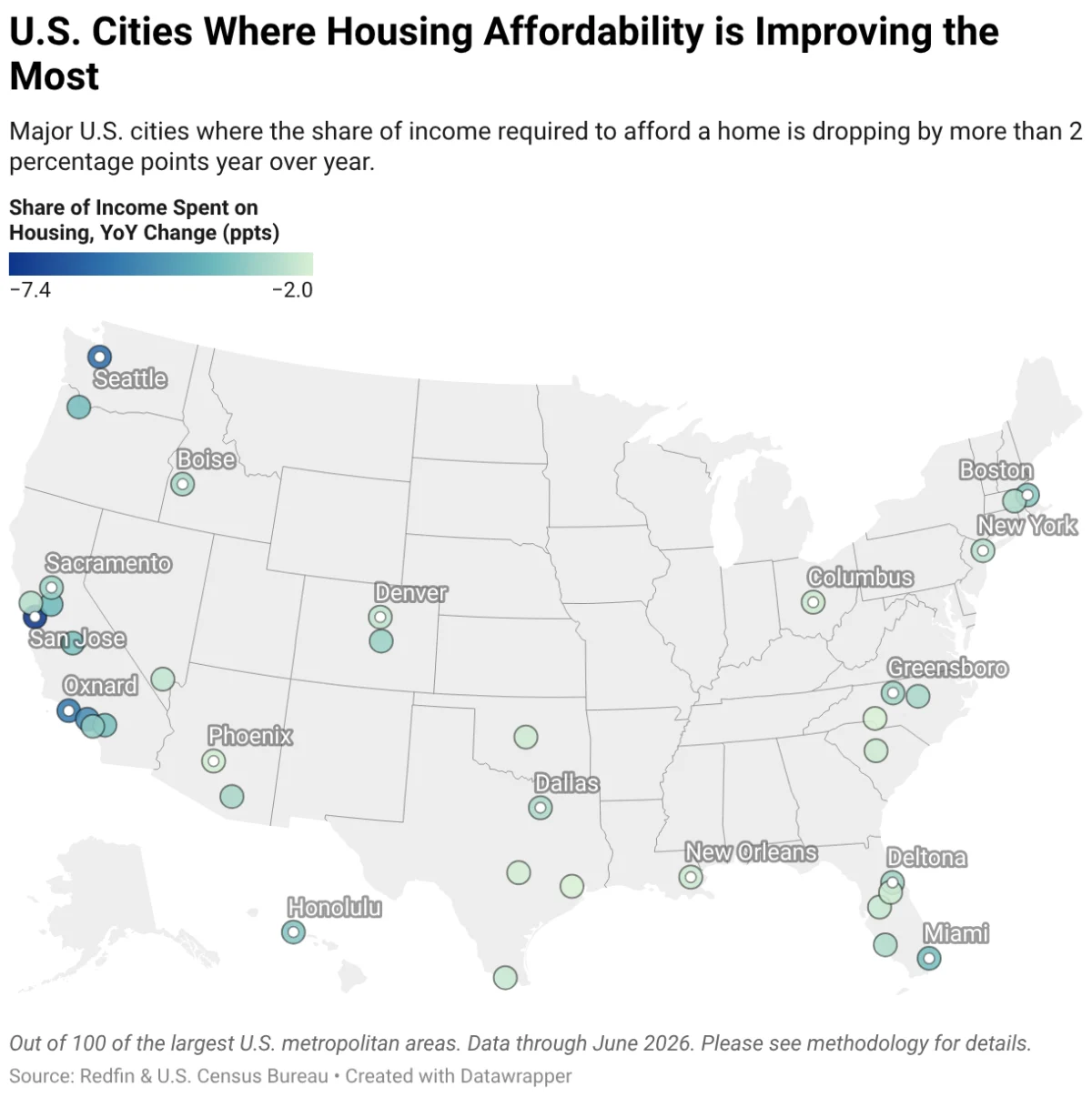
The most significant improvements in affordability are occurring in high-cost coastal metros, where prices had previously hit an unsustainable ceiling. San Jose, California, leads the nation, with the share of income required to purchase a median-priced home dropping by 7.4 percentage points year-over-year.
Top Cities for Improving Affordability:
- San Jose, CA: 65.9% of income required (-7.4 ppts)
- Seattle, WA: 46.4% of income required (-5.8 ppts)
- Oxnard, CA: 52.7% of income required (-5.5 ppts)
- Los Angeles, CA: 69.7% of income required (-5.0 ppts)
- Stockton, CA: 40.0% of income required (-3.7 ppts)
These markets are undergoing a necessary correction. As buyers are priced out, sellers are forced to meet them in the middle, offering concessions and price cuts that weren’t present during the pandemic.
Where Affordability is Declining
Conversely, some regions are experiencing the opposite effect. In areas like San Francisco, the surge in AI-related wealth has created a localized "super-bubble," where demand continues to outpace even the most aggressive construction efforts. Meanwhile, in the Midwest and Northeast, a chronic lack of new inventory—compounded by an aging housing stock—is driving prices upward despite lower absolute price points.
Cities Facing Growing Affordability Challenges:
- San Francisco, CA: Now the most expensive city in the nation, requiring 76.6% of income.
- West Palm Beach, FL: Seeing a 0.7 percentage point increase in cost burden.
- Pittsburgh, PA: A traditionally affordable market that is feeling the strain of limited inventory, with a 0.6 percentage point increase.
Official Economic Perspectives: Is a Crash Coming?
A common question among prospective buyers is whether these "corrections" will lead to a national housing crash. Economists are largely skeptical of this outcome.
"House prices are unlikely to drop on a national level, and for the health of the economy, that is a positive," Fairweather notes. "A national collapse in home prices usually signals a severe economic shock or a recession. Instead, what we want to see is the ‘slow and steady’ approach: price growth that remains below wage growth until the market returns to a state of equilibrium."
The Federal Reserve’s role in this cannot be understated. While volatility in mortgage rates continues to act as a governor on the market, the overarching goal remains a "soft landing" for the housing sector. The consensus among analysts is that the market will continue to stabilize, provided that we do not see major geopolitical or economic shocks that trigger mass unemployment.
Implications for the American Dream
Perhaps the most profound change in 2026 is the psychological shift among the American public. The "American Dream" of owning a single-family home by age 30 is being recalibrated. Younger generations, particularly Gen Z, are increasingly viewing long-term renting as a viable, and sometimes preferred, lifestyle choice. This is not necessarily due to a lack of desire, but a rational response to a market that has been, until now, inaccessible.
However, for those still committed to buying, the current environment offers a unique, albeit difficult, opportunity. Because demand is lower, sellers are far more willing to negotiate. The era of "blind offers" and "waived inspections" is effectively over in most of the country.
Strategic Advice for Buyers in 2026
If you are planning to enter the market, the current climate requires a different playbook than the one used in 2021 or 2022:
- Prioritize Professional Guidance: In a market where some sellers are de-listing properties out of frustration, having a local expert who understands neighborhood-specific trends is non-negotiable.
- Leverage the "Buyer’s Market" Elements: Do not be afraid to ask for seller concessions. Many sellers are eager to move and are willing to cover closing costs or perform repairs to close a deal.
- Calculate the True Cost: Use the current income-to-housing-cost ratios as a guide, not a rule. Ensure that your purchase leaves room for other financial goals, such as retirement and emergency savings.
- Get Pre-Approved, But Shop Around: With mortgage rates still volatile, securing a pre-approval is the first step, but comparing personalized rates across multiple lenders can save thousands of dollars annually.
Conclusion: The Path Forward
While the improvement in housing affordability in 2026 is a welcome development, it is not a cure-all. True, long-term stability in the American housing market will require more than just income growth; it will require a massive, sustained commitment to increasing housing supply. Until the nation addresses the fundamental shortage of homes, affordability will remain a delicate balance.
For now, the market is moving toward a more rational, if still challenging, state. For buyers who are prepared, disciplined, and patient, the door to homeownership is slightly more ajar than it has been in years—provided they are willing to navigate the complexities of a changing, and increasingly localized, landscape.