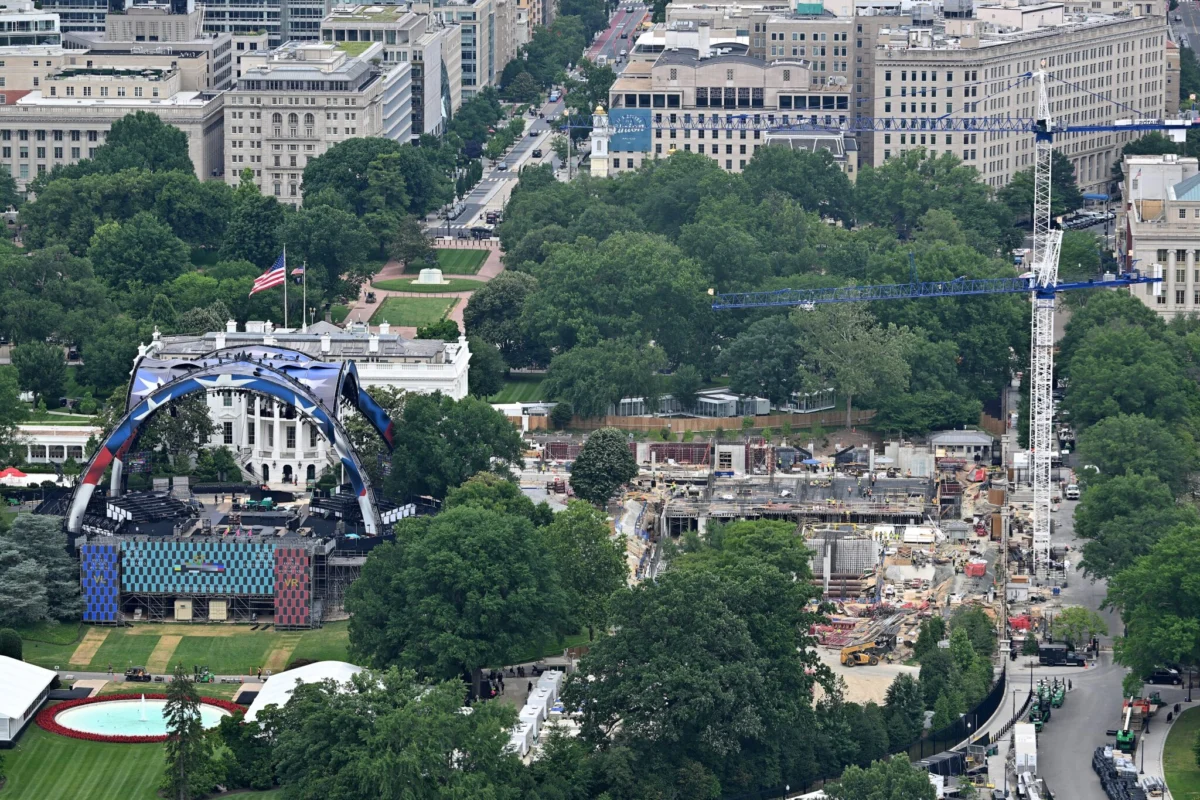
The Trump administration has escalated its legal battle to preserve the construction of a controversial ballroom at the White House, formally petitioning the U.S. Supreme Court on Friday to stay an appellate court order that threatens to halt the project. The application, filed by Solicitor General D. John Sauer, marks a critical juncture in a dispute that pits executive authority and national security considerations against federal preservation mandates and the oversight powers of the Legislative Branch.
At the heart of the matter is an injunction issued by U.S. District Judge Richard Leon, which mandates a cessation of all above-ground construction on the project. The Trump administration argues that the ballroom—described by officials as an “integrated military complex”—is not merely a venue for state dinners, but a necessary security enhancement. The government contends that the project is legally authorized under existing federal statutes and that the judiciary should not impede measures deemed essential for the protection of the President and the White House grounds.
The Legal Impasse: A Clash of Authorities
The core of the legal disagreement hinges on whether the administration possesses the unilateral authority to undertake a construction project of this magnitude without explicit congressional appropriation or specific legislative authorization.
The National Trust for Historic Preservation, the primary plaintiff in the case, has successfully argued in lower courts that the project violates the National Park Service Organic Act and laws governing construction on federal parkland in the District of Columbia. The courts have thus far sided with the Trust, ruling that the administration’s interpretation of existing statutes is overly broad and that the project, as currently designed, lacks the necessary congressional green light.
Solicitor General Sauer’s filing challenges these rulings on multiple fronts. First, he argues that the National Trust lacks Article III standing to sue. The administration asserts that the Trust’s key witness, architectural historian Alison Hoagland, has failed to demonstrate a "concrete and particularized" injury. The government argues that Hoagland’s objections to the project—based on aesthetics and historical preservation—are speculative, given that the final design of the structure remains a classified security matter.
Chronology of the Dispute
The controversy surrounding the White House ballroom has unfolded rapidly over the past year, reflecting the tensions between the Executive Branch and preservationist groups.
- Late 2025: Initial plans for the structure come to light. The National Trust for Historic Preservation files suit, alleging that the project bypasses mandatory environmental and historical review processes.
- December 2025: Alison Hoagland submits a declaration to the court, testifying that the proposed structure—which would occupy the site of the former East Wing—would irreparably harm the historic integrity of the White House. She argues that the building’s massing and height would diminish the visual primacy of the historic mansion.
- Early 2026: Construction commences under the auspices of "security enhancements." The government claims the project is 65% complete.
- August 7, 2026: A divided panel of the U.S. Court of Appeals for the D.C. Circuit upholds Judge Leon’s injunction, which permits below-ground work but halts all construction that would "lock in" the above-ground size and scale of the ballroom. The panel grants a 14-day stay to allow the administration to seek relief from the Supreme Court.
- August 14, 2026: The Trump administration files its formal request for a stay of the injunction with the Supreme Court, seeking to prevent the August 21 deadline from taking effect.
The "Integrated Military Complex": Security vs. Aesthetics
A significant portion of the administration’s argument rests on the claim that the ballroom is an essential component of the White House’s national security infrastructure. While the public refers to the project as a "ballroom," the administration’s legal filings characterize it as an “integrated military complex.”
According to the government, the facility includes advanced bomb shelters, fortified command-and-control structures, designated sniper positions, and a rooftop drone port. The administration maintains that these features are critical to mitigating modern asymmetric threats against the President and senior staff. By highlighting these components, the government is attempting to frame the project not as a discretionary architectural addition, but as a non-justiciable exercise of the President’s power as Commander-in-Chief.
Judge Leon’s ruling, however, remains skeptical of the "national security" label as a catch-all justification for bypassing environmental and historical laws. His order permits work that is "strictly necessary" for immediate physical protection but creates a hard line against the expansion of the structure’s physical footprint until the legal merits are resolved.
Perspectives from the National Trust
The National Trust for Historic Preservation maintains that the rule of law must apply even to the most sensitive executive projects. Their legal team argues that the administration’s attempt to characterize a massive, above-ground structure as a purely "military" necessity is a tactical move to evade the National Historic Preservation Act and other federal oversight requirements.
In her testimony, Hoagland articulated the existential threat to the White House’s architectural identity. "To have an adjacent structure overshadowing the White House, exceeding it in height and massing, would diminish the primacy of the White House, which makes its architectural statement through its singularity on the landscape," she wrote. The Trust contends that such a significant alteration to the President’s Park should require public transparency and specific congressional approval, regardless of the security features integrated within the walls.
Implications for Executive Power
The Supreme Court’s decision on whether to grant the stay will be closely watched by constitutional scholars and government oversight bodies alike. A decision to grant the stay would effectively allow construction to continue while the case proceeds through the appellate process, significantly increasing the likelihood that the structure will be completed before a final verdict on the merits is reached.
If the Court denies the stay, the administration will be forced to halt above-ground construction immediately on August 21. This would be a significant blow to the project’s timeline and would leave the half-finished, fortified structure in a state of suspended animation—a scenario that could create its own set of security and logistical challenges.
Furthermore, the case raises fundamental questions about the limits of presidential discretion. By invoking the "National Park Service Organic Act" and the "federal statute governing alterations and improvements to the White House," both sides are testing the boundaries of how much authority is implicitly granted to the President versus how much must be explicitly delegated by Congress.
The Path Forward
The Supreme Court has directed the National Trust to respond to the administration’s application by noon this coming Tuesday. While a decision on the stay is not a ruling on the merits of the case, it will signal the Court’s appetite for intervening in high-stakes disputes between the Executive Branch and federal preservation mandates.
For the Trump administration, the stakes are both political and practical. With the project already 65% complete, the government argues that a major shift in design—or a permanent halt—is no longer feasible without wasting hundreds of millions of dollars in taxpayer funds. For the opposition, the case serves as a test of whether the Executive Branch can unilaterally alter the most iconic landmarks in the nation under the guise of security, without the check and balance of public oversight or legislative debate.
As the August 21 deadline approaches, the nation’s highest court faces the unenviable task of balancing the immediate, classified security requirements of the Presidency against the long-standing, codified protections afforded to the nation’s most historic and symbolic grounds.