For millions of Americans, the prospect of owning a home has transitioned from a tangible milestone into a distant, often unreachable, pipe dream. Years of persistent inflation, elevated interest rates, and a historic lack of housing inventory have converged to create an environment where the typical homebuyer must commit nearly 40% of their monthly income to housing costs—a figure that far exceeds the traditional financial safety threshold of 30%. As we move deeper into 2026, the structural cracks in the U.S. housing market have become entrenched, forcing a generation to pivot toward long-term renting or rely on intergenerational wealth transfers just to secure a down payment.
The State of the Market: Key Takeaways
The current housing landscape is defined by a paradoxical struggle: while the frantic, frenzied bidding wars of the pandemic era have largely cooled, the fundamental barrier to entry remains sky-high.
- The 40% Burden: In the nation’s most expensive metropolitan areas, the share of income required to cover a mortgage has reached levels that essentially price out the middle class.
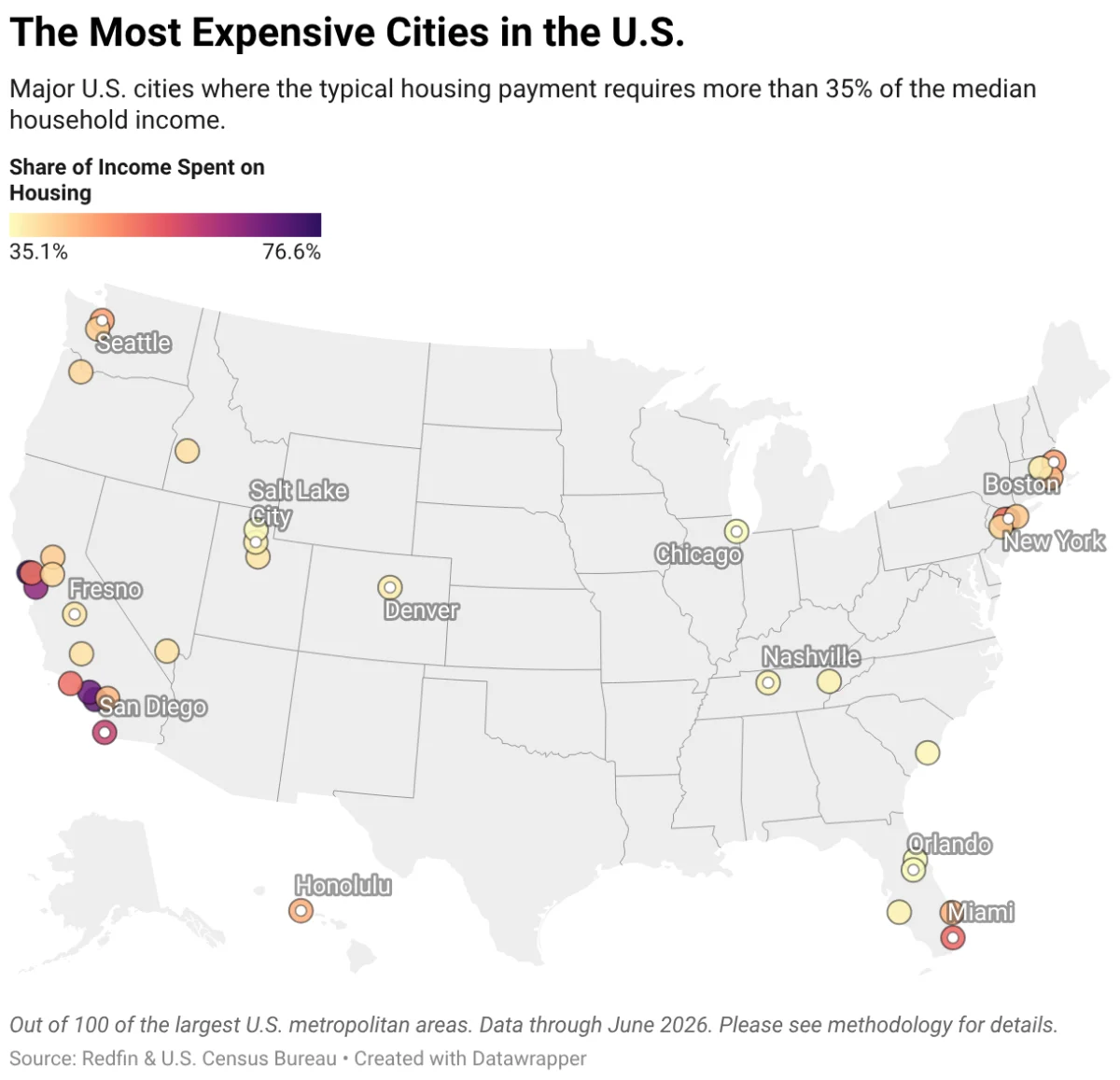
- Coastal Concentration: The most expensive markets are overwhelmingly clustered along the East and West Coasts, where land scarcity and restrictive zoning laws prevent necessary growth.
- The "AI Effect": Niche markets, particularly San Francisco, are seeing home prices decouple from local median incomes due to concentrated wealth in the technology sector.
- A Gradual Reset: While affordability is technically improving in some regions due to a slight cooling of demand, the "normalcy" of pre-pandemic pricing remains years, if not a decade, away.
Chronology of a Crisis: From Boom to Stagnation
To understand the current impasse, one must look back to the onset of the COVID-19 pandemic. In 2020 and 2021, a perfect storm of ultra-low mortgage rates and a sudden shift in lifestyle preferences triggered a homebuying frenzy. Buyers, eager to capitalize on cheap borrowing, flooded the market, driving prices up by as much as 10% month-over-month in some regions.
By late 2022, the Federal Reserve began a series of aggressive interest rate hikes to combat rising inflation. This move abruptly ended the era of "cheap money," sending mortgage rates soaring. However, instead of a dramatic crash in home prices, the market entered a state of "lock-in" stagnation. Homeowners who had secured 3% mortgage rates were unwilling to sell and trade into a 7% environment, causing inventory to dry up. This supply crunch meant that even as demand softened, prices remained sticky, preventing the correction that many economists initially predicted.
The Most Expensive Cities: A Statistical Breakdown
The data for 2026 paints a stark picture of inequality. In the most expensive U.S. cities, the share of income required to service a mortgage is staggering.
| City | Share of Income Required | Median Household Income | Median Sale Price |
|---|---|---|---|
| San Francisco, CA | 76.6% | $162,118 | $1,724,835 |
| Anaheim, CA | 71.6% | $126,178 | $1,271,194 |
| Los Angeles, CA | 69.7% | $97,775 | $947,164 |
| San Jose, CA | 65.9% | $176,401 | $1,615,164 |
| New York, NY | 65.4% | $98,287 | $843,474 |
| San Diego, CA | 59.5% | $115,304 | $952,149 |
| Miami, FL | 53.6% | $77,854 | $576,124 |
| Oxnard, CA | 52.7% | $119,133 | $871,391 |
| Oakland, CA | 51.8% | $139,407 | $977,074 |
| Newark, NJ | 50.5% | $113,773 | $697,245 |
These figures highlight a grim reality: in cities like San Francisco and Anaheim, the average household would need to spend over 70% of their gross earnings just to keep a roof over their heads, assuming a standard 20% down payment. This effectively renders homeownership an exclusive club for the highest earners, leaving the median-income worker entirely sidelined.
Expert Analysis: The Long Road to Equilibrium
Daryl Fairweather, Chief Economist at Redfin, describes the current state of the market as a "long, slow reset." According to Fairweather, the market is currently in a balancing act. The velocity of the pandemic years, where sellers regularly received offers for tens of thousands of dollars over the asking price, has been replaced by a more cautious, deliberate pace.
"Homebuyers in 2020-2022 were hungry to take advantage of low-rate mortgages," Fairweather notes. "That trend reversed as prices and rates skyrocketed in late 2022. Now, we are seeing the market balance out. It is not an overnight fix; it is a structural realignment that will continue for the foreseeable future."
While the national trend suggests a slow improvement in affordability—largely because incomes are rising slightly faster than home prices in some areas—this is not a universal experience. In San Francisco, for instance, affordability has actually declined by 1.5 percentage points year-over-year. This anomaly is driven by the hyper-concentration of AI wealth, which has created a local market that operates independently of national economic trends.
The Geographic Divide and Supply Constraints
The East and West Coasts remain the epicenter of the affordability crisis. This is not merely a matter of popularity; it is a failure of supply-side economics. For decades, these regions have been stifled by restrictive zoning laws, environmental regulations, and a lack of developable land.
Homebuilders have been historically hesitant to undertake large-scale projects in these coastal hubs due to the astronomical costs of land and the regulatory hurdles associated with building. This has resulted in a chronic inventory shortage. In contrast, some of the most dramatic gains in affordability have been seen in markets like San Jose and Seattle. In these cities, an increase in new listings—as sellers finally decide to enter the market despite interest rate concerns—has begun to tilt the balance back toward buyers, even if only slightly.
Implications for the Future of Housing
The implications of this prolonged affordability crisis are far-reaching.
- The Rise of "Rich Renters": As buying becomes impossible for the middle class, a new demographic of long-term renters has emerged. These are high-earning professionals who are choosing to rent in luxury buildings rather than settle for an entry-level home in a less desirable area.
- Generational Wealth Gaps: The reliance on family assistance for down payments is creating a two-tiered society of homeowners: those who can access family capital and those who cannot. This threatens to deepen existing wealth inequalities.
- Urban Migration Patterns: We are seeing a slow, steady migration away from the most expensive coastal metros toward smaller, "secondary" cities where a median income can still purchase a detached single-family home.
- Policy Pressure: The housing crisis has become a central focus of local and state politics. From rent control initiatives to aggressive zoning reforms aimed at increasing multi-family density, policymakers are under immense pressure to intervene.
Methodology
This analysis is based on a comprehensive study of 96 of the largest U.S. metropolitan areas as of June 2026. The study utilized data from the Multiple Listing Service (MLS), the U.S. Census Bureau, and the Federal Reserve Bank of Atlanta.
Affordability is calculated based on the percentage of median household income required for a monthly mortgage payment. A market is defined as "unaffordable" if the payment exceeds 35% of the median monthly income, based on a standard 30-year fixed-rate mortgage with a 20% down payment, inclusive of estimated property taxes and insurance. By isolating these metrics, the analysis provides a standardized view of how the average American household fares in the face of current market conditions.
Conclusion
As we look toward the remainder of 2026 and beyond, there is no "silver bullet" for the American housing market. The factors driving high costs—inventory shortages, restrictive land use, and the lingering effects of the pandemic era—are deeply entrenched. While the market is showing early signs of a cooling trend, the transition back to true affordability will be measured in years, not months. For now, the dream of homeownership remains a difficult climb, requiring either significant financial sacrifice, help from family, or a shift in expectations regarding location and property type.