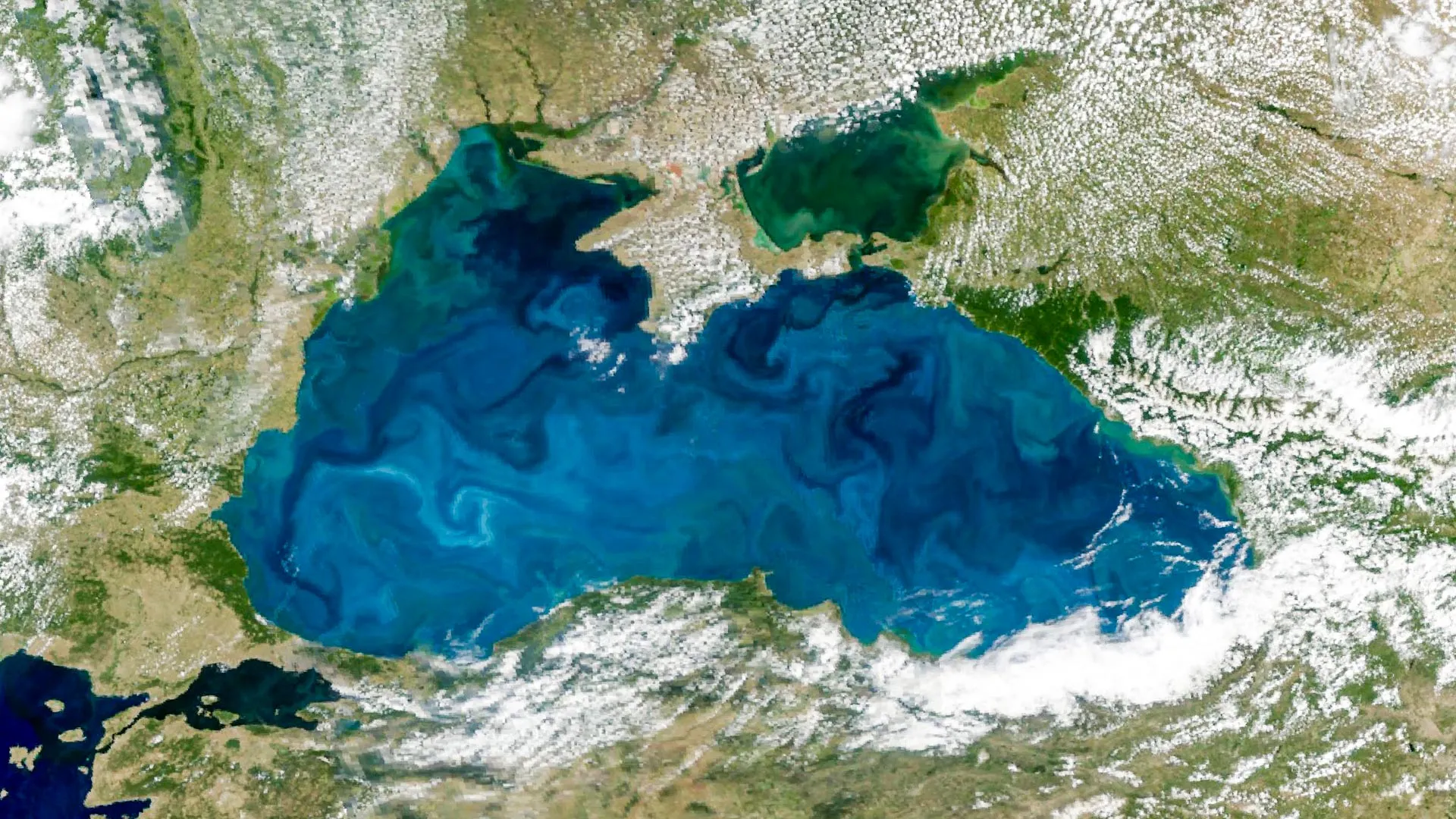
The Black Sea, a critical maritime crossroads bridging Europe and Asia, is historically defined by its deep, somber indigo waters. However, as the northern hemisphere transitions into the peak of summer, the sea undergoes a surreal and spectacular visual metamorphosis. In a display of natural artistry, vast stretches of the basin shift from their customary dark hues to a brilliant, milky turquoise. This striking phenomenon, captured in unprecedented detail by NASA’s state-of-the-art PACE (Plankton, Aerosol, Cloud, ocean Ecosystem) satellite on June 22, 2026, offers more than just a breathtaking satellite image—it serves as a vital window into the complex biological rhythms of our planet’s oceans.
The Science of the Bloom: Why the Sea Turns Turquoise
The turquoise transformation is not a change in the water’s chemistry in the traditional sense, but rather a biological event on a massive scale. At the heart of this phenomenon are coccolithophores, microscopic phytoplankton that function as the architects of this oceanic shift.
Unlike other forms of marine life, coccolithophores are encased in microscopic plates known as coccoliths, composed of calcium carbonate—the same mineral found in chalk and limestone. When the environmental conditions are just right, these organisms reproduce in gargantuan numbers, forming blooms that can span thousands of square kilometers. Because these calcium carbonate plates are highly reflective, they scatter sunlight back toward the surface. When sunlight hits these dense concentrations of plates, the water takes on a vibrant, opaque turquoise or "milky" appearance.
This event stands in stark contrast to the seasonal cycles of diatoms, another form of microscopic algae that dominate the Black Sea at different times of the year. Diatoms possess shells made of silica rather than calcium carbonate. Unlike the reflective, light-scattering nature of coccolithophores, diatoms tend to absorb more light, which contributes to the dark, deep-blue, or even greenish-brown appearance typically associated with the Black Sea’s standard state.
A Chronology of the 2026 Bloom
The 2026 bloom was particularly well-documented, providing scientists with a multi-perspective view of how phytoplankton populations migrate and flourish across narrow maritime straits.
- May 27, 2026: The transformation began to show its reach in the Bosphorus, the narrow, vital waterway that bifurcates Istanbul and connects the Black Sea to the Sea of Marmara. An astronaut aboard the International Space Station (ISS) captured a stunning photograph of the strait, revealing how the blooming phytoplankton traced the swirling currents of the channel. The image, which depicted the bloom’s tentacles extending deep into the heart of the waterway, provided a high-resolution look at the fluid dynamics of the event.
- Early June 2026: As the waters warmed and nutrient levels hit the "sweet spot" for coccolithophore growth, the blooms began to coalesce and expand from the coastal fringes into the open basin of the Black Sea.
- June 22, 2026: NASA’s PACE satellite, equipped with the sophisticated Ocean Color Instrument (OCI), successfully mapped the full extent of the bloom. The satellite’s ability to detect precise wavelengths of light allowed researchers to distinguish the coccolithophore-rich waters from the surrounding sea with clinical accuracy.
Supporting Data: The Power of Orbital Observation
The use of satellite imagery has revolutionized oceanography, especially in regions like the Black Sea where collecting physical water samples is logistically challenging, politically sensitive, or physically dangerous due to depth and currents.
NASA Earth Observatory synthesized data from multiple sources to create the definitive visualization of this event. By integrating data from NASA’s EOSDIS LANCE, the GIBS/Worldview system, and the NASA Ocean Biology Distributed Active Archive Center (OB.DAAC), researchers were able to create a composite that captures the event’s intensity.
The ISS imagery, taken by a member of the Expedition 74 crew using a Nikon Z9 camera with a 50mm lens, served as a crucial qualitative verification. These astronaut-captured images provide a perspective that sensors sometimes miss—the ability to see the three-dimensional "swirls" and vortexes of the bloom as it interacts with the complex topography of the Bosphorus. The images were carefully processed, cropped, and corrected to ensure that lens artifacts did not interfere with the scientific analysis of the plankton’s density.
The Global Implications: Carbon Cycling and Climate
While the turquoise aesthetic is the most visible aspect of these blooms, the biological function of coccolithophores is of profound interest to climate scientists. Phytoplankton are the "lungs" and the "carbon sinks" of the ocean.
The Carbon Sequestration Cycle
Coccolithophores play a dual role in the Earth’s carbon cycle:
- Photosynthesis: As these organisms grow, they consume carbon dioxide from the atmosphere and the upper layers of the ocean to build their biomass. This effectively lowers the concentration of atmospheric greenhouse gases.
- Biological Pump: Once the bloom reaches the end of its life cycle, the organisms die and sink toward the seafloor. Because their shells are heavy, calcium-rich structures, they act as an "anchor," pulling organic carbon down into the deep ocean. This carbon can be stored in seafloor sediments for millennia, effectively removing it from the active climate system.
Monitoring Ecosystem Health
Beyond carbon, these satellite observations act as an early warning system for marine ecosystem health. By tracking the frequency and intensity of these blooms, scientists can monitor how changing water temperatures, runoff, and pollution levels in the Black Sea affect the base of the marine food web. Because coccolithophores are sensitive to changes in ocean acidity and temperature, their blooms serve as a biological barometer for the health of the broader Mediterranean-Black Sea corridor.
Official Perspectives: The ISS Crew Earth Observations Facility
The documentation of the 2026 bloom was a collaborative success between the NASA Johnson Space Center’s Earth Science and Remote Sensing Unit and the ISS National Lab.
"The ability to capture these ephemeral events from the vantage point of the International Space Station is unparalleled," stated a spokesperson for the ISS Crew Earth Observations Facility. "These images are not just ‘pretty pictures’; they are foundational data sets that allow researchers to validate the readings from our automated satellites like PACE. When we see a swirl in the Bosphorus from orbit, we are seeing the direct impact of changing seasonal conditions on marine life."
The program continues to make these images freely available to the public and the scientific community, encouraging a global dialogue on the state of our oceans. By democratizing access to this high-resolution imagery, NASA enables citizen scientists and oceanographers alike to study the intricate patterns of the Black Sea’s turquoise season.
Conclusion: The Future of Ocean Monitoring
The 2026 Black Sea bloom reminds us that even the most well-known geographic features of our planet are dynamic, living systems. As climate change continues to alter ocean temperatures and circulation patterns, the timing, intensity, and location of these phytoplankton blooms may shift.
NASA’s commitment to combining the high-altitude, broad-spectrum data of the PACE satellite with the human-centric, high-resolution photography of the ISS crew ensures that we remain vigilant observers of these changes. The turquoise transformation of the Black Sea is not just a seasonal curiosity—it is a critical indicator of the health of our planet’s waters, a reminder of the massive scale of biological life, and a testament to the sophisticated technology we now possess to witness the Earth’s quiet, colorful, and essential transformations.