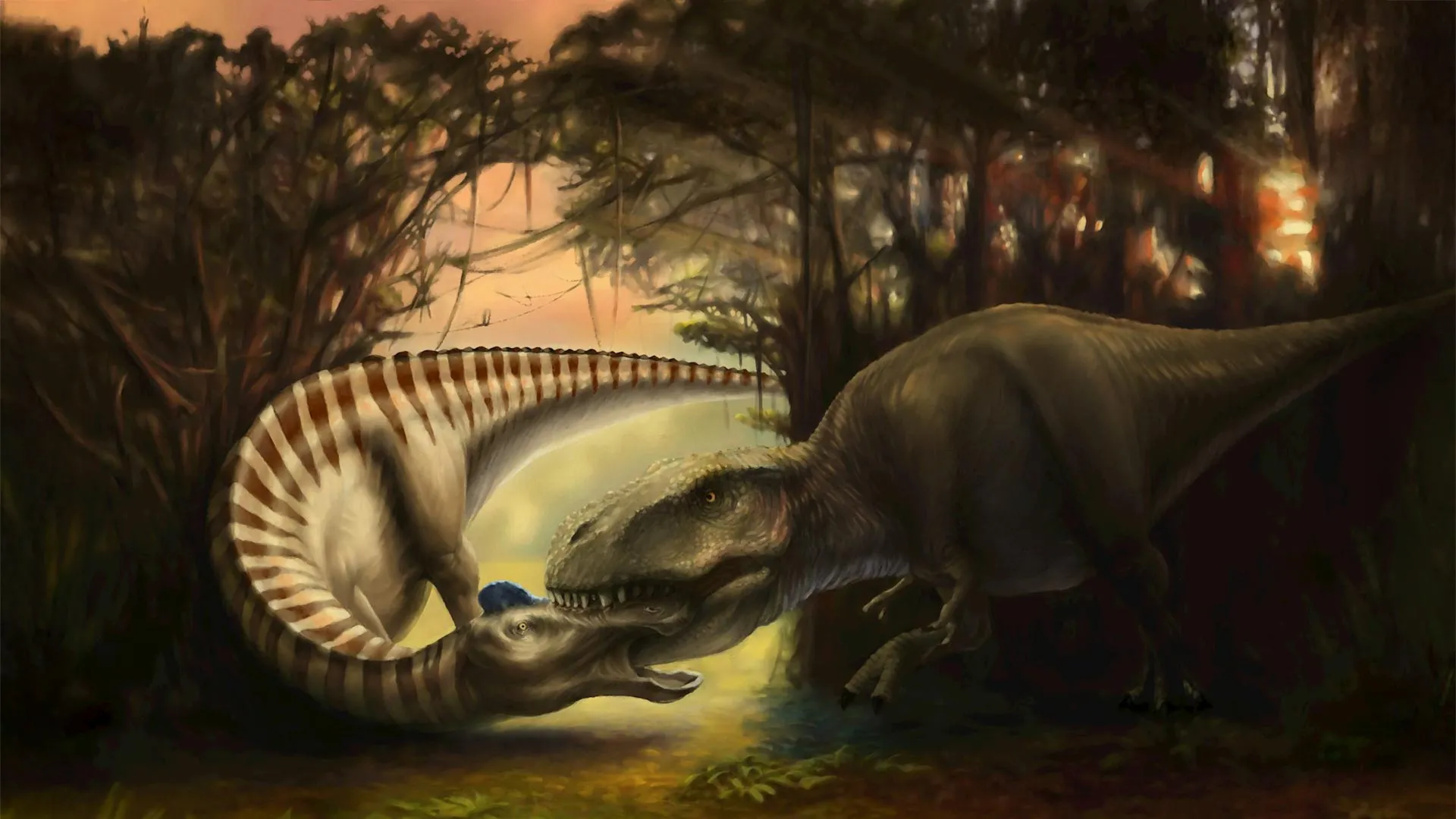
In the annals of paleontology, few discoveries capture the imagination quite like the raw, violent intersection of predator and prey. For millions of years, the Montana landscape—a verdant, subtropical paradise known today as the Hell Creek Formation—served as the theater for the most fearsome battles in terrestrial history. Now, a remarkable specimen housed at Montana State University’s Museum of the Rockies is providing scientists with an unprecedented, high-definition glimpse into the lethal mechanics of the Tyrannosaurus rex.
The specimen in question—a nearly complete skull of the duck-billed herbivore Edmontosaurus—contains a smoking gun: a serrated, broken tyrannosaur tooth permanently lodged in the creature’s facial bone. This fossil, discovered in 2005, has become the centerpiece of a rigorous new study published in the scientific journal PeerJ, offering a rare, tangible link to the behavioral habits of the apex predator of the Cretaceous period.
Main Facts: A Fatal Encounter Frozen in Time
The fossil represents more than just bone; it is a preserved moment of extreme biological trauma. Unearthed on land managed by the Bureau of Land Management in eastern Montana, the Edmontosaurus skull was immediately identified as a treasure trove of ecological data.
The primary significance of this find lies in the physical connection between the two animals. While paleontologists frequently encounter fossils bearing the scars of past trauma—healed bite marks or crushed vertebrae—the presence of an embedded tooth is an extraordinary rarity. This specimen provides researchers with the "who" and the "how" of the encounter. By isolating the genetic and morphological markers of the tooth, the team confirmed that the assailant was indeed a Tyrannosaurus rex, the undisputed monarch of the Hell Creek environment.
The lack of bone regeneration around the puncture site provides the most chilling detail: the victim did not survive the encounter. Whether the Edmontosaurus was hunted while alive or scavenged shortly after death, the force required to snap a tooth off inside the dense bone of the skull suggests a level of violence that underscores the sheer power of the T. rex bite force, which is estimated to be among the strongest of any terrestrial animal in Earth’s history.
Chronology: From the Cretaceous to the Museum Floor
66 Million Years Ago: The Late Cretaceous
The Hell Creek Formation was a swampy, humid delta, home to a diverse ecosystem. Edmontosaurus, a massive, herbivorous duck-billed dinosaur, roamed the landscape alongside the armored Triceratops and the gargantuan Tyrannosaurus rex. This was the twilight of the dinosaurs, a period characterized by intense evolutionary competition.
2005: The Discovery
Field researchers operating in the Hell Creek Formation uncovered the Edmontosaurus skull. Even in the field, the presence of the embedded tooth was noted as an anomaly. The skull was carefully excavated and transported to the Museum of the Rockies, where it underwent extensive stabilization and preparation.
2023–2024: The Scientific Investigation
The specimen became the focus of an in-depth study led by Taia Wyenberg-Henzler, a doctoral student at the University of Alberta, and John Scannella, Curator of Paleontology at the Museum of the Rockies. Utilizing modern diagnostic tools, the team embarked on a multi-year analysis to categorize the damage and verify the identity of the predator.
Present Day: Public Exhibition and Publication
The skull is currently a featured exhibit in the museum’s "Hall of Horns and Teeth," allowing the public to view the evidence of a 66-million-year-old struggle. The study’s findings, published in PeerJ, have since been integrated into the broader understanding of Cretaceous food webs.
Supporting Data: Technology Meets Ancient Biology
The methodology employed by Wyenberg-Henzler and Scannella represents the cutting edge of modern paleontology. Relying on visual identification alone is insufficient in a field where morphology can be deceiving; therefore, the team turned to high-resolution diagnostics.
Comparative Morphometrics
To ensure the assailant was a Tyrannosaurus rex, the team compared the serrations, dimensions, and curvature of the embedded tooth against every known theropod species native to the Hell Creek Formation. The match was unequivocal. The geometry of the tooth aligned perfectly with the known dental architecture of T. rex, effectively ruling out other predators like Nanotyrannus or Dakotaraptor.
Advanced Medical Imaging
The research team collaborated with Advanced Medical Imaging at the Bozeman Health Deaconess Hospital to perform CT scans of the skull. These scans were vital, as they allowed researchers to visualize the trajectory of the tooth through the bone without damaging the fragile specimen.
The scans revealed that the tooth had penetrated deep into the facial structure, breaking off upon impact. This indicates that the T. rex did not simply graze the victim; it struck with enough velocity and force to overcome the structural integrity of both its own tooth and the target’s skull. The angle of entry suggested a "face-to-face" confrontation, implying that the Edmontosaurus was likely engaged by the predator from the front—a classic hallmark of an active, predatory strike rather than opportunistic scavenging.
Official Responses: The Researchers’ Perspective
The team behind the study views the fossil not just as a specimen, but as a "Cretaceous crime scene."
"Although bite marks on bones are relatively common, finding an embedded tooth is extremely rare," remarked Taia Wyenberg-Henzler. "The great thing about an embedded tooth, particularly in a skull, is it gives you the identity of not only who was bitten but also who did the biting. This allowed us to paint a picture of what happened to this Edmontosaurus."
John Scannella emphasized the significance of the behavioral evidence captured by the fossil. "A fossil like this is extra exciting because it captures a behavior: a tyrannosaur biting into this duckbill’s face," Scannella stated. He noted the absence of healing as a critical diagnostic factor. "The skull shows no signs of healing around the tyrannosaur tooth, so it may have already been dead when it was bitten, or it may be dead because it was bitten. Either way, the interaction is captured in stone."
Wyenberg-Henzler added that the physical evidence points to a violent end. "Looking at the way the tooth is embedded in the nose of the Edmontosaurus suggests that it met its attacker face-to-face, something that usually happens to an animal that was killed by a predator," she explained. "The amount of force necessary for a tooth to have become broken off in bone also points to the use of deadly force. For me, this paints a terrifying picture of the last moments of this Edmontosaurus."
Implications: Rewriting the T. rex Narrative
For decades, the paleontology community has engaged in a fierce debate regarding the lifestyle of the Tyrannosaurus rex. Was it an apex predator that actively hunted down its meals, or was it primarily a scavenger that relied on the carcasses of animals that died of other causes?
The Case for Active Predation
This fossil acts as a powerful piece of evidence in favor of the active predator hypothesis. While it does not definitively rule out scavenging, the face-to-face nature of the attack and the immense force required to embed the tooth strongly correlate with a high-energy predatory strike.
Understanding Ecosystem Dynamics
The study also highlights the fragility of life in the Late Cretaceous. Edmontosaurus was a massive animal, yet it was clearly susceptible to the specialized hunting tactics of the T. rex. This suggests that the relationship between these species was not merely one of background co-existence, but one of constant, high-stakes evolutionary pressure.
Future Research Directions
The use of CT scanning and rigorous comparative morphology in this study sets a new standard for future investigations. As museum collections around the world continue to digitize their holdings and apply advanced medical imaging, it is likely that other "hidden" evidence of predation will emerge.
In conclusion, the Edmontosaurus skull at the Museum of the Rockies is more than a display piece. It is a bridge across time. It reminds us that 66 million years ago, the world was a place of visceral intensity, where the line between life and death was measured in the strength of a jaw and the sharpness of a tooth. By analyzing this singular, violent moment, researchers have managed to peer behind the veil of time, providing a vivid, terrifying, and ultimately invaluable look at the life and death of the giants who once ruled the Earth.