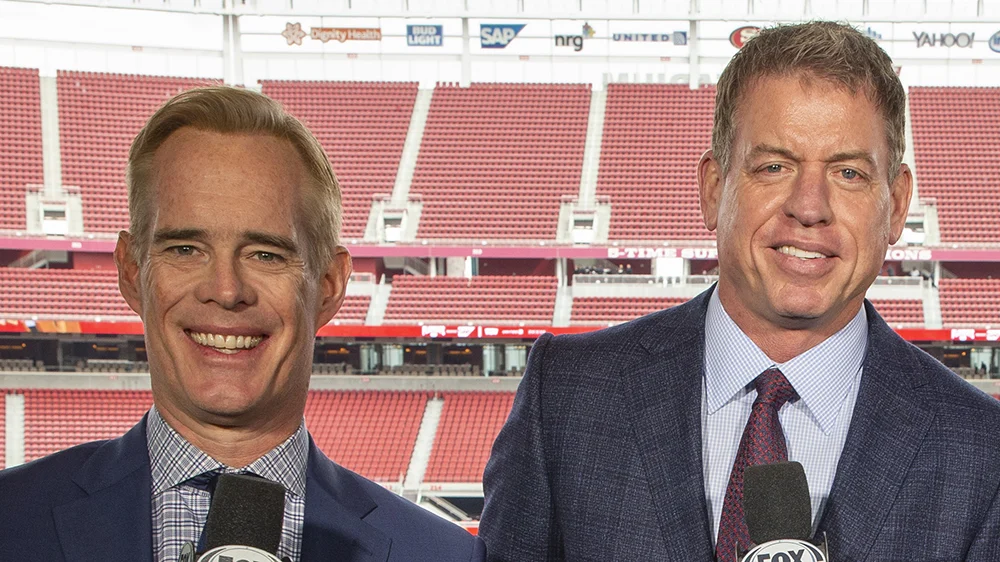
As the NFL prepares to kick off another Sunday, millions of fans will tune in, expecting the polished, expert commentary that has become synonymous with the modern viewing experience. Yet, behind the scenes of the broadcast booth, a different game is being played—one of leverage, expiring contracts, and shifting media economics. While the on-field action commands the headlines, the voices calling the plays are approaching a pivotal off-season that could redefine the landscape of sports broadcasting.
Prominent play-by-play stalwarts and color analysts—including ESPN’s Joe Buck and Troy Aikman, Amazon’s Al Michaels and Kirk Herbstreit, and Fox’s Greg Olsen—are currently operating under a cloud of uncertainty. According to sources familiar with the inner workings of these media giants, the contracts for several of these high-profile chroniclers of the gridiron are slated to expire after the current season. This impending deadline sets the stage for a period of intense negotiation, as networks weigh the astronomical cost of talent against the tightening realities of the media market.
The Evolution of the "Booth" Economy
The current state of NFL broadcasting is a direct byproduct of the massive 11-year media rights deal struck by the league in 2021. When the NFL secured its record-breaking broadcast agreements, TV networks engaged in a high-stakes arms race, scrambling to secure top-tier talent to anchor their coverage. The prevailing philosophy among media executives at the time was straightforward: you must spend massive sums to generate the revenue required to sustain these partnerships.
This trend was catalyzed by the meteoric rise of former Dallas Cowboys quarterback Tony Romo. When Romo joined CBS Sports in 2017, his uncanny ability to predict plays before they happened revolutionized the role of the color commentator. By 2020, CBS was effectively forced to re-sign Romo to a multi-season pact worth approximately $17 million annually to keep him from being poached by competitors.
That deal set the new "gold standard" for booth personnel, triggering a cascade of high-priced acquisitions across the industry. When ESPN lured Joe Buck and Troy Aikman away from Fox in 2022 to spearhead Monday Night Football, it was widely viewed as a strategic maneuver to repair a strained relationship between the Disney-backed network and the NFL. Similarly, Amazon Prime Video sought to establish credibility for its Thursday Night Football exclusive package by hiring broadcasting legend Al Michaels and college football titan Kirk Herbstreit. Meanwhile, Fox Sports made a historic splash by securing Tom Brady, a move that significantly altered the hierarchy of their booth talent and left veteran analyst Greg Olsen in a precarious position.
Chronology: How We Reached This Inflection Point
- 2017: Tony Romo joins CBS, changing the expectations for color analysts.
- 2020: CBS signs Romo to a $17M-per-year contract, signaling the start of the "super-salary" era for broadcasters.
- 2021: The NFL finalizes an 11-year, multibillion-dollar rights deal, prompting networks to aggressively pursue "marquee" talent.
- 2022: ESPN executes a massive coup, poaching Joe Buck and Troy Aikman from Fox to stabilize Monday Night Football. Amazon launches its standalone Thursday Night Football booth with Al Michaels and Kirk Herbstreit.
- 2024: Fox officially transitions Tom Brady into the lead analyst role, shifting Greg Olsen to the network’s secondary team.
- 2025/2026 (The Current Cycle): As media economics fluctuate, networks begin to scrutinize the sustainability of $15M–$20M annual salaries for booth talent.
Supporting Data: The Cost of Commentary
The financial stakes are staggering. Industry insiders estimate that top-tier NFL broadcast talent now commands between $15 million and $20 million per season. This represents a massive departure from previous decades, when the most significant sports-TV salaries were reserved for studio-show personalities gathered around desks for programs like The NFL Today or Fox NFL Kickoff.
"You would never see a big name call games professionally in the past," says Gideon Cohen, executive vice president of broadcast and new media at the sports management firm Athletes First. "Now, you have big names that are considering it because of the profile and the sheer amount of money involved."
However, the "return on investment" (ROI) is now under the microscope. While networks once believed that marquee names were essential to retaining viewers, the current economic climate—defined by the rise of streaming, the erosion of cable bundles, and soaring sports rights fees—is forcing a recalculation. When rights fees for the games themselves continue to escalate, production budgets and talent payrolls are often the first areas targeted for cost-cutting measures.
Official Responses and Corporate Strategy
Fox Sports, Amazon, ESPN, and CBS Sports have all declined to make executives available for formal comment on the status of their upcoming contract negotiations. However, the industry’s posture is becoming increasingly clear.
At Amazon, the situation is unique: Al Michaels remains on a year-to-year contract, suggesting a more fluid arrangement. Meanwhile, his partner, Kirk Herbstreit, is managing a "superhuman" schedule, balancing NFL duties with his heavy commitment to ESPN’s college football coverage and the long-running College GameDay.
Conversely, ESPN appears to be leaning into the stability offered by its high-priced stars. Since the arrival of Buck and Aikman, the network has seen a tangible improvement in the quality of its game assignments and a surge in ratings. With ABC slated to broadcast the Super Bowl in February 2027, ESPN is reportedly already in active negotiations to renew the pair. As Tim Scanlan, vice president of sports broadcast at Octagon, notes, "They’ve got another Super Bowl to handle. You could argue the [Buck/Aikman] investment really paid for itself."
The Complexity of the Current Landscape
The CBS/Romo Conundrum
CBS finds itself in a particularly volatile position. Tony Romo, once the league’s most coveted analyst, has faced personal and professional challenges, including a summer arrest for operating a vehicle while intoxicated. His absence from the opening weeks of the season has opened the door for former NFL star J.J. Watt to take a seat alongside Jim Nantz. Should Watt prove to be a permanent upgrade or a more cost-effective solution, it could fundamentally alter the network’s long-term strategy for its lead team.
The Greg Olsen Dilemma
Fox Sports faces a delicate balancing act with Greg Olsen. After being moved from the top team to the second team to accommodate Tom Brady, Olsen has remained a consummate professional. While industry observers speculate on how long Brady will commit to the grind of a full season—given his myriad of outside business interests—Fox executives remain mindful of Olsen’s value and his loyalty during a period of significant personnel upheaval.
Implications for the Future of Broadcasting
The primary concern for all networks remains their relationship with the NFL. With the league holding the option to renew or re-open its current 11-year rights deals after the 2029 season, no media company can afford to alienate the shield. The broadcast booth is the most visible manifestation of a network’s commitment to the league; thus, maintaining high-quality talent is viewed as a strategic necessity rather than a luxury.
However, the "infinite coffers" era is fading. The more the cost of live sports rights rises, the more pressure mounts on networks to balance their balance sheets. Experts suggest that we may soon see a diversification of the booth. Younger, high-profile stars—such as active players like Travis Kelce, who has already cultivated a massive media footprint through podcasting—could represent a future path for networks looking to inject fresh energy into their broadcasts at a different price point.
As the industry enters this cycle of contract expirations, the decision-making will be driven by a mix of nostalgia, performance metrics, and cold, hard financial chess. As Scanlan aptly summarizes, "The price of live events just keeps going up. As that happens, you start to look for savings in production and talent. You want to be very, very careful with any decision you make."
For now, the games will continue, the analysts will speak, and the fans will watch. But underneath the surface, the business of broadcasting is undergoing a transformation that may prove just as impactful as any play run on the field.