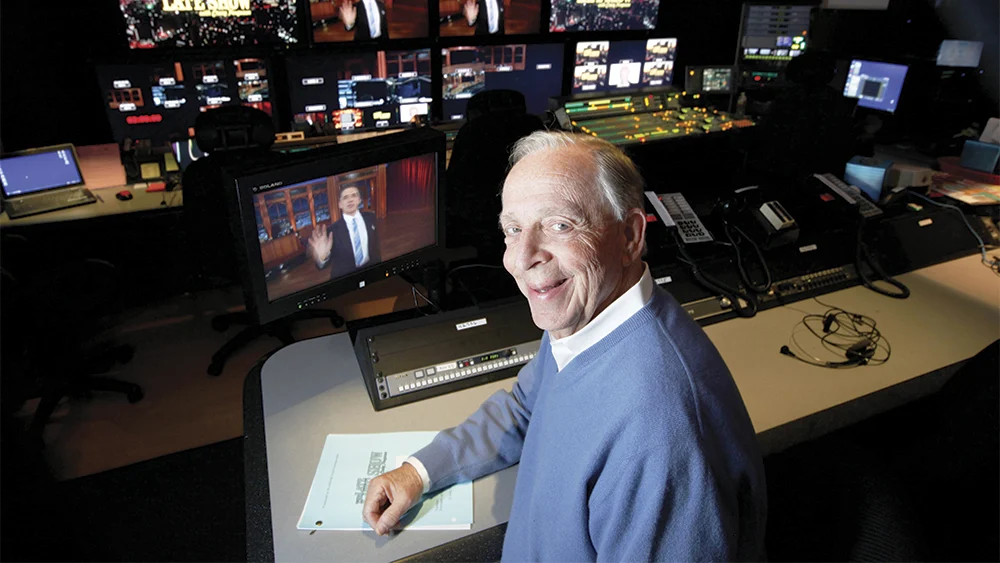
Peter Lassally, the legendary producer whose steady hand guided the titans of late-night television for over half a century, has passed away at the age of 93. Known as the "host whisperer" of the industry, Lassally was the invisible engine behind the most iconic moments in television history, leaving an indelible mark on the landscape of American culture through his work with Johnny Carson, David Letterman, and Craig Ferguson.
His death marks the end of a remarkable era in broadcasting. To understand the history of the "Tonight Show" or the evolution of the late-night talk format is to understand the career of Peter Lassally—a man who preferred the wings of the stage to the spotlight, yet whose influence was felt by every viewer who ever stayed up late for a laugh.
A Life Forged in Resilience
Before Lassally was shaping the tone of national television, he was a survivor of one of history’s darkest chapters. Born in Hamburg, Germany, in 1932, Lassally was a child when the rise of the Nazi regime forced his Jewish family to flee to the Netherlands. It was there that his life became intertwined with history in harrowing ways; his sister attended school with Anne Frank, and the family eventually faced the horrors of the Holocaust.
Lassally, along with his mother and sister, was imprisoned in the Westerbork transit camp and later the Theresienstadt concentration camp. The trauma and resilience of his youth were experiences he rarely spoke of, yet those who knew him well often cited his quiet strength and profound empathy as products of his early life. After surviving the Holocaust, the family immigrated to New York in 1947, providing a young Lassally with a fresh start in the burgeoning American media landscape.
Chronology: From Radio City Usher to Industry Titan
Lassally’s path to the executive suite began at the very bottom of the ladder. At age 19, he entered the NBC Page program, a rite of passage for many future media moguls. During this time, he worked as an usher at Radio City Music Hall, where he struck up a lifelong friendship with a fellow page named Regis Philbin.
The Rise of a Producer
After a stint in radio and working on Arthur Godfrey’s influential program, Lassally joined the staff of The Tonight Show Starring Johnny Carson in the 1970s. It was here that he earned his stripes, eventually rising to executive producer. He served as the primary steward of the "Tonight Show" franchise until Carson’s retirement in 1992.
When Carson stepped down, a seismic shift occurred in late-night television. David Letterman, widely considered the heir apparent, was famously passed over by NBC in favor of Jay Leno. It was at this juncture that Lassally proved his value as a strategist and confidant. He joined Letterman’s production shingle, Worldwide Pants, and became the driving force behind the decision to leave NBC entirely. Together, they founded the Late Show at CBS, successfully migrating Letterman’s irreverent, post-modern style to a new network and establishing a rival franchise that would define the 1990s and 2000s.
The "Late Late" Legacy
Lassally’s vision extended beyond the 11:30 p.m. slot. Under the agreement between Letterman and CBS, Worldwide Pants took control of the 12:37 a.m. hour, launching The Late Late Show. Lassally served as the executive producer for the show’s first iteration with Tom Snyder. Following a period of semi-retirement, he returned to the helm in 2005 to shepherd a then-underestimated Craig Ferguson. Under Lassally’s guidance, Ferguson’s show evolved into a critically acclaimed, surrealist outpost that defied the traditional talk show structure, proving Lassally’s uncanny ability to identify and nurture unique comedic voices.
Supporting Data: The Anatomy of a Producer
The influence of a producer is often difficult to quantify, but in the case of Peter Lassally, the evidence lies in the longevity and quality of the shows he touched.
- Longevity: His career spanned over 60 years, beginning in the late 1940s and concluding with his retirement in 2015.
- Emmy Recognition: He secured two Emmy Awards, though peers often noted that his true reward was the seamless, high-quality broadcast that hit the airwaves every night.
- The "Host Whisperer" Approach: Industry colleagues described his management style as "ego-less." Unlike the flamboyant producers of today, Lassally believed his job was to clear the path for the host. As former CBS Entertainment chairman Nina Tassler once noted, Lassally had an "unerring ability to diagnose problems with surgical precision," often resolving complex production issues before the host even knew they existed.
Official Responses and Industry Tributes
The industry response to Lassally’s passing has been one of profound mourning, reflecting his stature as a mentor to generations of television writers, producers, and performers.
Michael Naidus, who worked alongside Lassally as a showrunner on Craig Ferguson’s The Late Late Show, offered a poignant tribute:
"Peter had two loves in his life that lasted more than a half-century: the first with his lovely wife, Alice, and the second with the world of talk television. Each of those love affairs was a two-way street. Quite literally, hundreds of millions of people owe their late-night smiles and laughs to this beautiful soul, whose gift for finding extraordinary talent and honing it is unmatched and unrivaled."
Naidus continued, "And all the while, Peter took such joy from the moments he helped create, that his grin was as ubiquitous as his daily sliced apple. Whatever little I gave to the format is because he was kind and patient enough to teach it to me. It’s traditional to say ‘he will be missed’ in these circumstances, but the truth is Peter was and is irreplaceable."
Nina Tassler, in a retrospective on his career, summarized the essence of his character: "He’s kind of ego-less. There’s a comfort he derives from not wanting or needing to be in the spotlight."
Implications: The End of an Era
The death of Peter Lassally represents more than the passing of a veteran executive; it marks the conclusion of a specific philosophy of television production. Lassally belonged to a generation that prioritized the craft, the rhythm of the monologue, and the sanctity of the guest interview above the viral, bite-sized content that defines today’s digital-first late-night landscape.
The "Tonight Show" Legacy
Lassally was the keeper of the flame for the Carson-era style of broadcasting. By bringing that institutional knowledge to David Letterman, he helped bridge the gap between the classic variety style of the 1960s and the ironic, personality-driven talk shows of the late 20th century. His fingerprints are on the foundational structure of the CBS late-night lineup that existed for over three decades.
A Mentorship Model
Lassally’s legacy is also defined by his role as a mentor. He didn’t just produce shows; he built talent. Whether it was identifying the potential in Craig Ferguson—a man largely known at the time for a sitcom supporting role—or helping Letterman navigate the corporate politics of NBC and CBS, Lassally operated with a long-term view of success.
As the industry pivots toward shorter, algorithm-driven clips and social media engagement, the "Lassally model"—focused on patience, nurturing talent, and quiet, surgical problem-solving—is becoming a rarity. He leaves behind a family, including his children Andrea and Tom, and four grandchildren, but he also leaves behind a blueprint for success that will continue to inform the work of producers for decades to come.
In his final act, before retiring in 2015 as James Corden prepared to take over the Late Late Show slot, Lassally remained a steady presence. Even in his departure, he ensured a smooth transition, embodying the very trait that defined his professional life: the desire to see the show go on, without ever needing to take the bow himself.
Peter Lassally was, in every sense, the backbone of late-night television. As the lights dim on his storied career, the industry is left to reflect on the immense, quiet impact of a man who spent his life ensuring that the world was laughing—even if he was usually just standing in the shadows, holding a sliced apple, and watching it all work perfectly.