WASHINGTON D.C. – July 16, 2026 – Senator Lindsey Graham (R-S.C.), a towering figure in American foreign policy for over two decades and a uniquely involved legislator, passed away on July 11, 2026, at the age of 71. His death sent shockwaves through Washington and across the globe, prompting an immediate outpouring of grief and remembrance for a politician whose career was defined by a fierce commitment to American leadership abroad and a tenacious engagement in the legislative process at home.
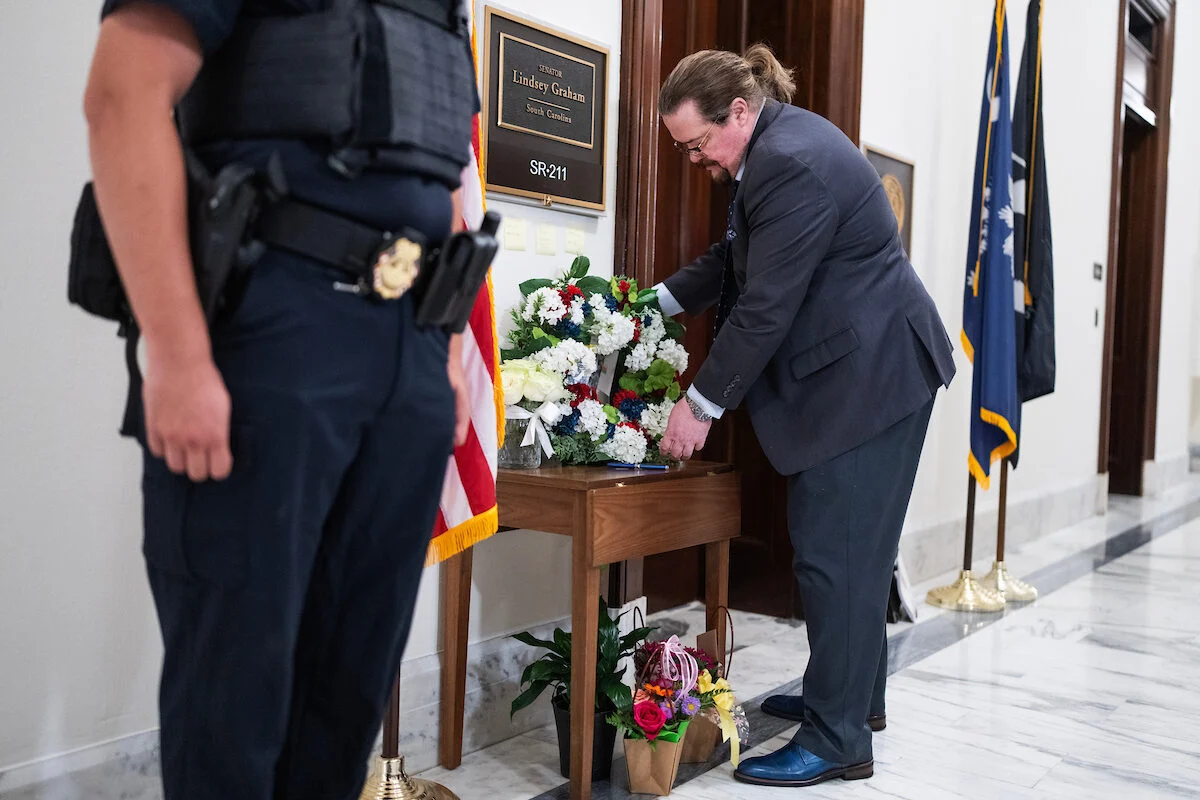
Among the first and most poignant tributes was paid on July 13, when a representative from the Kurdistan Communities Assembly solemnly laid flowers outside the senator’s Capitol Hill office. The gesture, captured in a somber photograph, symbolized the deep and often personal connections Graham forged with international allies, particularly those in volatile regions where he championed human rights and democratic aspirations. It underscored his enduring legacy as a foreign policy hawk who believed in assertive American power and unwavering support for partners facing existential threats.
Senator Graham’s passing marks the end of an era for a Senate known for its outsized personalities and deep-seated ideological battles. From his early days as a military prosecutor to his influential positions on the Senate Armed Services, Judiciary, and Foreign Relations Committees, Graham carved out a singular path, becoming an indispensable voice on national security, judicial appointments, and the intricate dance of legislative deal-making. His absence leaves a profound void, not just for the state of South Carolina he proudly served, but for the global stage where his influence was keenly felt.
The Kurdish Tribute: A Symbol of Enduring Alliances
The image of a representative from the Kurdistan Communities Assembly placing flowers at Senator Graham’s office on July 13, just days after his passing, spoke volumes about the depth and reach of his international advocacy. For years, Graham had been one of the most vocal and consistent champions for Kurdish self-determination and security in the Middle East. His support spanned multiple administrations, often cutting across partisan lines when it came to defending the Kurdish people, who he frequently referred to as “America’s most reliable allies” in the fight against terrorism.
His advocacy for the Kurds was not merely rhetorical. Senator Graham consistently pushed for increased aid to the Kurdistan Region of Iraq, lobbied against any actions that would undermine Kurdish autonomy, and was a fierce critic of any perceived abandonment of Kurdish forces by the United States. He frequently traveled to the region, meeting with leaders in Erbil and engaging directly with Peshmerga fighters, earning their trust and respect. He understood the complex geopolitical dynamics of the region, consistently arguing that a stable and secure Kurdistan was vital for broader regional stability and U.S. interests.
This specific tribute was more than a gesture of condolence; it was a powerful affirmation of the senator’s direct impact on lives far beyond America’s borders. It highlighted how Graham’s “foreign policy hawk” persona was often rooted in a deep, personal commitment to specific groups and causes, transforming abstract geopolitical strategies into tangible alliances. The flowers laid outside his office were a testament to a legacy built on principled engagement, demonstrating that even in his passing, Senator Graham’s influence on global allies remained palpable. The Kurdistan Communities Assembly’s act of remembrance underscored the senator’s unique ability to cultivate trust and loyalty among those he championed, leaving an indelible mark on international relations that will undoubtedly be felt for years to come.
A Chronology of Influence: From Judge Advocate to Senate Powerhouse
Lindsey Olin Graham’s journey to becoming one of Washington’s most influential figures was marked by a relentless drive and an unwavering commitment to public service. Born in Central, South Carolina, in 1955, Graham’s early life was steeped in the fabric of small-town America, working in his family’s restaurant and liquor store. He earned his undergraduate degree from the University of South Carolina in 1977 and later his Juris Doctor from the University of South Carolina School of Law in 1981.
His legal career began immediately, but it was his military service that truly set the stage for his future in public life. Commissioned into the United States Air Force as a Judge Advocate in 1982, Graham served both active duty and in the Air Force Reserve and Air National Guard, retiring as a colonel in 2015. This experience profoundly shaped his worldview, instilling in him a deep understanding of military strategy, international law, and the sacrifices demanded by service, which would later inform his hawkish foreign policy positions.
Graham’s political career began in the South Carolina House of Representatives in 1992. After just two years, he successfully ran for the U.S. House of Representatives in 1994, part of the Republican Revolution that swept Newt Gingrich into power. In the House, he quickly established himself as a conservative voice, notably playing a significant role as a House manager during the impeachment trial of President Bill Clinton.
In 2002, he successfully sought the U.S. Senate seat vacated by the retiring Strom Thurmond, beginning a Senate career that would span more than two decades. Upon entering the Senate in 2003, Graham rapidly ascended, leveraging his legal background and military expertise to secure influential appointments on the Senate Armed Services Committee, the Senate Judiciary Committee, and later the Senate Foreign Relations Committee. He became a fixture in national security debates, a leading voice on judicial nominations, and a central player in crafting bipartisan legislation on issues ranging from immigration reform to counter-terrorism measures. His tenure was marked by a willingness to challenge conventional wisdom within his own party, often forging unexpected alliances, while simultaneously remaining a staunch defender of conservative principles, particularly regarding national defense and judicial philosophy.
The Foreign Policy Hawk: Decades of Principled Interventionism
Senator Lindsey Graham was, without equivocation, a foreign policy hawk, a moniker he wore with pride throughout his career. His philosophy was rooted in the belief that American exceptionalism necessitated an active, assertive, and often interventionist role in global affairs to protect U.S. interests, promote democracy, and combat threats to international stability. This conviction was not merely academic; it was deeply ingrained, shaped by his military service and his extensive travels to conflict zones.
Graham consistently advocated for a robust military budget, arguing that American strength was the surest deterrent to aggression and a necessary tool for projecting influence. He was a vocal proponent of strong alliances, particularly NATO, and frequently criticized any perceived weakening of these partnerships. His relationship with the military brass and intelligence community was unparalleled, often acting as a bridge between the Pentagon and Congress, providing critical oversight while also championing their needs.
His hawkish stance manifested in numerous policy positions. He was a steadfast advocate for a forceful approach to Iran, consistently pushing for tougher sanctions, supporting regional allies against Iranian proxies, and warning against any nuclear deal that he deemed insufficient. Regarding China, he was an early and persistent voice calling for a more confrontational strategy, particularly on issues of human rights, trade imbalances, and Beijing’s growing military assertiveness in the Indo-Pacific. His positions on Russia were equally firm, advocating for severe sanctions and military aid to nations bordering Russia, viewing Moscow as a persistent threat to democratic norms.
Graham was a key architect of post-9/11 counter-terrorism legislation and strategy. He fiercely defended the use of military commissions and detention policies at Guantanamo Bay, arguing they were necessary tools in the war on terror. He pushed for sustained military presence in Iraq and Afghanistan long after many called for withdrawal, believing that premature departures would create dangerous power vacuums. His unwavering support for Israel was legendary, often serving as one of its most ardent defenders in Congress, advocating for its security and right to self-defense with an almost singular focus. His foreign policy was characterized by a moral clarity he believed was essential, often stating that America had a responsibility to stand with its friends and confront its enemies decisively.
The Involved Legislator: A Force in Domestic Policy and Senate Dynamics
Beyond his formidable reputation in foreign policy, Senator Graham was also an intensely "involved legislator" within the intricate machinery of the U.S. Senate. This aspect of his legacy spoke to his deep understanding of Senate rules, his willingness to engage in protracted negotiations, and his unique ability to navigate the complex personal and political relationships that define Capitol Hill. While often portrayed as a partisan warrior, particularly in later years, Graham also demonstrated a capacity for bipartisan deal-making on specific issues, a testament to his practical approach to governance.
On domestic policy, Graham made his mark most notably on immigration reform. Throughout his career, he made several attempts to craft comprehensive immigration legislation, working across the aisle with figures like Senator John McCain and later Senator Dick Durbin. Though often unsuccessful in passing grand reforms, his persistent engagement highlighted his belief in finding pragmatic solutions to complex national challenges, even when politically perilous.
His role on the Senate Judiciary Committee was equally significant. As a former prosecutor and military judge, Graham possessed a keen understanding of legal principles, which he applied rigorously during judicial confirmation hearings. He was a staunch advocate for conservative judicial appointments, playing a pivotal role in the confirmation of numerous federal judges and Supreme Court justices. His questioning style, often sharp and incisive, made him a central figure in some of the most contentious confirmation battles of his era, cementing his reputation as a formidable legal mind and a fierce partisan defender when necessary.
Graham was also a devoted advocate for his home state of South Carolina. He tirelessly championed economic development initiatives, secured funding for military bases critical to the state’s economy, and advocated for the needs of its citizens. He understood the direct link between federal policy and local impact, ensuring that South Carolina’s voice was always heard in Washington. His unique communication style – often direct, sometimes humorous, and always passionate – made him a recognizable and often sought-after voice on cable news, where he articulated his positions with clarity and conviction, endearing him to many while frustrating others. His legacy as an involved legislator is one of a senator who understood the power of his office and used it to its fullest extent, whether crafting landmark legislation, shaping judicial policy, or tirelessly advocating for his constituents.
Official Responses: A Bipartisan Chorus of Tributes
The news of Senator Lindsey Graham’s passing elicited a widespread and bipartisan outpouring of grief and respect from across the political spectrum, both domestically and internationally. The chorus of tributes underscored his complex relationships and the indelible mark he left on American politics.
President [Current President’s Name] issued a statement from the White House, calling Graham "a titan of the Senate whose dedication to our national security and unwavering patriotism served as an example to us all. Though we often stood on different sides of the aisle, I always admired his fierce intellect and his profound commitment to the American people. He leaves an irreplaceable void in the halls of Congress and in the hearts of those who knew him."
Senate Majority Leader [Current Majority Leader’s Name] praised Graham as "a true conservative warrior and an invaluable voice on foreign policy. His strategic insights and his relentless pursuit of American strength made our nation safer and our alliances stronger. He was a trusted colleague and a dear friend, and his leadership will be sorely missed."
Senate Minority Leader [Current Minority Leader’s Name] offered a more nuanced but equally respectful tribute: "Senator Graham was a formidable debater and a passionate advocate for his beliefs. While we frequently disagreed on policy, I always recognized his deep conviction and his willingness to engage in difficult conversations. He cared deeply about this country, and his contributions, particularly in national security, were immense. My thoughts are with his family and the people of South Carolina."
Numerous colleagues, past and present, shared their personal reflections. Senator John Barrasso (R-Wyo.) lauded Graham’s "unmatched understanding of military affairs," while Senator Tim Kaine (D-Va.), despite their frequent policy clashes, acknowledged Graham’s "sincere belief in American global leadership and his tireless work ethic." Foreign dignitaries also weighed in. The President of the Kurdistan Region of Iraq released a statement expressing profound sorrow, stating, "Senator Graham was a true friend to the Kurdish people, a champion of our cause, and a powerful voice for justice. His memory will forever be cherished in Kurdistan." The Israeli Prime Minister also offered condolences, highlighting Graham’s "unwavering support for Israel’s security and its right to defend itself."
In South Carolina, Governor [Current SC Governor’s Name] ordered flags to be flown at half-staff, declaring, "South Carolina has lost one of its most dedicated sons. Senator Graham served our state with distinction and honor, always putting the interests of his constituents first. His legacy of service will inspire generations to come." The breadth of these responses, from the highest offices to grassroots supporters, painted a vivid picture of a public servant whose impact transcended political divides and extended far beyond the nation’s borders.
Implications for a Divided Nation and Complex World
Senator Lindsey Graham’s passing creates an immediate and profound ripple effect across the political landscape, with significant implications for the U.S. Senate, national policy debates, and America’s role in a complex world.
Firstly, the most immediate impact will be felt in the Senate itself. As a senior member of the Armed Services, Judiciary, and Foreign Relations Committees, Graham was a force multiplier, bringing decades of experience and institutional knowledge to critical national security and judicial policy discussions. His absence leaves a significant void, particularly within the Republican caucus, where he was a leading voice for a muscular foreign policy and a traditional conservative approach to judicial appointments. Filling his committee slots with someone of comparable experience and influence will be a challenge, potentially shifting the balance of power or expertise within these crucial legislative bodies.
Secondly, his death will inevitably impact ongoing policy debates. On foreign policy, the "hawkish" wing of the Republican Party loses one of its most articulate and persistent advocates. While the philosophy of American strength and assertive engagement will certainly continue, Graham’s unique ability to bridge divides, explain complex geopolitical realities to a broader audience, and directly influence military and intelligence leaders will be difficult to replicate. Debates on issues such as aid to Ukraine, policy towards China and Russia, and America’s posture in the Middle East may lose a critical, experienced voice that often pushed for more decisive action.
Domestically, while his role on immigration and judicial policy was significant, his absence might also open new avenues for discussion, particularly on issues where his firm stances had sometimes created roadblocks. The political dynamics in South Carolina will also shift dramatically. The process of appointing a successor to serve until the next election will be closely watched, as will the subsequent race to fill his seat permanently. This will be a critical test for the state’s Republican Party and could introduce new figures and ideologies into the national conversation.
Finally, Graham’s passing carries symbolic weight for America’s global standing. He was a recognizable and respected (or, for some, formidable) figure on the international stage, someone who foreign leaders and diplomats knew could be counted on to advocate for certain principles. His death underscores the generational shift occurring in American politics, as figures who shaped post-Cold War foreign policy gradually leave the stage. His legacy, however, will continue to influence how America perceives its role in the world, reminding future generations of the enduring power of principled conviction and active engagement in global affairs.
In sum, Senator Lindsey Graham was more than just a politician; he was an institution. His departure leaves a void that will be felt keenly in the halls of power and in the global arena. His career was a testament to the power of unwavering belief, strategic engagement, and the complex, often contradictory, nature of American public service. As Washington mourns and the world reflects, his legacy as a foreign policy hawk and an involved legislator will undoubtedly continue to shape conversations about America’s past, present, and future role on the global stage.