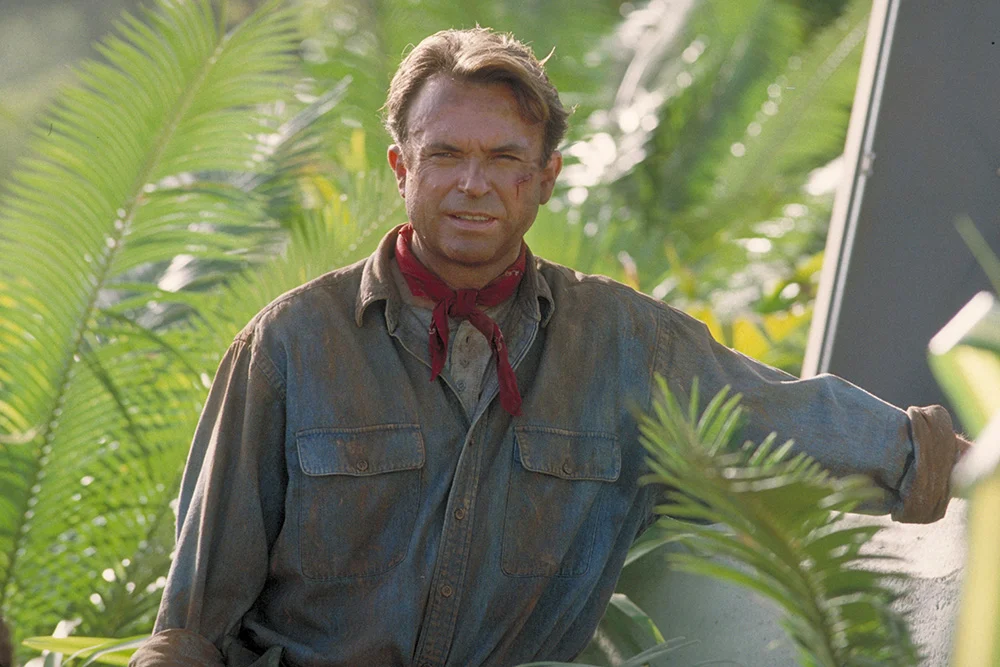
For nearly two decades, Sam Neill existed in the cinematic ether as the ultimate "actor’s actor"—a reliable, sturdy presence who anchored some of the most profound performances of the late 20th century without ever clamoring for the spotlight. It was not until the age of 45, when he finally stepped into the shoes of Dr. Alan Grant in Jurassic Park, that the industry officially labeled him a star. Yet, to those who had been paying attention, the "stardom" was merely a technicality. Neill had spent his career as a master of the supporting pillar, a performer whose intelligence and carefully modulated restraint elevated every production he touched.
The Foundations of a Quiet Career
Born in New Zealand and tempered by the gritty, character-driven landscapes of early international cinema, Neill’s career was never defined by the pursuit of the "all-guns-blazing" lead. Instead, he cultivated a reputation for quiet masculine decency or, when required, a chilling, steely resolve.
During his formative years, Neill’s filmography reads like a syllabus for prestige drama. He did his finest work by serving as the foundation for some of the most formidable actresses of the era. Whether he was standing alongside Judy Davis in My Brilliant Career (1979), navigating the psychological wreckage of Andrzej Żuławski’s Possession (1981) with Isabelle Adjani, or playing the foil to Nicole Kidman in the taut thriller Dead Calm (1989), Neill’s philosophy remained consistent: his job was to ensure his co-star shone brightest.
His work with Meryl Streep in Plenty (1985) and A Cry in the Dark (1988) cemented this identity. Neill was the quintessential scene partner—never pulling focus, never overplaying, and always providing the emotional weight necessary for his counterparts to reach their peaks. If he wasn’t a household name by 1990, it was because he had intentionally chosen a path of professional humility that kept him in high demand among the world’s most discerning directors.
1993: The Bifurcation of a Hollywood Icon
The year 1993 stands as the most pivotal moment in Neill’s career, a strange convergence where he simultaneously became a global blockbuster headliner and a nuanced character actor in a prestige period piece.
When Steven Spielberg cast him as the paleontologist Dr. Alan Grant in Jurassic Park, Neill was suddenly elevated to the A-list. He was the face of a marketing juggernaut, his likeness immortalized in plastic as an action figure. Yet, Neill was under no illusions. He understood that he was, in effect, playing second banana to the film’s true stars: the prehistoric, computer-generated titans.
As producer Kathleen Kennedy famously remarked at the time, the role of Alan Grant "isn’t an intensely complicated part." The production needed someone who was professional, affordable, and, crucially, someone who wouldn’t overshadow the dinosaurs. Neill was the perfect choice. He carried the weight of the film with a grounded, relatable charisma that allowed the audience to suspend their disbelief, effectively becoming the anchor in a storm of digital spectacle.
Simultaneously, Neill was delivering a haunting, antithetical performance in Jane Campion’s The Piano. In this colonial-era fable, Neill was the antithesis of the heroic Dr. Grant. As the abusive, cuckolded husband, he played a man defined by priggishness and a pathetic, impotent rage—the polar opposite of Harvey Keitel’s liberated, sensual frontiersman. It was a testament to his range that these two films—one a populist thrill ride, the other a searing feminist masterpiece—were being discussed in the same breath.
Supporting Data: A Philosophy of Service
Neill’s reaction to his sudden fame was, in character, muted. In a contemporary interview with the Los Angeles Times, he acknowledged that Jurassic Park had granted him "a little more leverage" in the industry, but he was quick to pivot. He expressed a deep-seated "penchant for small films," noting that his agents were frequently frustrated by his refusal to chase traditional leading-man projects.
His contribution to The Piano—which went on to win the Palme d’Or at Cannes—remains a highlight of his career, despite the lack of personal accolades. While Holly Hunter swept the awards season, Neill was left off the nomination lists. He never expressed bitterness; rather, he viewed his involvement as a form of service. Years later, he would describe the film as "a medal on my chest," emphasizing that being a small part of a cinematic historical milestone was far more meaningful than any individual trophy.
The Evolution of the "Nice Guy" Brand
The trajectory of Sam Neill’s career post-1993 followed a strategic, if unconventional, pattern. He never sought another Jurassic Park-level blockbuster to define his legacy. Instead, he utilized the financial security that blockbuster residuals provided to curate an eclectic, artistic portfolio.
His career became a mosaic of high-concept genre work and intimate, character-driven indie projects:
- Genre Mastery: His work in John Carpenter’s In the Mouth of Madness showcased his ability to carry a film through sheer intensity.
- Artistic Exploration: Collaborations with directors like Sally Potter in Yes pushed him into linguistically and philosophically complex territories.
- Cultural Significance: His roles in Warwick Thornton’s Sweet Country and Taika Waititi’s Hunt for the Wilderpeople demonstrated a commitment to supporting diverse, visionary voices in cinema.
In the digital age, Neill’s profile shifted once more. Through social media, he became a beloved public figure, celebrated for his dry wit, his vineyard, and his genuine, down-to-earth love for the natural world. This transition from "stiff, stoic actor" to "internet’s favorite gentleman" solidified his reputation as one of the industry’s genuinely kindest souls.
Implications for Modern Acting
What can be learned from the career of Sam Neill? The primary implication is that "stardom" is a subjective, often misleading metric. Neill’s refusal to conform to the standard Hollywood archetype allowed him to sustain a career that has spanned over four decades without suffering the burnout or typecasting that plagues many leading men.
By positioning himself as a servant to the artistic whole, Neill ensured that his work would age better than most. While the flashy stars of the 90s faded or struggled to transition into mature roles, Neill’s foundation of "carefully etched and modulated" performances allowed him to age gracefully into the elder statesman of the industry.
His legacy is not defined by the box office receipts of Jurassic Park, but by the consistency of his craft. He serves as a reminder that the most essential component of any great film is not the lead actor, but the willingness of the players to disappear into the story. Whether playing a dinosaur-hunting scientist or an abusive colonial husband, Sam Neill’s presence was always exactly what the film required—and rarely what the audience expected. In the end, his "quiet decency" wasn’t a lack of ambition; it was a masterclass in how to remain relevant in an industry that usually demands the exact opposite.