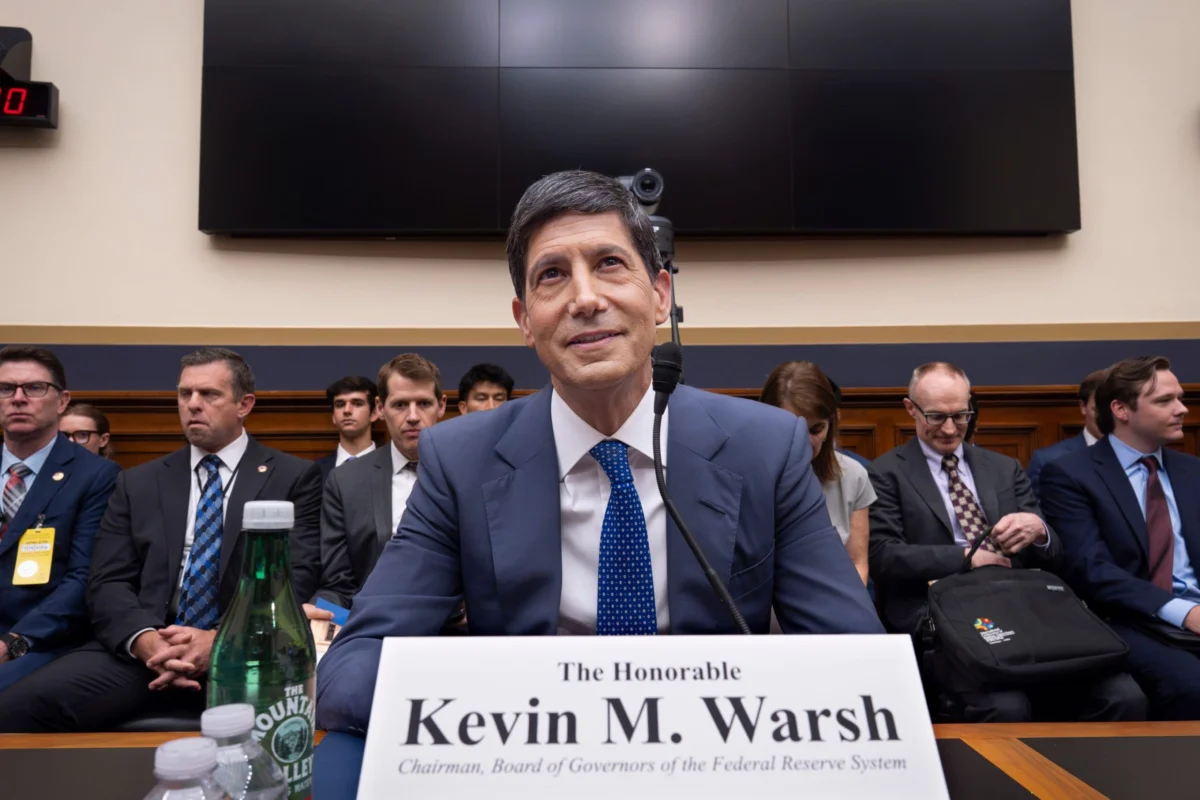
WASHINGTON D.C. — In a high-stakes debut before the House Financial Services Committee on Tuesday, Federal Reserve Chair Kevin Warsh delivered a stern mandate for the nation’s monetary policy, pledging to make high inflation “a thing of the past.” However, despite a cooling consumer price index (CPI) report released hours earlier, Warsh maintained a calculated ambiguity regarding the central bank’s next move, highlighting a profound ideological rift within the Federal Open Market Committee (FOMC) and a global landscape fraught with new inflationary risks.
Warsh, who assumed the chairmanship on May 22 following the departure of Jerome Powell, finds himself at the helm of a central bank caught between surprisingly positive domestic data and a volatile international environment. His testimony served as a formal introduction of his leadership style: one characterized by a "data-dependent" approach and a notable retreat from the "forward guidance" strategies favored by his predecessor.
Main Facts: A Cautious Stance Amidst Cooling Data
The primary takeaway from Tuesday’s proceedings was Warsh’s refusal to declare victory over the inflationary cycle that has gripped the U.S. economy. While the latest government data showed a 0.4% decline in headline inflation from May to June—largely a result of a temporary reprieve in energy costs—Warsh remained unmoved.
"There might be some that look at this morning’s data and say, ‘mission accomplished,’" Warsh told lawmakers. "That is not my view."
The Federal Reserve Chair emphasized that the central bank has "no tolerance for persistently elevated inflation" and remains "resolutely committed" to restoring price stability, defined by the Fed’s long-standing 2% target. Currently, while headline inflation has dropped to 3.5% from 4.2% in May, core inflation—which strips out the volatile food and energy sectors—sits at 2.6%. While this is an improvement from May’s 2.9%, it remains stubbornly above the threshold the Fed deems acceptable for a healthy economy.
Compounding the complexity of Warsh’s task is a deeply divided rate-setting committee. Last month’s forecasts revealed a 50/50 split among the 19 policymakers: roughly half envision further interest rate hikes before the year’s end, while the other half supports a "wait-and-see" approach or even potential rate cuts. This internal friction places Warsh in the difficult position of mediator-in-chief as he attempts to forge a consensus in an era of rapid economic shifts.
Chronology: From the Powell Transition to the "Warsh Doctrine"
The path to Tuesday’s testimony began on May 22, when Kevin Warsh officially took over the chair from Jerome Powell. His appointment signaled a shift toward a more hawkish, or at least more enigmatic, monetary policy.
- February 28: The geopolitical landscape shifted dramatically when the U.S. launched military actions against Iran. This event triggered an immediate spike in global oil prices, setting the stage for a volatile spring.
- May 22: Warsh is sworn in as Chair. He immediately signals a departure from providing explicit "roadmaps" for interest rate hikes, preferring to keep the markets guessing to maintain policy flexibility.
- June (Mid-Month): The FOMC releases its "dot plot" forecasts, revealing the sharp 10-9 split among officials regarding the trajectory of interest rates.
- Early July: Gas prices, which had fallen nearly 20% from their post-February peaks, begin to climb again due to renewed hostilities in the Middle East.
- Tuesday Morning: The Labor Department releases the June CPI report. The data shows a 0.4% monthly decline in inflation, bringing the annual rate down to 3.5%.
- Tuesday Afternoon: Warsh appears before the House Financial Services Committee, tempering the morning’s optimism with a reminder of the Fed’s long-term objectives.
Supporting Data: The Dichotomy of Energy and Technology
The economic landscape Warsh described is one of "two speeds." On one hand, traditional sectors are seeing a cooling of prices; on the other, emerging technologies and geopolitical strife are creating new inflationary "hot spots."
The Inflation Breakdown
The June report offered a glimmer of hope. The 0.4% month-over-month drop was primarily driven by cheaper gasoline. However, the "core" figures remained unchanged on a monthly basis. Economists track core inflation (2.6% annually) more closely than headline inflation because it serves as a better predictor of future price trends. The fact that core inflation did not drop further suggests that the underlying price pressures in the service sector and housing remain firm.
The Energy Factor
The stability of the U.S. economy remains tethered to the Middle East. Since the U.S. attack on Iran on February 28, gas prices have been on a roller coaster. While they recently sat 20% below their peak, the past week has seen a reversal. Current gas prices remain roughly 35% higher than their pre-conflict levels, a reality that threatens to seep into the costs of goods and services via transportation and logistics.
The "Hyperscaler" Effect
Perhaps the most striking data point discussed Tuesday was the role of Artificial Intelligence (AI) in driving inflation. Warsh identified massive investment in AI infrastructure by "hyperscalers"—Alphabet (Google), Microsoft, Amazon, and Meta—as a primary feature of the current economy.
The demand for high-end memory chips and processors has caused semiconductor prices to soar. This "silicon inflation" is no longer confined to data centers; it is manifesting in the consumer market, leading to price hikes for laptops, tablets, and gaming consoles. Warsh noted that the Fed is closely monitoring how this capital expenditure boom affects both the supply chain and the labor market.
Official Responses: Political Pressure and Internal Dissent
The testimony was not merely an economic briefing; it was a political gauntlet. Warsh faced intense questioning from House Democrats regarding the Fed’s independence in an era of heightened executive scrutiny.
The Question of Independence
Representative Gregory Meeks (D-NY) pressed Warsh on his ability to withstand pressure from the White House. President Donald Trump has been a vocal critic of the Federal Reserve, frequently demanding lower interest rates to stimulate growth.
"My commitment to you is to follow the law and follow the data," Warsh responded, asserting that he would rely on "our very best judgment" rather than political mandates.
Warsh also pointed to a recent Supreme Court victory for the central bank. The Court blocked an attempt by President Trump to remove Fed Governor Lisa Cook, a move Warsh cited as a definitive legal affirmation of the Fed’s independence. "To the extent there were questions about it, the court has answered those questions," he said.
A Divided Fed
While Warsh remained tight-lipped about future moves, his colleagues have been more vocal.
- Christopher Waller (Fed Governor): On Monday, Waller took a hawkish stance, suggesting that if the inflation data had come in "hot," the Fed would have had to consider immediate rate hikes.
- John Williams (NY Fed President): Conversely, Williams suggested last week that if core inflation remains at a 0.2% monthly pace, the Fed could successfully avoid further hikes, opting for a period of stability instead.
These conflicting signals from top officials highlight the "stiff challenge" Warsh faces in unifying a committee that is essentially at a stalemate.
Implications: The Road Ahead for the American Consumer
The implications of Warsh’s testimony and the current economic data point to a period of "protracted uncertainty."
1. The End of Forward Guidance
Under Warsh, the era of the Fed telling the markets exactly what to expect months in advance appears to be over. This could lead to higher market volatility as investors react more sharply to every new piece of economic data, from employment reports to retail sales.
2. The "Higher for Longer" Reality
Despite the 0.4% dip in monthly inflation, Warsh’s refusal to declare "mission accomplished" suggests that interest rates will likely remain at their current elevated levels for the foreseeable future. The Fed is wary of cutting rates too early and risking a "second wave" of inflation, a mistake made in the 1970s that current policymakers are desperate to avoid.
3. Geopolitical Wildcards
The ongoing conflict in the Middle East remains the biggest threat to the Fed’s plans. If oil prices continue their upward trajectory due to the Iran war, the progress made on headline inflation could be erased by the end of the third quarter, forcing the Fed’s hand into another round of rate hikes.
4. The AI Productivity Paradox
While AI investment is currently driving up semiconductor prices, the Fed is also looking at the long-term potential for AI to increase productivity. If AI allows companies to produce more with less, it could eventually act as a deflationary force. However, as Warsh noted, the "most striking feature" right now is the immediate cost of building the infrastructure, which remains an inflationary pressure.
In conclusion, Kevin Warsh’s first appearance before Congress established him as a cautious, data-centric leader who is unwilling to be swayed by a single month of positive data or political rhetoric. As the nation grapples with the twin pressures of a high-tech revolution and a traditional energy crisis, the Federal Reserve under Warsh appears set on a path of rigorous, if unpredictable, vigilance.