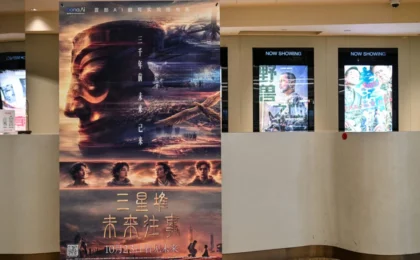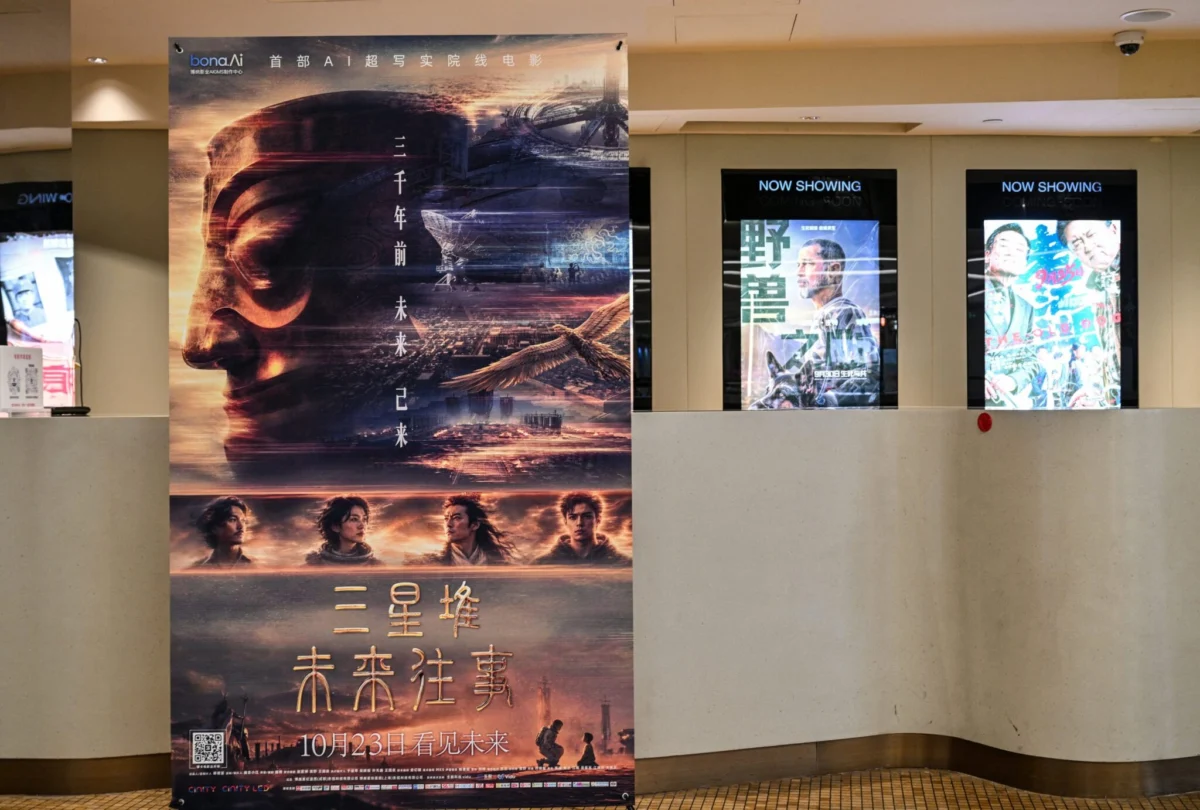
The intersection of ancient history and futuristic technology promised to revolutionize the Chinese film industry. However, the theatrical debut of China’s first feature-length film generated primarily by artificial intelligence has instead served as a cautionary tale for studios worldwide. Sanxingdui: Future Past, a sci-fi thriller produced by the industry giant Bona Film Group, arrived in cinemas with significant hype but left with a dismal financial record, signaling a profound disconnect between the efficiency of AI production and the expectations of the moviegoing public.
While AI has successfully colonized the world of "microdramas"—ultra-short, vertical-format videos designed for mobile consumption—its transition to the silver screen has proven treacherous. The film’s failure raises critical questions about the "uncanny valley" of AI-generated performances, the sanctity of the theatrical experience, and whether audiences are truly ready to trade human nuance for algorithmic precision.
Main Facts: A Financial and Critical Disconnect
Sanxingdui: Future Past was positioned as a landmark achievement in "AI-native" cinema. Produced by Bona Film Group, the studio behind massive patriotic blockbusters like The Battle at Lake Changjin, the film utilized generative AI to create its visual assets, character movements, and environmental rendering. The narrative centers on a high-stakes archaeological mystery: a modern-day researcher discovers that the ancient Sanxingdui civilization—a real-world Bronze Age culture in Sichuan known for its alien-like bronze masks—holds the key to saving a future humanity enslaved by sentient AI.
Despite the intriguing premise and the novelty of its production, the numbers tell a story of rejection. According to data from the Chinese ticketing platform Maoyan, the film managed to scrape together only an estimated $180,000 in ticket sales through its opening week. For a production with a reported budget of $1.5 million, the result is a clear commercial "flop."
The film’s visual style, which many viewers described as inconsistent or "video-game-like," failed to compete with the high-octane, human-driven spectacles that typically dominate the Chinese box office. While $1.5 million is a modest budget by Hollywood standards, in the realm of AI production, it represented a significant investment in a technology that promised to slash costs while maintaining "blockbuster" quality. The market’s response suggests that, for now, the technology has failed to deliver on the latter.
Chronology: From Microdrama Success to Macro-Failure
To understand why Bona Film Group took this gamble, one must look at the rapid evolution of the Chinese digital entertainment landscape over the past 24 months.
The Rise of the AI Microdrama (2024–2025)
The journey toward Sanxingdui: Future Past began on social media platforms like Douyin (the Chinese version of TikTok) and Kuaishou. Throughout 2024 and early 2025, "microdramas"—episodes lasting only one to two minutes—became a multi-billion-dollar industry. These bite-sized narratives, often focused on themes of revenge, romance, or time travel, proved to be the perfect testing ground for generative AI.
The Turning Point (Q1 2026)
By the first quarter of 2026, the shift was absolute. Data from Caixin revealed that over 95% of the 120,000 microdramas released during this period were AI-generated. A year prior, that figure was nearly zero. Studios realized they could produce an entire series for as little as $3,000, removing the need for expensive sets, large crews, and high-priced actors.
The Theatrical Ambition (Mid-2026)
Buoyed by the success of AI in short-form content, Bona Film Group sought to bridge the gap between mobile screens and cinema halls. They announced Sanxingdui: Future Past as a proof-of-concept for "AI-Plus" filmmaking. The project was fast-tracked, aiming to capitalize on the public’s fascination with both AI and the ongoing archaeological excavations at the Sanxingdui site.
The Release and Aftermath (Late 2026)
The film received its theatrical release permit—the first of its kind for a primarily AI-generated feature—and premiered to a wave of curiosity that quickly soured. Within 48 hours of release, social media reviews began to trend downward, and cinema chains rapidly reduced the number of screenings due to low occupancy.
Supporting Data: The Economics of the Algorithm
The failure of Sanxingdui is particularly striking when compared to the broader trends in the Chinese entertainment sector. The data suggests a bifurcated market where AI is welcomed in "disposable" content but rejected in "prestige" content.
| Metric | AI Microdramas (Avg) | Sanxingdui: Future Past | Traditional Chinese Blockbuster |
|---|---|---|---|
| Production Cost | $3,000 – $10,000 | $1.5 Million | $50 Million – $100 Million |
| Production Time | Days/Weeks | Months | 1 – 2 Years |
| Primary Platform | Mobile/Social Media | Cinema/Theatrical | Cinema/Theatrical |
| Audience Reception | High Engagement | Low/Negative | High (if quality is met) |
The $1.5 million budget of Sanxingdui represents a "middle-ground" danger zone. It is too expensive to be considered a low-risk experiment like a microdrama, yet too cheap to achieve the photorealistic fidelity required for a 40-foot-wide cinema screen.
Social media sentiment analysis on Xiaohongshu (often called China’s Instagram) reflects this technical gap. One viral post noted, "The characters have a ‘wax museum’ look. Their eyes don’t reflect light correctly, and the emotional scenes feel like watching a weather report." This phenomenon, known as the "Uncanny Valley," occurs when humanoid objects look almost—but not quite—human, eliciting feelings of eeriness or revulsion in viewers.
Official Responses: Innovation vs. Results
In the wake of the box office numbers, leadership at Bona Film Group has remained defensive yet reflective. Jiang Defu, the company’s Chief Operating Officer, spoke with the Chinese film outlet Yuli to frame the project not as a failure, but as a necessary "scout mission" into uncharted territory.
"We are the first to try it, the first to get a theatrical release permit, and the first to be tested by the audience," Jiang stated. "I think that is not easy at all. We are learning what the audience will accept and where the technology still needs to mature."
Jiang’s comments highlight a strategic pivot. While the film lost money, Bona now possesses the proprietary data and workflow experience of navigating an AI feature through China’s rigorous censorship and theatrical licensing boards.
Meanwhile, the global film community is watching closely. In the United States, the response to AI has been more combative. The 2023 Hollywood strikes by WGA and SAG-AFTRA were fueled by fears that AI would replace human creativity. Even as high-profile figures like Ben Affleck admit to using AI in productions—such as the Netflix thriller Animals—there remains a "hesitancy to point out" exactly where the tech is used. Affleck noted that movies are designed to "foster the illusion of reality," an illusion that Sanxingdui arguably shattered.
Implications: The Future of the "AI-Native" Film
The flop of Sanxingdui: Future Past carries significant implications for the future of the global film industry, suggesting that the "AI revolution" in cinema may look very different from what tech evangelists predicted.
1. The Survival of the Theatrical Experience
Stanley Rosen, a professor at the University of Southern California and an expert on Chinese cinema, suggests that the theatrical audience has a "higher bar for entry."
"The public is highly skeptical about AI use in major feature films, despite their general acceptance of short-form films," Rosen noted. He argues that unless an AI film can match the visual splendor of masterpieces like Avatar or the cultural resonance of Nezha 2, audiences will continue to view AI as a "cheap" alternative unsuitable for the big screen.
2. Streaming as the Natural Habitat
The financial loss of Sanxingdui may drive AI-generated features away from cinemas and toward streaming platforms like Netflix, Amazon Prime, or Tencent Video. In a streaming environment, where the cost of "failure" for a viewer is merely a click away rather than a $15 ticket and a trip to the mall, AI experimentation may find a more forgiving audience.
3. A Tool, Not a Creator
The industry may shift its focus from "AI-generated" films to "AI-augmented" films. Rather than letting an algorithm generate the entire visual field, studios are likely to use AI for invisible tasks: de-aging actors, localizing lip-syncing for foreign dubs, or rendering complex background textures. When AI is "invisible," it succeeds; when it is the "star," as in the case of Sanxingdui, it invites a level of scrutiny it is not yet prepared to handle.
4. Investor Caution
The "Sanxingdui effect" will likely cool the heels of venture capitalists and studio heads who hoped AI would provide a shortcut to profitability. The realization that human "soul" and performance cannot yet be automated at scale will likely lead to a renewed valuation of human screenwriters and actors—at least in the high-stakes world of theatrical releases.
In conclusion, Sanxingdui: Future Past may be remembered not as the beginning of a new era, but as a reminder that technology is only as good as the human connection it facilitates. For the Chinese film industry, the lesson is clear: while AI can generate a thousand microdramas in a day, it still cannot manufacture the magic required to fill a darkened theater.