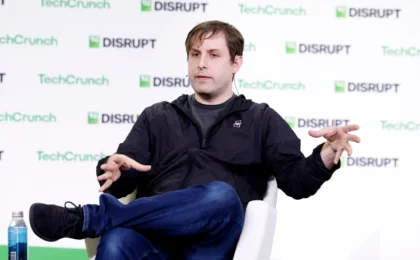
After two days of high-stakes demonstrations, intense grilling by industry veterans, and a showcase of cutting-edge engineering, the field has been narrowed. TechCrunch Disrupt 2026 has reached its climax: the announcement of the five finalists who will compete for the coveted Startup Battlefield Cup and a $100,000 equity-free grand prize.
From the quiet, sterile precision of laboratory-grown intestinal tissue to the high-orbit processing power of satellite computing, these five startups represent the vanguard of the next generation of technology. Whether they are protecting the digital integrity of the internet or automating the factories that build our most essential devices, these companies are moving beyond theoretical concepts into tangible, scalable solutions.
The Crucible: The Road to the Finals
The selection process for the 2026 Startup Battlefield was exhaustive. Over the past 48 hours, 20 startups—selected from a global pool of thousands of applicants—took the stage at Disrupt to demonstrate their products in real-time. The judging panel, comprised of seasoned investors, technology pioneers, and domain experts, did not settle for slide decks; they demanded live, functional proof of concept.
The Battlefield this year was partitioned into four critical pillars of modern innovation: Space and Physical AI, Energy and Manufacturing, Health Tech and Life Sciences, and Enterprise and Security. This thematic structure ensured that the competition wasn’t just a battle of business models, but a competition of engineering prowess and market necessity.
The stakes are high. Beyond the $100,000 in non-dilutive capital, the Startup Battlefield Cup carries immense industry prestige, often serving as a catalyst for future venture capital funding and strategic partnerships. The finals are scheduled to take place tomorrow, Thursday, at 11:30 am Pacific time. Attendees can watch the live showdown on the main stage at Disrupt or tune in via the official livestream.
The Final Five: Disrupting the Status Quo
The following five startups have emerged as the finalists, each offering a distinct solution to a systemic problem in their respective fields.
1. Apate.ai: Turning the Tables on Cybercriminals
Cybercrime is a multi-billion dollar epidemic, but Apate.ai is fighting back by weaponizing empathy—or rather, the simulation of it. Instead of merely hardening firewalls, Apate deploys thousands of sophisticated AI agents designed to act as "honeypots" for scammers.
These agents mimic human behavior with alarming accuracy, adjusting for age, gender, accent, and language. By engaging fraudsters in extended conversations, responding to phishing links, and infiltrating scam-heavy social media groups, Apate gathers intelligence that can be used to disrupt criminal networks. The strategy is to waste the scammer’s most valuable resource: their time. By keeping them occupied with fake leads, Apate prevents them from targeting real victims.
2. Flox Intelligence: Wildlife Conservation Through Edge Computing
Wildlife collisions with human infrastructure—from airports to high-speed railways—are a perennial, costly, and often lethal problem. Traditional deterrents like sirens, lights, and culling have proven either ineffective or ethically problematic.
Flox Intelligence has developed an autonomous "perception system" that acts as a digital fence. Utilizing edge devices equipped with advanced motion sensors and high-resolution cameras, the system is trained on specific wildlife behavior patterns. When an animal approaches a restricted area, the device uses on-device machine learning to identify the species and emits a targeted, species-specific sound to drive the animal away. It is a harmonious blend of ecology and high-tech engineering.
3. Intero Biosystems: Human-Relevant Drug Discovery
The pharmaceutical industry has long relied on animal testing to gauge the safety and efficacy of new drugs—a process that is not only ethically fraught but also frequently inaccurate due to biological differences between species.
Intero Biosystems is changing this paradigm by developing "lab-grown" human intestinal organoids. Unlike previous generations of organ-on-a-chip technology, which only replicated single-cell layers, Intero’s organoids contain a complex, multi-tissue environment that mimics the actual human gut. By providing a human-relevant model, Intero allows researchers to test drugs more accurately, potentially accelerating the development of life-saving medications while drastically reducing the need for animal subjects.
4. Industrial Next: The Future of Agile Manufacturing
Manufacturing is often characterized by rigid, slow-to-reconfigure assembly lines. Industrial Next is dismantling this barrier with its AI-driven, self-contained robotic stations. Powered by proprietary foundation models, these robots bridge the gap between vision, task context, and physical motion.
The startup’s technology allows manufacturers to retool an entire production line in minutes rather than weeks, eliminating the need for traditional, complex manual programming. The agility of this system is already being put to the test: some of their workstations are currently deployed in the manufacturing of one of the world’s most popular smartphones. It is a clear indication that the company is not just a concept, but an active participant in global supply chains.
5. Satlyt: The Distributed Cloud in Orbit
As the number of satellites in low-Earth orbit (LEO) continues to explode, the demand for on-orbit processing is reaching a breaking point. Currently, most spacecraft rely on ground-based flight controllers to solve technical issues, creating a bottleneck that limits autonomy and efficiency.
Satlyt is building the software architecture to decentralize this intelligence. By enabling satellites to share the computational load, Satlyt effectively creates a "distributed cloud" in space. The startup has already successfully flown its software on two demonstration missions, and their next objective is the "holy grail" of space computing: establishing a shared, cooperative network between two independent satellites.
Implications for the Tech Ecosystem
The common thread linking these finalists is the maturation of Artificial Intelligence. In 2026, we are no longer looking at "Generative AI" that simply creates text or images; we are looking at "Actionable AI"—systems that interact with the physical world, defend digital perimeters, and perform biological research.
For the investor community, these finalists signal a shift toward "Deep Tech." There is a renewed appetite for startups that solve difficult, physical-world problems rather than those that simply offer incremental improvements to digital platforms. The transition from software-only models to hardware-software integration—as seen in the work of Industrial Next and Flox Intelligence—is likely to define the next decade of venture capital.
A Final Word from the Stage
As the founders prepare for their final pitch, the pressure is palpable. For many, this represents the culmination of years of R&D, seed funding rounds, and sleepless nights. The judges, who have scrutinized every unit of efficiency and every projected revenue stream, will be looking for one key attribute: scalability.
The winner of the Startup Battlefield Cup will not just walk away with $100,000; they will be crowned as the company most likely to define the coming year. Whether it is a shift in how we manufacture our tools, how we protect our biological health, or how we manage our footprint in space, these five companies are currently in the best position to rewrite the rules of their respective industries.
We invite you to join us tomorrow at 11:30 am Pacific. Witness the final pitches, the deliberation of the judges, and the crowning of the Startup Battlefield 2026 champion. This is not just a competition; it is a glimpse into the architecture of our future.
Disclaimer: When you purchase through links in our articles, we may earn a small commission. This does not affect our editorial independence or the rigorous process used to select the Startup Battlefield finalists.