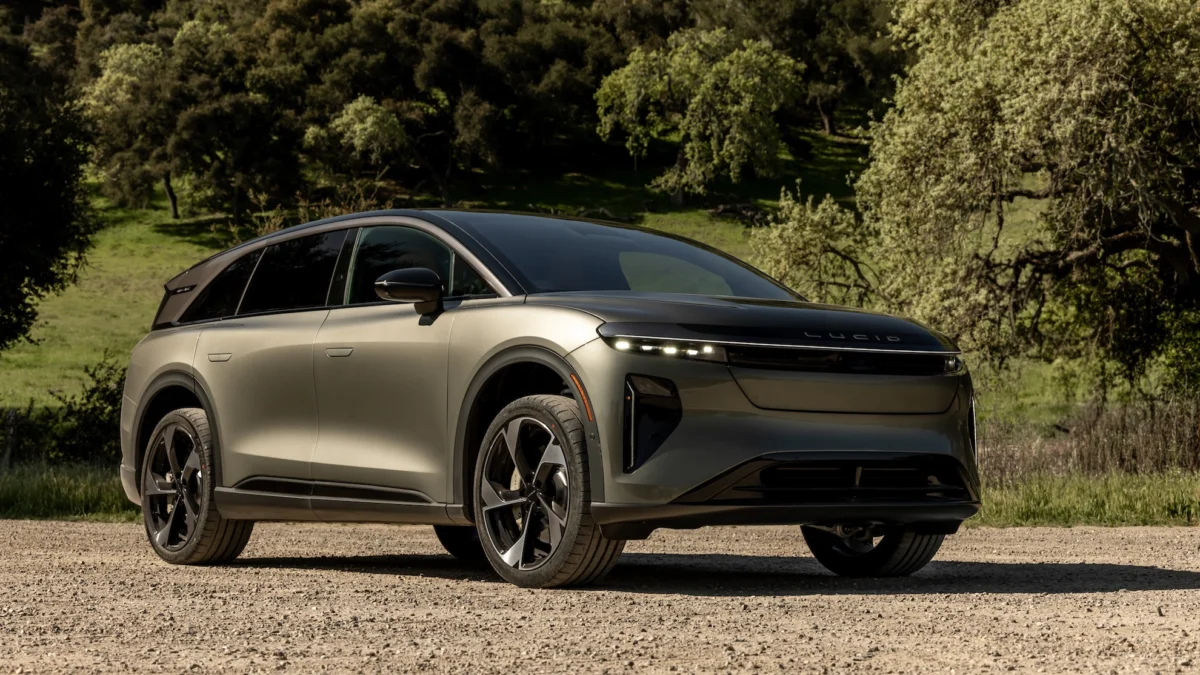
In the volatile landscape of the electric vehicle (EV) industry, few companies find themselves under as much scrutiny as Lucid Motors. Following the release of its third-quarter financial figures this week, the luxury automaker finds itself at a critical juncture. With production numbers hitting their lowest point since the early 2025 rollout of the Gravity SUV, Lucid is currently grappling with a sobering reality: despite its engineering prowess, the company has struggled to translate high-end innovation into mass-market momentum.
As the company attempts a rigorous internal restructuring under new leadership, the contrast between its current output and the ambitious projections of its 2021 public debut has never been more apparent.
The Q3 Snapshot: A Deliberate Slowdown
Lucid Motors reported that it built 2,954 electric vehicles in the third quarter of this year. To the casual observer, this figure may appear modest, but it represents a significant 54% decline compared to the same period a year ago. For the third consecutive quarter, Lucid’s production volume has trended downward, signaling that this is not a temporary operational hiccup but a calculated tactical shift.
According to company communications, Lucid is purposely throttling production. By aligning its assembly lines more closely with current market demand, the automaker aims to prevent the accumulation of unsold inventory—a common pitfall that has plagued other EV startups struggling with capital efficiency.
Deliveries, meanwhile, remained stagnant. The company delivered 3,806 units during the quarter, a figure that remained effectively flat relative to the second quarter and reflected a slight decline from the third quarter of 2025. The persistent gap between production and delivery—where, in five of the last six quarters, Lucid built more vehicles than it successfully sold—highlights the ongoing difficulty the brand faces in capturing a larger slice of the premium EV market.
A Chronology of Contraction
To understand the current state of Lucid Motors, one must look back at the trajectory of the last several years. The company’s journey from a high-flying SPAC darling to a manufacturer attempting a hard-nosed turnaround has been marked by a series of pivots and setbacks.
- 2021: The SPAC Surge: Lucid went public via a merger with a special purpose acquisition company (SPAC), raising $4 billion. At the time, the company’s guidance was brimming with optimism, projecting that it would ship as many as 90,000 EVs in 2024 alone.
- 2025: The Gravity Expansion: Early 2025 marked the start of production for the Gravity SUV, the company’s second major model. While intended to expand the brand’s reach, the production ramp-up coincided with a softening in luxury EV demand.
- 2026: The Napoli Era: Facing mounting pressure, the company installed Silvio Napoli as CEO. Napoli’s tenure has been defined by a "simplification" initiative, aimed at reversing the company’s trend of over-expansion and under-delivery.
- Mid-2026 to Present: This period has been defined by drastic cost-cutting measures, including the elimination of 1,500 staff positions and the dissolution of a second factory shift at the company’s Arizona facility. The primary goal of these measures is to secure $1.4 billion in cash savings, a necessity for a company now focused on survival and long-term sustainability rather than hyper-growth.
Supporting Data: The Competitive Gap
The challenges facing Lucid become even more pronounced when contrasted with the performance of its peers. The EV sector is currently undergoing a "correction," where premium pricing is meeting resistance from a broader consumer base looking for affordability.
Rivian, arguably Lucid’s most direct competitor in the "upstart" category, recently reported its most successful quarter to date. Riding the momentum of its new, more affordable R2 SUV, Rivian shipped nearly 20,000 vehicles in the third quarter—a dramatic increase from the 12,194 units delivered in the second quarter.
While Rivian has managed to find a product-market fit that resonates with a wider audience, Lucid’s current models remain firmly in the high-luxury bracket. The company’s inability to scale its luxury offerings has forced a delay in its third EV, the "Cosmos." Initially slated to be the company’s "mass-market" entry with a starting price under $50,000, the Cosmos is now on the back burner, leaving a significant hole in Lucid’s product portfolio.
Official Responses and the Search for Accountability
During the second-quarter earnings call held this past August, CEO Silvio Napoli offered a refreshingly candid assessment of why Lucid has failed to meet its initial promises. His remarks served as an admission that the company had lost its way by prioritizing speed over execution.
"While there is no question that Lucid brought leading innovations and outstanding products to the market, we have disappointed on several fronts, and for far too long," Napoli stated. "We have not executed consistently. We missed commitments, launched products before they were ready, underinvested in service, responded too slowly to quality issues, and allowed complexity to slow decisions down."
This admission is central to the "simplification" strategy. By cutting the workforce and streamlining leadership, Napoli hopes to clear the bureaucratic hurdles that allowed these issues to fester. Regarding the delayed Cosmos, Napoli maintained a defensive posture, arguing that the company cannot afford to rush another launch. "We will not repeat the mistakes of the past by bringing a product to market before it is ready," he told shareholders.
The Implications: What Lies Ahead for Lucid?
The implications of these developments are twofold: internal survival and external credibility.
Internal Stability
The $1.4 billion in projected cost savings is not merely an accounting target; it is a vital runway. For a company that has burned through billions in capital to build advanced manufacturing facilities, the ability to operate lean is now the primary metric of success. The removal of the second shift in Arizona is a painful but necessary step toward ensuring that the company’s fixed costs do not overwhelm its current revenue streams.
Market Credibility
Lucid faces a massive branding challenge. When a company misses its public guidance by as wide a margin as Lucid has—promising 90,000 units for 2024 while struggling to deliver a fraction of that—it loses the trust of institutional investors. To regain that, Lucid must demonstrate that it can achieve consistent, predictable production numbers.
The focus on the Cosmos remains the ultimate "make or break" moment for the firm. If Lucid can eventually bring a $50,000 vehicle to market that maintains the brand’s reputation for technical excellence without the quality control issues that marred earlier launches, it may still have a path to relevance. However, with every quarter that passes, the competition from legacy automakers and established EV players like Tesla and Rivian grows more intense.
A New Philosophy
Ultimately, the narrative of Lucid Motors is shifting from one of "EV disruptor" to "disciplined manufacturer." Whether this shift has come in time to save the company remains the central question of its fiscal future. For now, Silvio Napoli and his team are banking on the idea that slower, more deliberate growth is the only way to avoid the fate of many other automotive startups that failed to survive the transition from concept to scale.
As the industry enters the final quarter of the year, all eyes will be on whether the "simplification" efforts begin to stabilize the balance sheet, or if the lack of new, affordable product will continue to leave Lucid on the sidelines of the broader EV transition.