GLOUCESTERSHIRE, United Kingdom — In a move that signals a significant tactical reorganization of American airpower in Europe, the United States Air Force has completed the withdrawal of its strategic bomber fleet from RAF Fairford. The departure follows a high-stakes investigation into a foiled terror plot targeting the installation, an incident that British intelligence has linked directly to the ongoing conflict with the Islamic Republic of Iran.
The redeployment, confirmed by Pentagon officials and verified by independent aviation monitors, marks a pivotal moment in a war that President Donald Trump once promised would be a "matter of weeks," but which has now entered a more complex and dangerous phase of hybrid warfare and regional escalation.
Main Facts: The Sunday Departure and the Security Breach
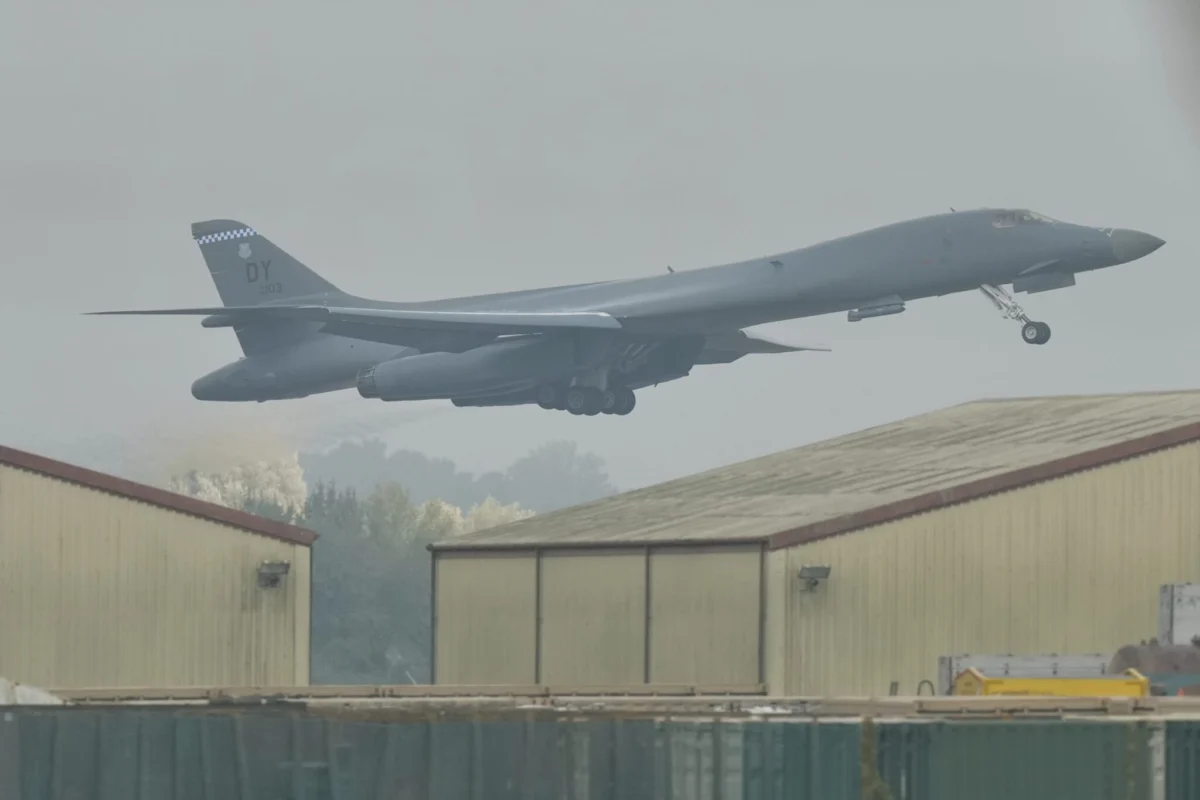
On Sunday morning, aviation enthusiasts and local residents near the Gloucestershire countryside witnessed a mass exodus of heavy metal. A host of B-1B Lancer supersonic bombers, accompanied by B-52H Stratofortresses, were observed taking off from the two-mile-long runway at RAF Fairford. Their destination: their respective home bases in the continental United States, including Dyess Air Force Base in Texas and Barksdale Air Force Base in Louisiana.
The decision to bring the bombers home was not a scheduled rotation. According to a senior Pentagon official speaking on the condition of anonymity, the move was accelerated by "credible and specific" security threats. These threats culminated in a security incident at the base in late September and the subsequent arrest of a dual British-Iranian national in central London last week.
The suspect, whose identity remains withheld under British anti-terrorism laws, is believed to have been the linchpin of a cell plotting a direct kinetic strike or sabotage operation against the Fairford facility. In total, six individuals have been taken into custody. While all have been released on bail, the investigation remains active, and the vulnerability of the base—located 100 miles west of London—has become a primary concern for U.S. European Command (EUCOM).
RAF Fairford has long served as the U.S. Air Force’s primary forward operating location for heavy bombers in Europe. Since the "opening days" of the war on Iran, the base has been a beehive of activity, serving as the launch point for long-range sorties into the Middle East. However, the proximity of the base to civilian populations and the recent infiltration attempts have forced a recalculation of the risk-to-reward ratio of maintaining a permanent bomber presence on British soil.
Chronology: From Deployment to Withdrawal
The timeline of the current crisis reveals a steady escalation of hostilities that has spilled over from the borders of Iran into the heart of Western Europe.
- Early Spring: Following the commencement of hostilities, the U.S. Air Force deployed a massive "Bomber Task Force" to RAF Fairford. This included a mix of B-52s for their massive payload capacity and B-1Bs for their low-level, high-speed penetration capabilities.
- Summer Months: President Trump repeatedly tells the American public that the campaign against Tehran is reaching its conclusion, stating the war would "last a matter of weeks." During this period, Fairford-based bombers conducted frequent missions over Iranian territory, targeting command-and-control centers and nuclear infrastructure.
- Late September: A "security incident" occurs at the perimeter of RAF Fairford. While initial reports were vague, it is now understood that individuals attempted to breach the base’s high-security fencing, prompting a lockdown.
- Last Week: British counter-terrorism police arrest a dual British-Iranian national in London. This arrest leads to five further detentions. The investigation uncovers plans for a coordinated attack on the airbase, intended to disable the U.S. bomber fleet on the ground.
- Saturday: President Trump, speaking to reporters before an Ohio rally, acknowledges the shifting nature of the conflict, stating that Iran has been "decimated" but warning that the remaining phase of the war will be settled "the easy way or the hard way."
- Sunday: The Military Air Tracking Alliance and other observers confirm the departure of the B-1 and B-52 fleets from Fairford, effectively ending the continuous bomber presence at the base for the first time since the war began.
Supporting Data: The Shifting Chessboard of Air and Sea Power
While the withdrawal from Fairford might appear to be a retreat, military analysts suggest it is a shift toward a more "dynamic force employment" model. The U.S. is not reducing its overall combat power; rather, it is moving its assets to less vulnerable or more mobile platforms.
The Naval Buildup
As the land-based bombers depart England, the U.S. Navy is surging its presence in the Persian Gulf and North Arabian Sea. A U.S. official confirmed on Thursday that the USS Theodore Roosevelt (CVN-71) aircraft carrier is en route to the region. Joining it is the USS Makin Island (LHD-8) amphibious readiness group, which brings with it a formidable force of 7,000 sailors and 2,000 Marines, along with F-35B Lightning II stealth fighters.
By the end of October, the Pentagon expects to have three carrier strike groups in the region. This provides the U.S. with a floating, sovereign airfield that is significantly harder for Iranian-linked terror cells to target than a fixed base in the English countryside.
Historical Context of RAF Fairford
To understand the gravity of the withdrawal, one must look at Fairford’s history. It was the only European base capable of supporting the B-52 during the Cold War and played a critical role in Operation Desert Storm, Operation Allied Force (Kosovo), and the 2003 invasion of Iraq. The decision to vacate the base during an active conflict is almost unprecedented in the modern era and highlights the severity of the "hybrid threat" posed by Iranian proxies.
Official Responses: Rhetoric and Denials
The political fallout from the security breach and the subsequent withdrawal has been swift.
The White House:
President Trump’s comments on Saturday suggested a leader frustrated by the persistence of the Iranian regime. "We have decisions that I’ll make about Iran," Trump said. "Iran’s been decimated. So the only question is—it’ll either be the easy way, or the hard way." His rhetoric suggests that while the bombers are leaving the UK, the kinetic phase of the war is far from over.
Downing Street and British Authorities:
UK officials have been more specific regarding the nature of the threat. Intelligence reports suggest that Iran-linked proxies have been behind a string of arson attacks and intimidation campaigns across Britain, particularly targeting Jewish communities. A spokesperson for the Home Office stated that the investigation into the Fairford plot has "clear links to Tehran," describing it as part of a broader strategy to "sow fear and destabilize the U.K. domestic environment" in response to the Middle Eastern conflict.
Tehran’s Stance:
The Iranian Ministry of Foreign Affairs has officially denied any involvement in the Fairford plot, dismissing the allegations as "baseless fabrications" intended to justify further American aggression. However, the regime has remained consistent in its doctrine: any foreign base used to launch strikes against Iranian soil is a "legitimate target" for the Islamic Revolutionary Guard Corps (IRGC) and its global network of proxies.
Implications: A New Era of Hybrid Warfare
The withdrawal from RAF Fairford carries several long-term implications for the U.S.-UK "Special Relationship" and the future of global conflict.
1. The Vulnerability of the "Rear Guard"
The Fairford incident proves that in modern warfare, there is no such thing as a "safe" rear area. Long-range strategic assets stationed thousands of miles from the front lines are now vulnerable to asymmetrical attacks by radicalized individuals or state-sponsored sleeper cells. This will likely lead to a massive overhaul of security protocols at "shared" bases like RAF Mildenhall, RAF Lakenheath, and Ramstein Air Base in Germany.
2. The Domestic Political Burden
For President Trump, the withdrawal complicates the domestic narrative of the war. Having promised a quick victory, the sight of American bombers returning home not in triumph, but due to security threats in an allied country, may be seized upon by political opponents. However, the administration will likely frame this as a "mission accomplished" for the land-based fleet, transitioning to a more agile naval-led campaign.
3. The Future of RAF Fairford
Questions now remain regarding the future utility of RAF Fairford. If the U.S. Air Force deems the base too difficult to defend against hybrid threats, it may lose its status as a premier forward operating location. This would be a blow to the local economy in Gloucestershire and a shift in the strategic geography of NATO’s air defense.
4. Expansion of Iranian Proxy Tactics
The UK’s warning that Tehran could expand its targets if the conflict continues suggests that the Fairford plot was merely a "proof of concept." If Iran can successfully force the redeployment of a U.S. bomber fleet through domestic subversion and terror plots, they may apply the same pressure to other European allies, attempting to drive a wedge between Washington and its NATO partners.
As the B-1s and B-52s cross the Atlantic, the war on Iran enters a period of high-tension uncertainty. The "hard way" that the President alluded to may not just involve more strikes in the Middle East, but a grueling, clandestine struggle against an enemy that has shown it can reach across oceans to strike at the heart of the Western military machine. For now, the skies over Fairford are quiet, but the silence is far from peaceful.