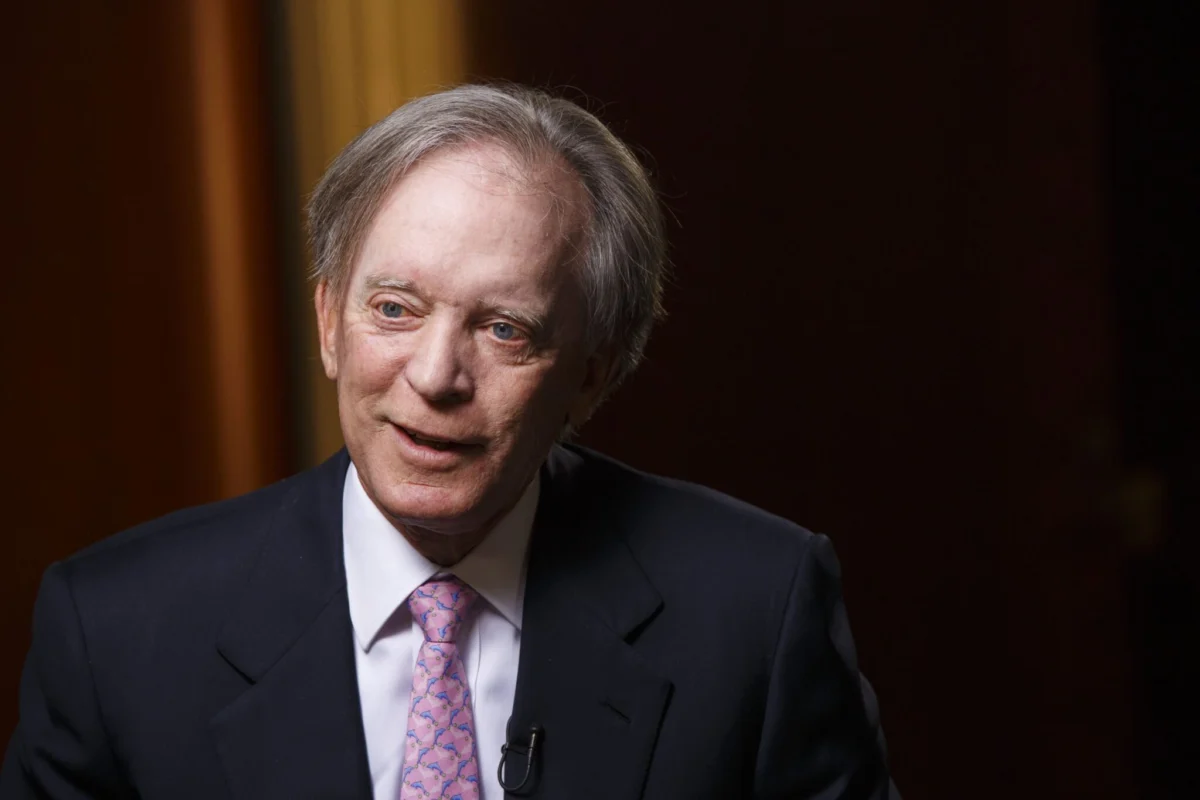
In a financial landscape increasingly defined by volatility and unprecedented debt levels, one of the most influential figures in the history of fixed-income investing has issued a stark warning. Bill Gross, the co-founder of PIMCO and the man long celebrated as the "Bond King," has signaled that the era of reliable bond returns and traditional market stability may be coming to a definitive end.
In a comprehensive assessment of the global economy, Gross cautioned that the total volume of government, mortgage, and corporate credit has ballooned to a staggering $84 trillion. This "lopsided" balance sheet, he argues, has created a systemic fragility that threatens future economic growth and necessitates a fundamental shift in how investors approach capital preservation.
Main Facts: The "Preserve and Protect" Mandate
Bill Gross’s recent missive, primarily detailed in a Financial Times op-ed, serves as a sharp pivot from the strategies that built his multi-decade legacy. Gross, who famously revolutionized bond investing by moving away from passive "coupon clipping" toward aggressive active trading, is now advising investors to largely abandon the asset class that made him famous.
The core tenets of Gross’s current outlook include:
- Avoidance of Long-Term Debt: Gross explicitly warned against holding longer-term bonds, suggesting that the risk-to-reward ratio has become unfavorable as yields face upward pressure from fiscal instability.
- The T-Bill Sanctuary: In a rare endorsement of cash equivalents, Gross identified one-year Treasury bills—currently yielding approximately 4.55%—as the only viable "bond" investment in the current climate.
- Equity Skepticism: With major indices hitting record highs, Gross warned that higher yields will eventually contract profit margins, making "what you are used to" in the stock market a relic of the past.
- The Debt-to-GDP Crisis: Gross pointed out that U.S. federal debt has reached 100% of the Gross Domestic Product (GDP), a level historically reserved for the aftermath of major world wars, yet occurring now during a period of nominal peacetime.
Gross’s current motto, "Preserve and protect," reflects a defensive posture born from the belief that the "AI sector’s debt boom" and government profligacy have created an environment where volatility is the only certainty.
Chronology: From the Rise of PIMCO to the Era of Peak Debt
To understand the weight of Gross’s warning, one must look at the evolution of the bond market over the last forty years—a period during which Gross was often the primary architect of market sentiment.
The Active Trading Revolution (1970s–2000s)
Before Gross co-founded PIMCO in 1971, bond investing was a "sleepy" corner of finance. Investors typically bought bonds and held them to maturity. Gross changed this by treating bonds as tradable commodities, capitalizing on price fluctuations and interest rate shifts. For decades, this approach yielded returns that far outpaced the broader market, earning him the "Bond King" title.
The Post-2008 Transformation
Following the 2008 financial crisis, the bond market underwent a structural shift. Central banks, led by the Federal Reserve, became the primary buyers of debt through Quantitative Easing (QE). This suppressed volatility and kept yields artificially low, creating a "goldilocks" environment for both stocks and bonds.
The 2023–2024 Inflection Point
The chronology took a dark turn following the global pandemic and the subsequent inflationary spike. As central banks began raising rates to combat inflation, the decades-long bond bull market ended. Since the onset of geopolitical tensions, including the conflict involving Iran, 10-year Treasury yields have soared by more than 100 basis points, recently touching their highest levels in 24 years. This shift marks the transition from a central-bank-supported market to one dominated by more mercurial private actors.
Supporting Data: The Anatomy of a Lopsided Economy
Gross’s warnings are backed by a series of data points that illustrate a decoupling of debt from sustainable productivity.
The $84 Trillion Shadow
The $84 trillion figure cited by Gross represents the combined weight of U.S. government obligations, corporate debt, and household mortgages. According to Gross, while this debt fueled immediate post-pandemic growth, it has become a drag on the future. He notes that "too much debt can lead to too much risk," particularly when productivity cycles underperform.
The Rise of the Basis Trade
A significant factor in current market instability is the changing ownership of U.S. debt. Historically, "sticky" investors like foreign central banks and domestic mutual funds held the lion’s share of Treasuries. Today, price-sensitive hedge funds have filled the void.
Data shows that hedge funds’ share of total Treasury holdings has nearly doubled since 2023, now standing at 8.5%. Much of this is driven by the "basis trade"—a highly leveraged strategy where funds exploit tiny price differences between Treasury bonds and Treasury futures. While this provides liquidity, it also introduces systemic risk; if funding conditions tighten, these funds may be forced to unwind positions simultaneously, leading to a "flash crash" in the world’s most important safe-haven asset.
Valuations and the AI Anomaly
Gross is particularly skeptical of the current tech-driven equity rally. He notes that the AI sector’s debt boom is an anomaly by historical standards. For Gross, the math is simple: unless "hyperscale" AI companies maintain a price-to-earnings (P/E) ratio of less than 20, they are likely overvalued. As yields remain elevated, the cost of servicing the debt used to fuel these tech expansions will inevitably eat into corporate profit margins.
Official Responses and Expert Perspectives
The financial community has reacted to Gross’s assessment with a mixture of agreement and concern regarding the mechanics of the "new" bond market.
Joe Maher, a markets economist at Capital Economics, recently echoed Gross’s concerns regarding the role of hedge funds. In an August research note, Maher warned that the "safe-haven" reputation of sovereign bonds is under threat.
"In a risk-off environment, safe-haven flows into sovereign bonds may be offset by hedge funds unwinding their leveraged trading positions as funding conditions tighten," Maher wrote. He further emphasized that because hedge funds have no legal obligation to act as market makers, they are likely to withdraw liquidity exactly when the market needs it most—during times of extreme stress.
Furthermore, Maher warned of "cross-asset contagion." If a selloff begins in the stock market, hedge funds might be forced to dump their bond positions to cover equity losses, creating a feedback loop where both stocks and bonds fall simultaneously—destroying the "60/40" portfolio diversification that investors have relied on for half a century.
While Treasury officials have generally defended the resilience of the market, the sheer volume of issuance required to fund the U.S. deficit has led to "underwhelming" auctions in recent months, suggesting that the "Bond King’s" fears of a lack of buyers may be manifesting in real-time.
Implications: Navigating the "End of What You Are Used To"
The implications of Gross’s warning suggest a fundamental restructuring of investment portfolios. If the benchmark 10-year Treasury bond is no longer a stable anchor, the "standard" investment playbook is effectively obsolete.
1. The Erosion of the Safe Haven
For decades, Treasuries were the "risk-free" asset. Gross’s analysis implies that they have now become "risk-bearing" assets due to price volatility and the potential for liquidity dry-ups. Investors may need to look toward short-term instruments (like the 1-year T-bill) or alternative hard assets to find true safety.
2. Threats to Traditional Income Stocks
Gross even cast doubt on traditional "widow and orphan" stocks. While telecommunications giants like Verizon and AT&T offer attractive dividends, Gross pointed out that their core businesses face existential threats from disruptive technologies like SpaceX’s Starlink. This suggests that even "defensive" equity sectors are no longer safe from the broader macro and technological shifts.
3. Higher Volatility as the New Normal
The most significant implication is the permanence of volatility. Gross warned investors to be prepared for the end of the "steady-state" markets of the 2010s. With federal debt at 100% of GDP, the government has less "fiscal space" to react to the next economic downturn, potentially leading to more erratic policy responses and further market swings.
4. The Selective Opportunity in Discounted Funds
Gross did offer a small glimmer of hope for value hunters, noting that some income funds trading at a discount to their net asset values (NAV) might offer opportunities. However, he cautioned that these, too, are sensitive to interest rate surprises.
Conclusion: A Royal Warning
When the "Bond King" tells the world to stop buying bonds, the financial community listens. Bill Gross’s assessment of the $84 trillion credit landscape is not merely a critique of current prices, but a structural warning about the architecture of global finance.
The transition from a market supported by central banks to one dominated by leveraged hedge funds and "hyperscale" debt has created a precarious environment. As Gross concludes, the priority for the modern investor has shifted from the pursuit of aggressive growth to the urgent need to "preserve and protect." In this new era, the strategies that defined the last forty years may no longer be enough to navigate the volatility of the next four.