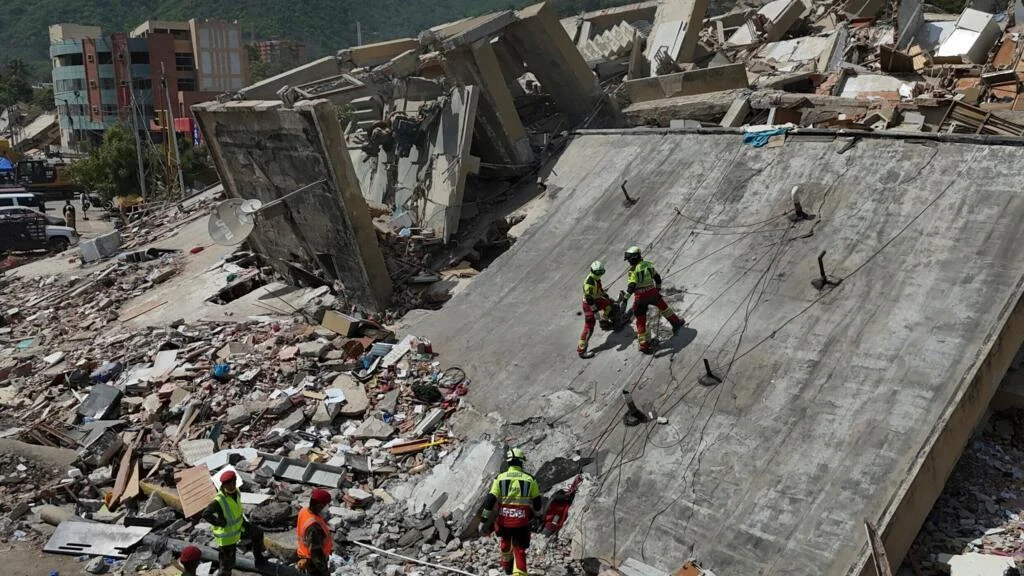
LA GUAIRA, VENEZUELA – The coastal state of La Guaira has become the epicenter of a harrowing humanitarian emergency. As the sun set on Sunday, rescue teams from across the globe continued a desperate, rhythmic assault on the mountains of pulverized concrete and twisted rebar that were once homes, schools, and offices.
Following a pair of devastating earthquakes that struck the nation mid-week, the official death toll has climbed to 1,450. However, as the 72-hour "golden window" for survival closes, a grim reality sets in: the true scale of the catastrophe remains obscured by thousands of missing persons, a shattered infrastructure, and a political landscape as fractured as the earth itself.
The Chronology of a National Tragedy
The nightmare began on Wednesday, when twin tremors—magnitudes 7.2 and 7.5—ripped through the coastal regions north of Caracas. The quakes struck with terrifying intensity, leveling 774 buildings in La Guaira alone and turning densely populated neighborhoods into piles of dust and debris.
By Thursday, the initial shock gave way to the frantic reality of search-and-rescue operations. Civilian volunteers, often working with their bare hands or rudimentary tools, led the first wave of response. They were later joined by over 2,600 international rescue personnel, including specialized teams from Switzerland, Mexico, and the United States.
Friday and Saturday were marked by a series of agonizingly slow recoveries. While the government confirmed the rescue of 33 people by Saturday evening—a figure that included several young children—these small victories were punctuated by hundreds of powerful aftershocks that kept the ground unstable and the survivors in a state of constant, traumatized vigilance.
As of Sunday, the focus shifted from pure search-and-rescue to a hybrid operation involving the establishment of temporary camps for the 12,721 officially displaced persons.
Supporting Data: The Magnitude of Loss
The statistics emerging from the disaster zones illustrate the scale of the devastation. The U.S. Geological Survey (USGS) has issued sobering projections, warning that the final death toll could eventually surpass 10,000, which would rank this event among the most lethal seismic disasters in Latin American history.
Key Figures as of Sunday:
- Confirmed Deaths: 1,450
- Confirmed Injured: 3,150
- Buildings Collapsed: 774
- Displaced Persons: 12,721
- Missing Persons: While government estimates remain in the hundreds, an opposition-managed tracking portal reports nearly 50,000 individuals listed as unaccounted for, highlighting a widening gap between official narratives and the reality on the ground.
The disruption to the nation’s lifeblood—its energy sector—has compounded the misery. On Sunday, workers confirmed that the Amuay refinery, the nation’s largest at 645,000 barrels per day, was forced to cease operations following a widespread power outage in the western Falcon state. While officials claim 75% of power has been restored in La Guaira, the broader national grid remains dangerously fragile.
The Golden Window: Scientific and Human Perspectives
For the international rescue contingents, the clock is the ultimate adversary. Sebastian Eugster, leader of the Swiss rescue team, noted the cruel mathematics of disaster response. "There exists a window of roughly three days, 72 hours, where the probability afterwards decreases that you can save people alive," he explained.
His team, supported by eight search-and-rescue dogs, has successfully located multiple survivors. However, the emotional toll on rescuers is immense; Eugster admitted that there were instances where they detected life, but were unable to breach the debris in time to prevent tragedy.

Despite these failures, moments of profound relief have periodically pierced the gloom. On Sunday, a father and his son were pulled from a collapsed structure in a dramatic operation. Earlier, the U.S. State Department shared footage of an infant being carefully extracted from rubble, while a Colombian team saved an 11-year-old boy named Moises. Trapped three meters deep, Moises was recovered with a broken arm; he is now a symbol of the struggle, even as the nation mourns the loss of his mother and sister, who did not survive the collapse.
Official Responses and Political Friction
The government, led by interim President Delcy Rodriguez, finds itself under intense scrutiny. Rodriguez, who ascended to power following the January ouster of the previous administration, has attempted to project a sense of stability and control.
"Rescue and recovery efforts are ongoing. Today, we have recovered people alive and, therefore, operations are not being suspended. We always maintain hope," Rodriguez stated during a press briefing on Sunday. She announced the formation of a presidential commission tasked with assessing the habitability of standing buildings, a move aimed at preventing further loss of life from structural failure.
However, the administration’s response has not been without controversy. While the government initially welcomed civilian volunteers, they later restricted access to key roads in La Guaira, citing the need to clear congestion for emergency vehicles. This decision has sparked accusations of bureaucratic interference, with many citizens expressing frustration at what they perceive as a sluggish or exclusionary official response.
The political stakes are further complicated by the planned return of opposition leader and Nobel Peace Prize winner Maria Corina Machado. Having lived in hiding or abroad since the disputed 2024 elections, Machado’s insistence on returning during the height of the crisis has reportedly caused friction within Washington. U.S. officials, while committed to providing massive humanitarian aid—including a pending funding package of hundreds of millions of dollars—have signaled that her return could destabilize an already volatile security environment.
Implications: A Nation at a Crossroads
The earthquake is not merely a natural disaster; it is a stress test for a country already mired in deep political and economic crisis. The collapse of 774 buildings has exposed decades of poor urban planning and insufficient construction standards, legacies of a state that has prioritized political survival over public safety infrastructure.
The economic implications are equally dire. With the shutdown of the Amuay refinery and the destruction of local commerce in the coastal states, Venezuela faces a potential deepening of its economic isolation. The international community, led by the United States, has pledged significant financial support, yet the challenge will be ensuring that these resources reach the victims rather than being lost in the friction of political infighting.
As the search transitions into the recovery phase, the government faces a Herculean task: managing a massive housing crisis, restoring a grid that was already failing before the first tremor, and maintaining the trust of a population that is increasingly looking to independent sources for information and support.
For the families standing on the edges of the debris, clutching photographs of loved ones, the politics are secondary to the silence. As the heavy machinery continues to hum and the search dogs continue to sniff the ruins, the nation waits—not for a political resolution, but for the next sign of life, a brief reprieve in a landscape defined by loss.