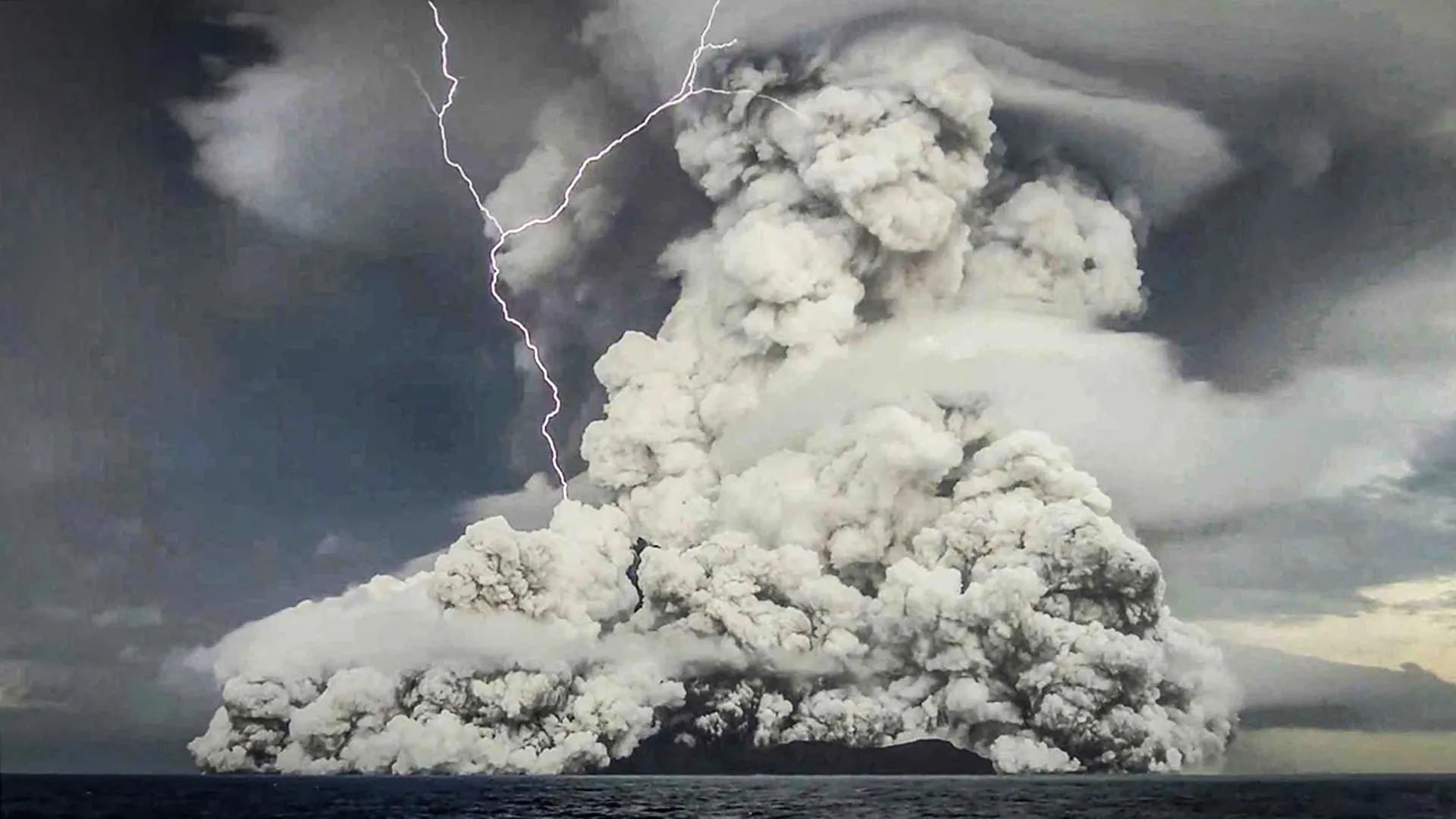
In January 2022, the Hunga Tonga-Hunga Ha’apai volcano in the South Pacific unleashed one of the most violent geological events in recorded history. The eruption, which sent a plume of ash and water vapor soaring into the stratosphere, was an awe-inspiring display of raw planetary power. However, as the dust settled, researchers began to uncover a secondary, more enigmatic phenomenon buried within the data: the massive eruption plume was not just a source of pollution, but a highly efficient, self-regulating chemical laboratory capable of neutralizing its own methane emissions.
This discovery, published in Nature Communications, has sent shockwaves through the climate science community. It suggests that nature possesses chemical pathways for atmospheric remediation that we are only just beginning to understand—pathways that could theoretically be harnessed to address the escalating threat of global warming.
The Chronology of a Discovery
The story of this discovery began not on the ground, but in orbit. As the plume from Hunga Tonga-Hunga Ha’apai circled the globe, satellite instruments—specifically the TROPOMI sensor aboard the European Space Agency’s Sentinel-5P—began picking up a signal that caught researchers off guard: a massive, persistent spike in formaldehyde.
Tracking the Fingerprint
Formaldehyde is a notoriously short-lived chemical. In the atmosphere, it serves as a transient "intermediate" product—a chemical footprint left behind during the breakdown of methane. Because formaldehyde vanishes within a matter of hours, its presence in such high concentrations over a ten-day period was a smoking gun. It indicated that a continuous, massive chemical reaction was occurring within the volcanic cloud, actively dismantling methane molecules as the plume drifted toward South America.
Dr. Maarten van Herpen, lead author of the study from Acacia Impact Innovation BV, noted the shock of the research team: "When we analyzed the satellite images, we were surprised to see a cloud with a record-high concentration of formaldehyde. Because formaldehyde only exists for a few hours, this showed that the cloud must have been destroying methane continuously for more than a week."
The Chemical Mechanism
The process identified by the team hinges on an unlikely trio: volcanic ash, salty seawater, and intense solar radiation. The eruption, occurring beneath the ocean’s surface, acted as a massive hydraulic pump, blasting immense quantities of seawater and mineral-rich ash into the stratosphere.
Once in the upper atmosphere, these components formed "iron salt aerosols"—microscopic particles that, when struck by sunlight, trigger the release of reactive chlorine atoms. Chlorine is a potent oxidant; it attacks methane molecules with aggressive efficiency, breaking them down into simpler components. This process, previously observed in dust storms over the Atlantic, was unexpectedly found to be functioning at the extreme altitudes and temperatures of the stratosphere, providing a blueprint for potential atmospheric geoengineering.
Supporting Data: By the Numbers
To understand the scale of this natural "methane scrubbing," the research team performed a rigorous accounting of the emissions versus the destruction rate.
- The Volcanic Output: The eruption released approximately 300 gigagrams (Gg) of methane—a volume equivalent to the annual methane output of two million cows.
- The Destruction Rate: Simultaneously, the chemical reaction within the plume neutralized approximately 900 megagrams (Mg) of methane per day.
- Atmospheric Impact: Over the course of the ten-day period tracked by satellite, the plume effectively neutralized a significant portion of the methane released during the event, showcasing a "self-cleaning" effect previously absent from climate models.
This data is transformative because it suggests that the global "methane budget"—the ledger used by scientists to track how much of the gas enters the atmosphere and how much leaves it—has been missing a critical variable: volcanic and mineral dust.
Official Responses and Scientific Context
The implications of this study are profound, particularly regarding how we calculate the longevity of greenhouse gases. The research team, a collaborative effort involving experts from the University of Copenhagen, the Royal Netherlands Meteorological Institute, and the Royal Belgian Institute for Space Aeronomy, emphasized that their findings necessitate a recalibration of climate data.
Rethinking the Global Methane Budget
"We now know that atmospheric dust—for example from a volcanic eruption—impacts the methane budget," says Professor Matthew Johnson of the University of Copenhagen. "Because dust has not previously been taken into account, it is important that we correct the data on which these estimates are based."
For climate researchers, this means that some of the natural "sinks" that remove methane from the atmosphere have been underestimated. By failing to account for how aerosols interact with methane, current models may be missing a piece of the puzzle regarding how quickly the planet can recover from methane-heavy events.
The Satellite Challenge
The successful identification of this process was made possible only through the Herculean efforts of Dr. Isabelle De Smedt and her team, who had to push the TROPOMI instrument to its absolute limit. Retrieving data from a stratospheric volcanic plume required correcting for interference from high concentrations of sulfur dioxide—a feat that, according to the researchers, was "far outside the instrument’s standard operating conditions." The fact that they were able to confirm the formaldehyde signal validates satellite monitoring as a reliable tool for observing real-time atmospheric chemistry on a global scale.
Implications: The "Emergency Brake" on Climate Change
Methane is a potent, albeit short-lived, greenhouse gas. While it remains in the atmosphere for only about a decade, its heat-trapping capacity is roughly 80 times that of carbon dioxide over a 20-year period. This creates a unique opportunity: by reducing methane now, we can achieve rapid, near-term cooling, effectively hitting an "emergency brake" on the accelerating climate crisis.
Can We Mimic the Volcano?
The most provocative aspect of the Hunga Tonga study is the possibility of replicating this process deliberately. If chlorine-based aerosols can be deployed to neutralize methane, we might possess a viable, albeit complex, tool for atmospheric restoration.
However, the scientific community is moving with extreme caution. The proposal of "atmospheric methane removal" is fraught with ethical and environmental risks. Deliberately altering the stratosphere could have unforeseen consequences, from damaging the ozone layer to disrupting weather patterns.
"It’s an obvious idea for industry to try to replicate this natural phenomenon—but only if it can be proven to be safe and effective," Professor Johnson notes. "Our satellite method could offer a way to help figure out how humans might slow global warming."
A Tool, Not a Cure
It is vital to distinguish between methane removal and carbon dioxide reduction. While methane reduction acts as a temporary relief valve, it does not address the fundamental issue of long-term climate stability. Carbon dioxide remains in the atmosphere for centuries; therefore, any strategy involving methane removal must be paired with aggressive decarbonization.
Conclusion: Lessons from the Stratosphere
The eruption of Hunga Tonga-Hunga Ha’apai was a destructive force of nature, yet it provided a masterclass in atmospheric chemistry. By demonstrating that the Earth possesses latent mechanisms to break down methane, the event has opened a new frontier in climate research.
As we move forward, the focus will shift from observation to investigation. Can we harness the power of iron salt aerosols safely? Can we monitor the efficacy of such interventions using the same satellite technology that unveiled this volcanic secret? These are the questions that will define the next decade of climate science.
For now, the lesson remains clear: the atmosphere is a dynamic, reactive system. While we have spent decades focusing on the sources of pollution, the Hunga Tonga event reminds us that understanding the "sinks"—the natural processes that remove these pollutants—may be equally critical in the race to preserve a stable climate for the future. With the help of advanced satellite monitoring and a deeper understanding of atmospheric chemistry, the "emergency brake" on global warming might finally be within our reach.