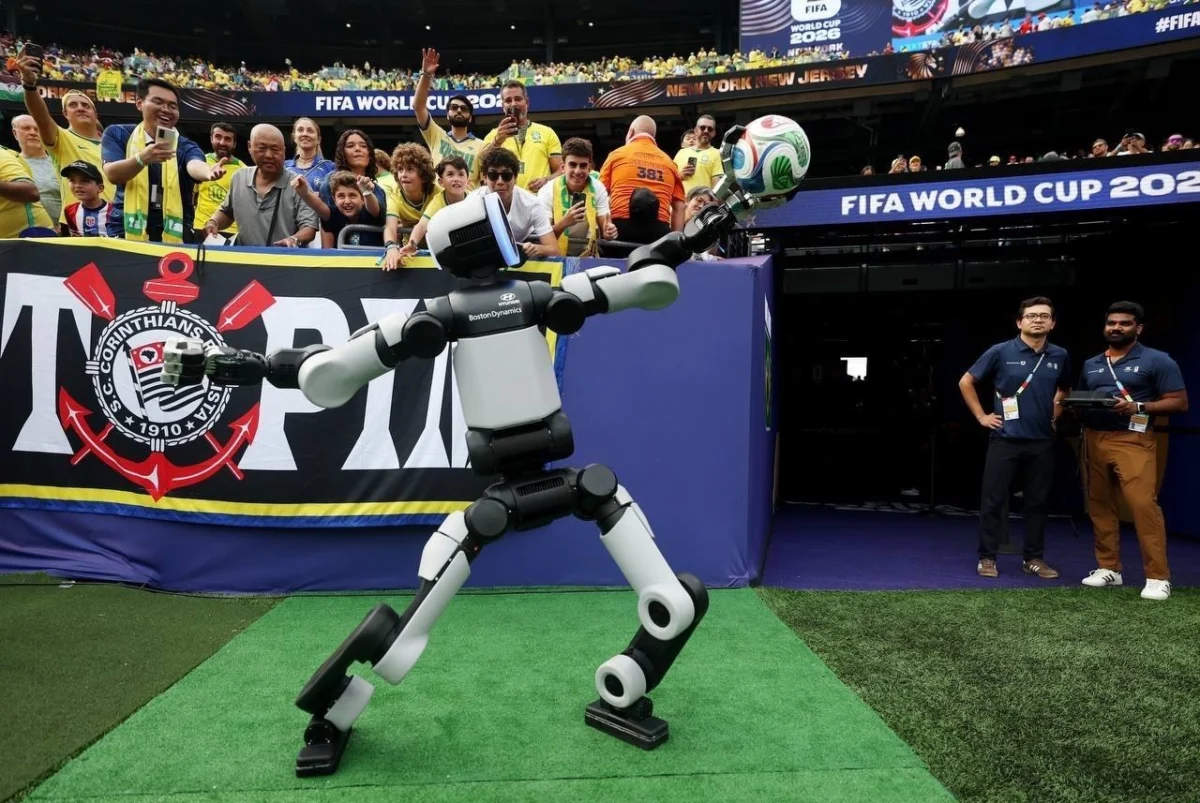
NEW YORK/NEW JERSEY — The 80,000 spectators packed into the New York/New Jersey Stadium for the FIFA World Cup Round of 16 match between Brazil and Norway expected a display of world-class athleticism. What they did not expect was a glimpse into the future of human-machine interaction. At halftime, in a moment that shattered historical precedents for the world’s most-watched sporting event, a six-foot-tall humanoid robot named Atlas strode onto the pitch.
Far from a stiff, mechanical novelty, Atlas moved with a fluid, uncanny grace. It performed a series of iconic goal celebrations—mimicking the signature styles of Harry Kane, Erling Haaland, Matheus Cunha, and Son Heung-min—to the roar of the crowd. The demonstration culminated in a symbolic gesture: Atlas walked to the center circle, turned to the referee, and delivered the match ball for the second half.
This was not merely a marketing stunt; it was the public unveiling of the fifth-generation Atlas, a fully electric humanoid built by Boston Dynamics and backed by the industrial might of the Hyundai Motor Group. It marked the first time a humanoid robot of this sophistication has operated autonomously in such a high-pressure, unscripted environment, signaling a pivot point for the robotics industry.
Main Facts: A New Breed of Machine
The Atlas robot showcased at the World Cup represents the pinnacle of current robotic engineering. Unlike its hydraulic predecessors, which were often tethered or prone to leaks, this new iteration is entirely electric. It is designed for "taxing industrial work," according to Boston Dynamics, but its performance on the pitch demonstrated a level of versatility previously confined to science fiction.
Technical Specifications at a Glance:
- Degrees of Freedom: 56 independent points of articulation, allowing for movements that mirror—and in some cases exceed—human range of motion.
- Reach and Power: A 2.3-meter reach with the capacity to lift and maneuver up to 110 pounds (approx. 50kg).
- Autonomy: Equipped with the ability to swap its own batteries, ensuring near-continuous operation without human intervention.
- Physicality: Roughly human-sized, standing six feet tall, but built with high-torque actuators that allow for the explosive movements required for athletic celebrations.
The appearance was the result of a five-year collaborative project between Boston Dynamics and its parent company, Hyundai. By placing the robot at the "heart of football’s most sacred ritual," Hyundai sought to demonstrate that robotics has moved beyond the laboratory and the isolated factory floor into the public consciousness.
Chronology: From Research Lab to the World Stage
The journey of Atlas to the World Cup pitch is a decade-long saga of evolution. Originally developed through funding from DARPA (the U.S. Defense Advanced Research Projects Agency), Atlas began as a clunky, tethered machine designed for search-and-rescue in disaster zones.
2013–2020: The Research Phase
During this period, Boston Dynamics focused on balance and bipedal locomotion. Viral videos of Atlas performing backflips and parkour showcased the robot’s physical potential, but these movements were largely pre-programmed and required controlled environments.
2021: The Hyundai Acquisition
The trajectory of Atlas changed when Hyundai Motor Group acquired a controlling stake in Boston Dynamics from SoftBank in a deal valued at $1.1 billion. Hyundai’s vision was clear: transition Boston Dynamics from a research-heavy "YouTube sensation" into a commercially viable manufacturer of industrial and service robots.
2022–2023: The Shift to Electric
Engineers began the grueling process of redesigning Atlas from the ground up. The transition from hydraulics to electric actuators was essential for mass production, reliability, and precision. During this window, the project for the World Cup appearance was greenlit, initiating a two-year intensive training period.
The Final 24 Hours of Training
While the hardware was being perfected, the "brain" of the robot underwent a revolutionary shift. In the weeks leading up to the New York/New Jersey appearance, Atlas was put through a physics-based simulation. Using cloud-based GPUs, the robot performed millions of repetitions of walking on grass and mimicking soccer movements. In a staggering display of AI efficiency, Atlas mastered a year’s worth of human physical training in just 24 hours of simulated time.
Supporting Data: Learning vs. Programming
The most significant technological breakthrough highlighted by the World Cup event is how Atlas "thinks." Traditionally, robots are programmed with "if-then" logic—fixed sequences of instructions. If a robot encounters a surface it doesn’t recognize, it typically fails.
Alberto Rodriguez, Director of Robot Behavior at Boston Dynamics, explains that Atlas is now "trained" rather than "programmed." This methodology shares more in common with Large Language Models (LLMs) like ChatGPT than with traditional factory robotics.
The Training Regime:
- Motion Capture Data: Engineers recorded professional footballers and their own staff performing drills. This provided a "guiding reference" for the robot.
- Physics-Based Simulation: Atlas "lived" in a digital world where the laws of physics were simulated. Here, it could fall, slip, and fail millions of times without damaging the hardware.
- Adversarial Learning: To ensure the robot wouldn’t freeze on the stadium grass, engineers "lied" to the system during training. They would suddenly change the friction of the ground, move the ball, or tell the robot its feet were a different size than they actually were.
- Muscle Memory: This process creates what Rodriguez calls "muscle memory"—instinctive reactions to variables that happen too fast for real-time calculation.
This training allowed Atlas to handle the "complex surface" of the stadium pitch. Grass is a nightmare for robotics; it is inconsistent, slippery, and can snag a robot’s foot. By training in a hostile simulated environment, Atlas learned to adapt its gait in real-time to maintain balance.
Official Responses: The Strategic Vision
For Hyundai, the World Cup appearance was a statement of intent. The company is currently undergoing a massive transformation from a traditional automaker to a "mobility solutions provider."
"By placing Atlas at the heart of football’s most sacred ritual, we made a statement no commercial ever could," Sungwon Jee, Hyundai Motor Company’s Executive Vice President and Global Chief Marketing Officer, told Fortune. "The ball delivery is the moment Atlas enters public consciousness for the first time—the beginning of that journey toward becoming a partner that supports people in meaningful ways."
Jee emphasized that the World Cup marks a "pivot point" where the company moves from internal exploration to public demonstration. The goal is to normalize the presence of humanoids in human spaces, reducing the "uncanny valley" effect and building trust in autonomous systems.
Alberto Rodriguez echoed this sentiment, focusing on the reliability of the hardware. "We’ve shown that this brand-new humanoid hardware can perform in the most extreme environments, operating reliably in record-high temperatures," he noted. The humidity and heat of a summer match in New Jersey served as a stress test for the robot’s cooling systems and sensors.
Implications: A $26 Billion Bet on the Future
The spectacle at the stadium is the vanguard of a massive industrial shift. Hyundai has committed to a $26 billion investment in the United States over the next four years. A central pillar of this investment is a dedicated robotics manufacturing facility near Savannah, Georgia.
The Industrial Roadmap:
- Mass Production: By 2028, Hyundai aims to produce 30,000 Atlas units annually.
- Initial Deployment: The first wave of Atlas robots is already being tested in Hyundai’s automotive plants, specifically focusing on "part sequencing"—the complex task of organizing and moving various car components on an assembly line.
- The Labor Shift: As Atlas moves from the pitch to the factory, it addresses a growing global labor shortage in "taxing" industrial roles. Unlike previous generations of robots that were fixed in place, Atlas can navigate existing factory layouts designed for humans.
Socio-Economic Impact
The successful demonstration at the World Cup raises profound questions about the future of work and daily life. If a robot can mimic the nuances of a professional athlete’s celebration and navigate a crowded stadium, its application in logistics, elder care, and emergency response becomes a matter of "when," not "if."
The strategy of using a global sporting event to introduce this technology is a calculated move to manage public perception. By associating Atlas with the joy of sport and the precision of world-class athletes, Hyundai and Boston Dynamics are attempting to frame the humanoid robot not as a threat, but as a "partner."
As the second half of the Brazil-Norway match began, the robot walked calmly off the pitch, its task complete. But for the robotics industry and the global economy, the journey is just beginning. The 5th-generation Atlas has moved beyond the viral video and into the real world, carrying with it the weight of a multi-billion dollar industry and the potential to redefine human mobility forever.