Warren Buffett once famously remarked that "diversification is protection against ignorance," suggesting that it makes little sense for those who know what they are doing. Yet, in the decades since that quip, the financial landscape has undergone a seismic shift. The explosive growth of S&P 500 exchange-traded funds (ETFs) suggests that millions of investors have decided to embrace a strategy that Buffett once seemingly dismissed. They are not merely "playing dumb"; they are participating in a sophisticated, data-backed strategy that has turned retirement accounts into engines of long-term wealth.
The Myth of Market Mastery
For the average investor, the allure of "beating the market" is a siren song. It promises outsized returns and the satisfaction of outsmarting the crowd. However, the reality is far more sobering. Consistently outperforming the S&P 500—the definitive benchmark for U.S. equities—is an Herculean task that even the world’s greatest investors struggle to sustain.
Take Warren Buffett himself. Widely considered the "GOAT" (Greatest of All Time) of long-term investing, his performance at Berkshire Hathaway (BRK.B) is the stuff of legend. Between 1964 and 2024, Berkshire delivered a staggering overall gain of more than 5,500,000%, representing a compound annual gain of nearly 20%. By comparison, the S&P 500 yielded a 39,000% total return over the same period.
While doubling the market’s performance over six decades is an unparalleled achievement, it is vital to contextualize the difficulty: Berkshire stock still trailed the S&P 500 in 20 of those years, sometimes by as much as 40 percentage points. If the greatest investor in history cannot avoid significant underperformance during various market cycles, what hope does the average portfolio manager have?
Chronology of the Passive Shift
The transition from active stock-picking to passive indexing was not an overnight phenomenon. It was a gradual evolution driven by the persistent failure of active managers to provide value beyond the cost of their fees.
The Era of Active Dominance (1970s–1990s)
For decades, the conventional wisdom on Wall Street was that professional management was essential. Investors paid hefty fees for analysts and fund managers to navigate volatility and pick "winners." However, as academic research began to surface in the 1980s and 90s, the "efficient market hypothesis" gained traction, suggesting that most information is already priced into stocks, making the pursuit of "alpha" (excess returns) a fool’s errand.
The Bogle Revolution (2000s)
Jack Bogle, the founder of Vanguard, became the face of the counter-movement. His mantra—"Don’t look for the needle in the haystack. Just buy the haystack!"—fundamentally changed the retail investing landscape. In 2006, S&P 500 ETFs collectively held roughly $80 billion in assets under management. It was a niche product for the mathematically inclined.
The Passive Explosion (2010–Present)
The 2008 financial crisis served as a brutal wake-up call for active management. As markets plummeted, many active funds failed to protect their clients, while index funds simply mirrored the decline and subsequent recovery. Today, assets under management in S&P 500 ETFs have ballooned to approximately $2.7 trillion. The shift is complete: passive investing is no longer a fringe strategy; it is the bedrock of modern institutional and retail portfolios.
The Brutal Math of Stock Performance
The primary reason professional portfolio managers struggle to beat the market is simple: most stocks themselves fail to beat the market.
A landmark study by Hendrik Bessembinder, a professor of finance at Arizona State University’s W.P. Carey School of Business, revealed a startling truth about the equity markets. Between 1990 and 2020, more than 55% of all U.S. stocks underperformed risk-free, one-month U.S. Treasury bills. They didn’t just trail the S&P 500; they failed to outperform holding cash.
Even more distressing for the "stock-picker" mentality is the distribution of wealth creation. Over that same three-decade period, the entire $76 trillion in net global stock market wealth was generated by the top-performing 2.4% of companies. This "power law" of investing explains why active managers fail: if you do not happen to hold that 2.4% slice of "winners," your portfolio is almost mathematically guaranteed to drag behind the broader index.
The Data: Why the S&P 500 Remains King
For the skeptical investor, the numbers provide a compelling argument for the "haystack" approach. Let us look at the performance of the SPDR S&P 500 ETF Trust (SPY), the "granddaddy" of the index funds.
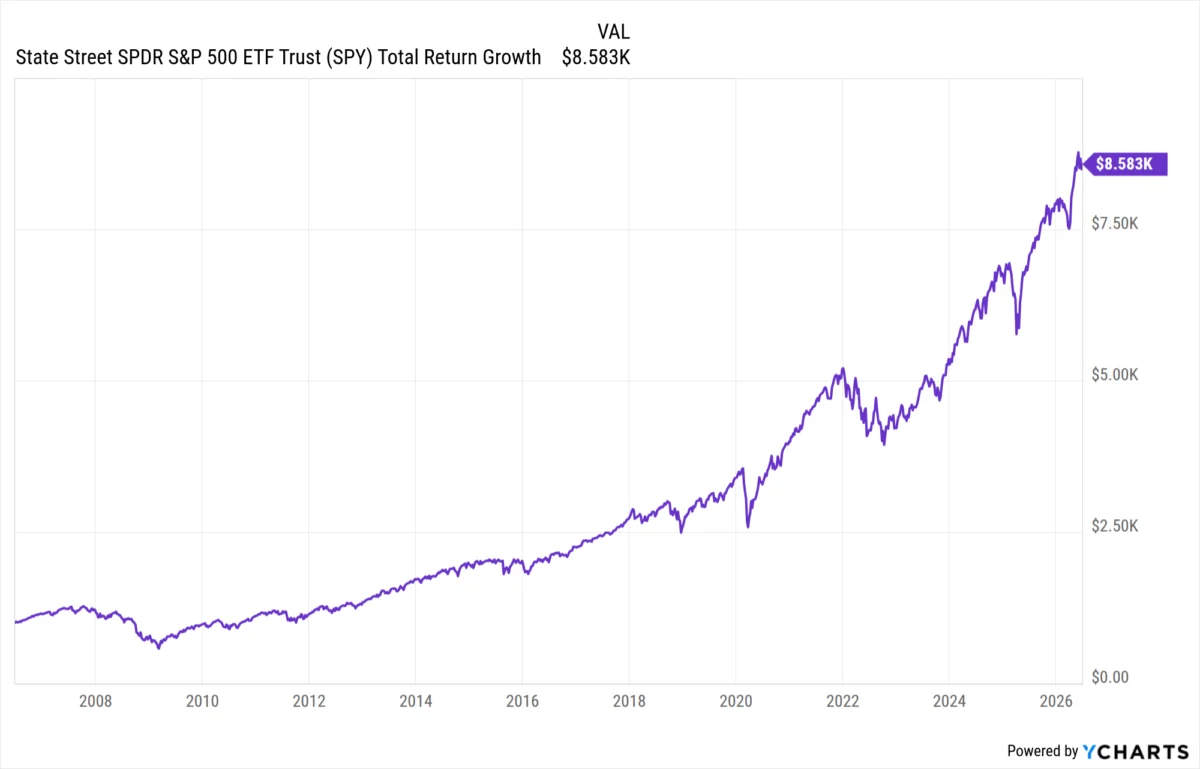
If an investor had invested $1,000 into SPY two decades ago, that investment would be worth more than $8,500 today. This represents an annualized return of 11.2%. While fees and the "cash drag" of dividend timing prevent ETFs from perfectly matching the S&P 500’s total return of 11.3%, the difference is negligible compared to the 1% to 2% management fees often charged by active mutual funds.
According to S&P Global, over the past 20 years, 93% of U.S. large-cap stock funds lagged the performance of the S&P 500. This is not a temporary statistical anomaly; it is a long-term, systemic trend that has persisted across multiple economic cycles, interest rate environments, and technological shifts.
Official Perspectives: The Experts Weigh In
Market analysts and researchers continue to debate the future of the S&P 500, but the consensus on passive vehicles remains overwhelmingly positive. Nicholas Colas, co-founder of DataTrek Research, notes that historical returns are highly variable, ranging from 2.6% to 17.7% over 20-year rolling windows since 1928.
"The fate of the next 20 years for the S&P 500 is largely reliant on the development of artificial intelligence and whatever innovations come after it," Colas notes. "The ability for U.S. companies to generate substantial profit from these technologies will be the primary driver of equity growth. We remain optimistic and are long-term bulls on U.S. large-cap stocks."
This outlook underscores a critical point: by owning an S&P 500 ETF, you are not betting on a single company to invent the next big thing; you are betting on the American economy’s capacity to innovate and capture the value of that innovation.
The Implications for Retirement Planning
The rise of passive investing has democratized wealth creation. In the past, high-quality, long-term portfolio management was the domain of the ultra-wealthy who could afford expensive financial advisors and boutique hedge funds. Today, a retail investor with $100 can gain instant, low-cost exposure to the 500 largest companies in the United States.
The Power of Cost Efficiency
The primary implication of this shift is the drastic reduction in costs. Active funds often carry expense ratios that eat into long-term compounding. When you multiply a 1.5% fee by 30 years of compounding, the result is a significant reduction in final retirement wealth. Low-cost ETFs (often with expense ratios under 0.05%) ensure that the vast majority of market gains remain in the investor’s pocket.
Avoiding Behavioral Pitfalls
Perhaps the greatest benefit of passive investing is psychological. By "buying the haystack," investors avoid the temptation to chase hot stocks or panic-sell during minor corrections. A passive strategy forces a long-term horizon, which, historically, has been the only reliable path to wealth creation.
Conclusion: The Wisdom of the "Dumb" Investor
Warren Buffett’s original remark about diversification was a critique of "diworsification"—the act of buying too many mediocre assets for the sake of safety. However, when it comes to the S&P 500, the "diversification" is not an act of ignorance; it is an act of efficiency.
By accepting market-matching returns, investors are opting out of the expensive and often futile game of trying to beat the pros at their own game. They are leveraging the inherent strength of the U.S. corporate engine. In an era where the data consistently shows that the vast majority of stocks fail to beat cash, "playing dumb" by investing in the entire index is looking increasingly like the smartest move one can make. As the passive market continues to grow, it serves as a testament to the fact that, in investing, the simplest path is often the most prosperous.