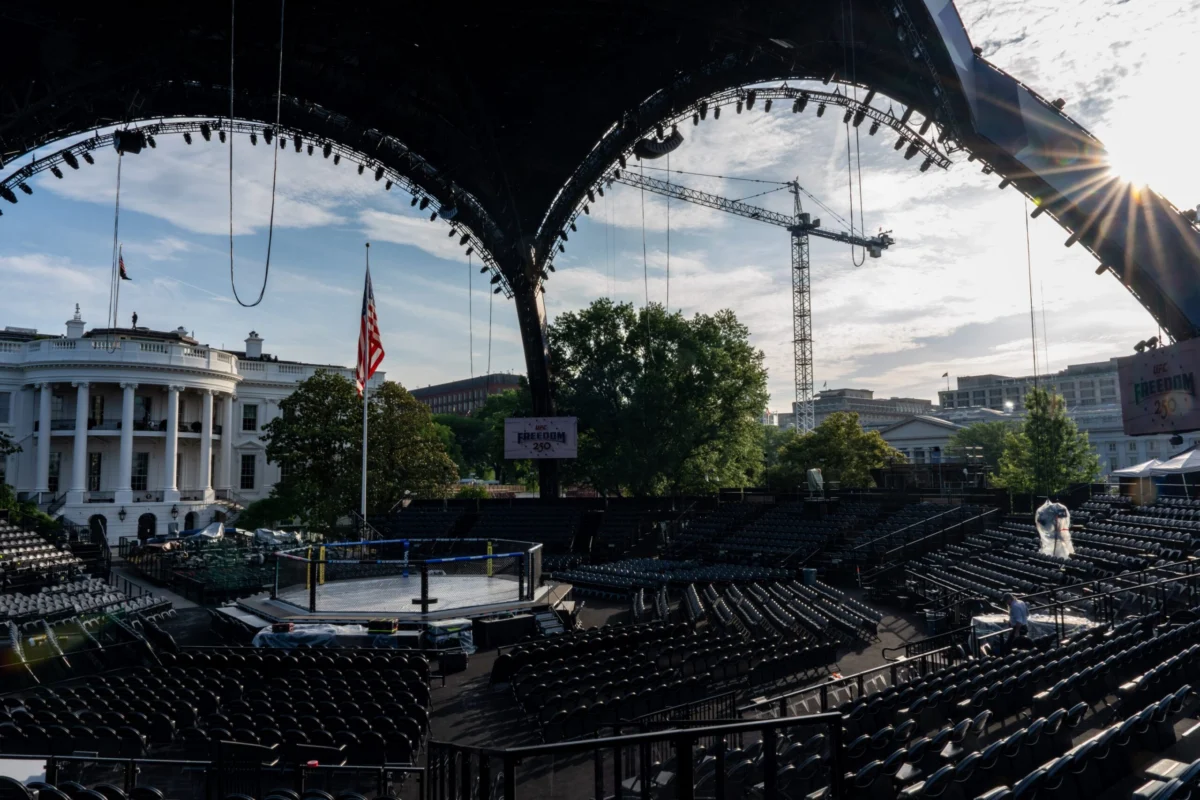
WASHINGTON, D.C. — In a collision of executive power, professional prize-fighting, and high-stakes media maneuvering, the South Lawn of the White House has been transformed from a symbol of diplomatic decorum into a high-tech gladiatorial arena. Dubbed "UFC Freedom 250," the event marks a historic, if polarizing, milestone: the first time a professional mixed martial arts (MMA) event has been staged on the grounds of the Executive Mansion.
The spectacle, scheduled for Sunday evening, serves as a triple-tiered celebration. It commemorates the 80th birthday of President Donald J. Trump, honors the 250th anniversary of the United States’ founding, and solidifies the decades-long alliance between the President and Ultimate Fighting Championship (UFC) CEO Dana White. As the sun sets over the Potomac, the world will witness an unprecedented "home game" for a president who has long championed the grit and violence of the Octagon as a metaphor for his own political brand.
Main Facts: A $60 Million Spectacle in the Heart of Democracy
UFC Freedom 250 is not merely a sports event; it is a massive logistical and financial undertaking with a production budget exceeding $60 million. The centerpiece is "The Claw," a temporary, four-sided architectural marvel that towers 90 feet (27 meters) above the manicured grass of the South Lawn—the same site that typically hosts the annual Easter Egg Roll.
The technical specifications are staggering. The Claw houses a sophisticated array of lighting rigs, high-fidelity speakers, and four massive LED screens, allowing for a 360-degree viewing experience. Because the primary arena on the lawn can only accommodate roughly 4,000 invited guests—including dignitaries, donors, and military veterans—the administration has expanded the footprint to the Ellipse. There, an estimated 120,000 fans, who secured tickets through a free public lottery, will watch the broadcast on jumbotrons in what is being billed as the largest "watch party" in the history of the nation’s capital.
The event will stream exclusively on Paramount+, bypassing traditional linear broadcast networks like CBS. This move is a strategic play by the Ellison family, owners of Skydance Media and close allies of the President, who recently secured a $7.7 billion, seven-year deal to become the exclusive home of the UFC.
Chronology: From the Taj Mahal to the Oval Office
The road to Freedom 250 began more than a quarter-century ago. In the early 2000s, when MMA was banned in many states and disparaged by critics like Senator John McCain as "human cockfighting," Donald Trump was one of the few mainstream figures to embrace the sport. He hosted early UFC events at his Trump Taj Mahal in Atlantic City, providing the fledgling promotion with a veneer of legitimacy when it was on the brink of financial collapse.
- July 2025: During a campaign-style rally in Iowa, Trump first publicly floated the idea of bringing the Octagon to the White House. He promised a "full fight" and a massive crowd, framing it as a celebration of American strength.
- April 2026: Following a period of intense lobbying by top-tier fighters, including Conor McGregor and Michael Chandler, the White House officially announced the partnership with the UFC for the "America 250" celebrations.
- May 2026: Construction began on the South Lawn, drawing sharp criticism from preservationists and political opponents who argued the event desecrated the historical sanctity of the grounds.
- June 2026: A federal lawsuit seeking to halt the event on the grounds of "misuse of federal property" and "security concerns" was filed.
- Friday, June 12, 2026: A federal judge rejected the injunction, clearing the way for the fights to proceed.
The timeline reflects Trump’s consistent efforts to blur the lines between governance and entertainment, a strategy that has defined his tenure and his public persona.
Supporting Data: The International Card and Economic Impact
Despite the domestic political overtones, the fight card itself is a testament to the UFC’s global reach. The main event features Alex Pereira of Brazil defending his interim heavyweight title against France’s Ciryl Gane. The co-main event pits Spanish-Georgian superstar Ilia Topuria against Justin Gaethje, one of the few Americans on the card.
The Freedom 250 Main Card:
- Interim Heavyweight Alex Pereira (Brazil) vs. Ciryl Gane (France)
- Lightweight Title Unification: Ilia Topuria (Spain/Georgia) vs. Justin Gaethje (USA)
- Lightweight Bout: Michael Chandler (USA) vs. TBD (Following injury withdrawals)
- Heavyweight Bout: Derrick Lewis (USA) vs. Alexandr Romanov (Moldova)
- Bantamweight Feature: Sean O’Malley (USA) vs. Merab Dvalishvili (Georgia)
- Middleweight Bout: Bo Nickal (USA) vs. Kyle Daukaus (USA)
The inclusion of Bo Nickal is particularly poignant. Nickal, a three-time NCAA wrestling champion, first met Trump at the White House in 2019. Their relationship has since evolved into a personal friendship, with Nickal frequently joining the President for rounds of golf. "To go from a town of 5,000 in Wyoming to fighting on the South Lawn for the President is surreal," Nickal told reporters during a press event at the Lincoln Memorial.
From an economic perspective, the event is expected to generate record-breaking subscription numbers for Paramount+. While Dana White’s initial projections of 125 million viewers (matching Super Bowl LVIII) may be tempered by the streaming-only format, industry analysts suggest the "curiosity factor" could drive millions of new sign-ups, justifying the Ellison family’s multi-billion dollar investment.
Official Responses: A Divided Capital
The reaction to Freedom 250 has been as combative as the sport itself.
Dana White, UFC CEO:
"This is a 1-of-1 event. You’re never going to see this again. We have fighters training in the shadow of the Washington Monument. It’s going to be a pain in the ass to manage the security, but once that first bell rings, it’s going to be the most incredible visual in the history of sports."
The Administration:
White House spokespeople have framed the event as an inclusive celebration of "the American spirit of competition." They have dismissed criticisms regarding the cost and the "bloodthirsty" nature of the sport, pointing to the high viewership and the lottery system that allowed "regular Americans" to attend for free.
Political Opponents:
Critics have been less charitable. Several members of Congress released a joint statement calling the event a "tacky commodification of the Executive Branch." They raised concerns about the $60 million price tag during a period of "soaring inflation" and questioned the appropriateness of hosting a violent spectacle while the nation navigates a complex military standoff with Iran.
Implications: The Normalization of the "Promoter-in-Chief"
The staging of UFC Freedom 250 carries profound implications for the American presidency and the future of sports media.
1. The Presidential Brand as Entertainment
Trump has successfully leveraged the UFC’s "bad boy" image to reinforce his own persona as a "fighter" who is unafraid of convention. By bringing the Octagon to his doorstep, he is not just hosting a sports event; he is domesticating a subculture that prizes raw power and individual dominance—values that resonate deeply with his political base. This represents a significant shift in how the White House is used as a stage for soft power.
2. The Future of Sports Broadcasting
The exclusivity of the event on Paramount+ signals a tipping point in the "streaming wars." If a presidential-sanctioned event of this magnitude can successfully bypass traditional networks, it sets a precedent for future "tentpole" events. The close ties between the Ellison family and the Trump administration also raise questions about the intersection of corporate media interests and executive patronage.
3. Security and Civil Order
The logistical challenge of hosting 120,000 people at the Ellipse, combined with the presence of the President and high-profile international athletes, has put the Secret Service and D.C. Metropolitan Police on high alert. A shooting that cut short the White House Correspondents’ Association dinner in April remains fresh in the minds of security officials. The success or failure of the security perimeter on Sunday will likely influence how future large-scale events are handled in the capital.
4. Cultural Polarization
Freedom 250 serves as a microcosm of a divided America. To his supporters, the event is a bold, patriotic celebration of American exceptionalism and a middle finger to "elitist" norms. To his detractors, it is a "trainwreck" that prioritizes spectacle over the dignity of the office.
As the "American Bad Ass" chords of Kid Rock prepare to echo across the South Lawn, one thing is certain: the boundaries between the arena and the office have never been more blurred. Whether this represents a vibrant new chapter in American culture or a concerning departure from tradition will be debated long after the final knockout. For now, the lights are on, the cage is locked, and the President has the best seat in the house.