For three decades, Tom Cruise has occupied a singular space in the Hollywood firmament. He is less an actor and more a force of nature, a cinematic monument defined by death-defying stunts, an unwavering commitment to the theatrical experience, and a public persona that has shifted from the cocky, leather-jacketed youth of the 1980s to the stoic, Christ-like savior of global cinema.
Yet, to understand the Tom Cruise of today, one must return to 1996. Specifically, one must return to the first 30 minutes of Brian De Palma’s Mission: Impossible. In that half-hour, the template for the next thirty years of Cruise’s career was poured, set, and permanently hardened. It was the moment the "Cruise Jerk" died, and the "Ethan Hunt Savior" was born.
The Evolution of the "Cruise Jerk"
To modern audiences, the image of Tom Cruise is synonymous with absolute, high-octane selflessness. He is the man who hangs off the side of planes and leaps from skyscrapers, not for ego, but for the audience’s pleasure. However, looking back at his filmography from the 1980s and early 90s, the picture was vastly different.
Cruise built his empire on the back of characters who were, by any reasonable definition, jerks. In Top Gun, Pete "Maverick" Mitchell was a textbook example of arrogant brilliance. In The Color of Money, he played a character who leaned into his own toxicity. Even in roles where he found redemption, such as Charlie Babbitt in Rain Man, the journey was predicated on the character shedding his skin of selfishness.

Cruise was the master of the "Cocksure Protagonist." Whether he was playing a high-stakes lawyer in A Few Good Men or a sports agent in Jerry Maguire, his characters were defined by their sharp edges, their unearned confidence, and a certain smirking distance from the humanity of those around them. He was the biggest movie star in the world precisely because he embodied the era’s fascination with the untouchable, talented, and slightly insufferable winner.
The 30-Minute Transformation: A Masterclass in Narrative Deconstruction
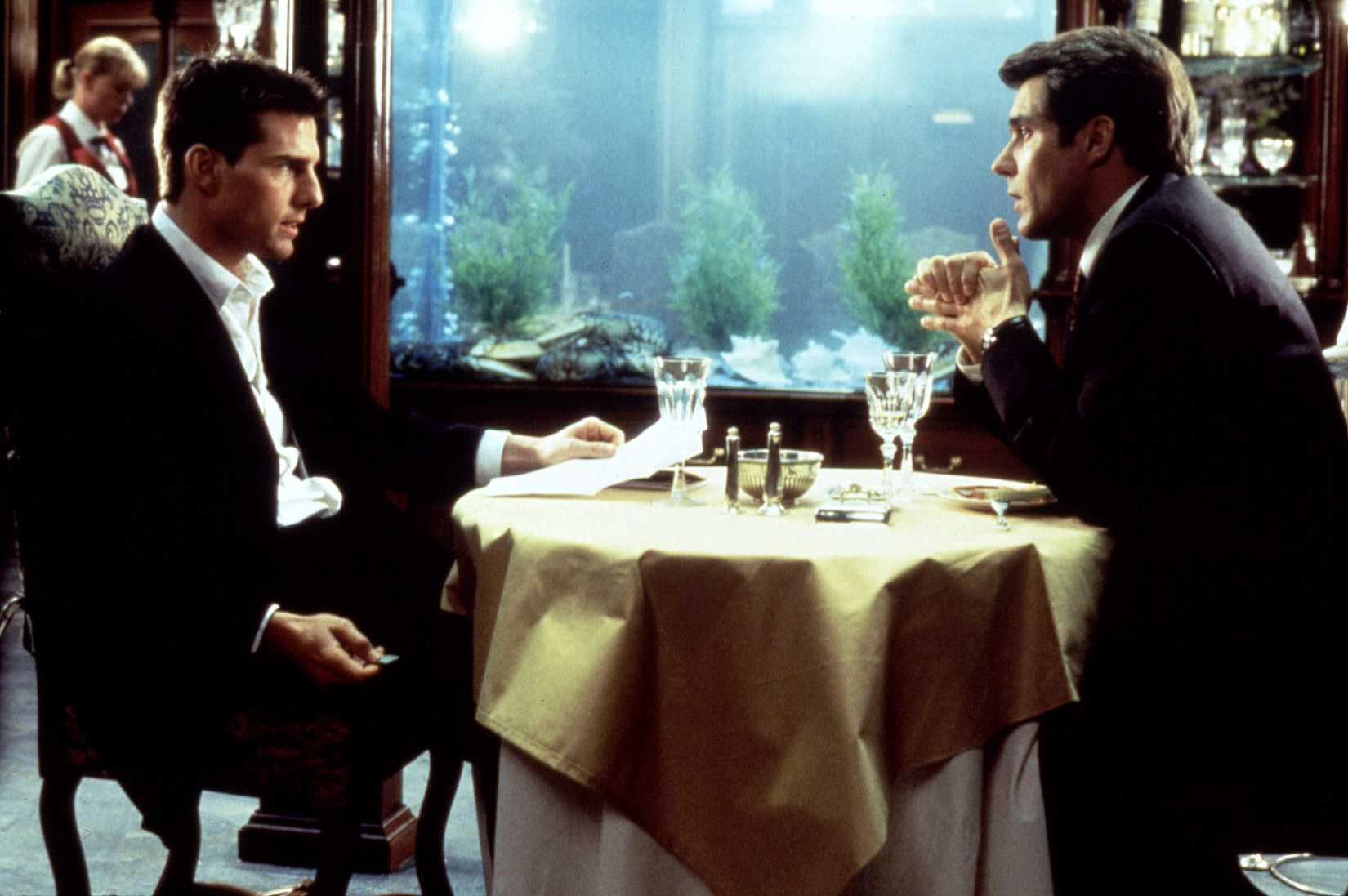
When Mission: Impossible arrived in 1996, it appeared to be a standard-issue reboot of a classic television property. It featured an all-star cast including Jon Voight, Kristin Scott Thomas, and Emilio Estevez. For the first half-hour, the film plays with these expectations. We see Ethan Hunt—sporting the era-defining spiky hair and a V-neck shirt—wielding his charm with the same ease he uses to pull off a magic trick.
Then, Brian De Palma pulled the rug out from under the audience.
In a sequence that remains one of the most effective pivots in blockbuster history, the entire IMF team is systematically dismantled. They are killed or compromised, leaving Hunt standing amidst the wreckage. The "luxury cast" is wiped away, and the audience is left with a solitary, framed, and betrayed figure.

This sequence accomplished two things simultaneously:
- The Death of the Ensemble: By stripping away his team, the film forced Ethan Hunt into isolation. This isolation would become the bedrock of the entire franchise.
- The Birth of the Martyr: The shift from a team-based mission to a lone-wolf crusade against corruption transformed Hunt from a cocky agent into a tragic hero.
Chronology of a Franchise Archetype
Following the events of 1996, the Mission: Impossible franchise underwent a slow, deliberate evolution.
- 1996-2000 (The Transition): The original film established the lone wolf status. Mission: Impossible 2 attempted to force a romantic narrative, which felt out of sync with the character’s newly established isolation.
- 2006 (The Pivot): With Mission: Impossible III, the tone began to shift toward the high-stakes, hyper-kinetic style that would define the series’ later years.
- 2011-2023 (The Savior Era): Starting with Ghost Protocol, the series solidified the formula: Hunt as the center of a gravity-defying, world-saving machine. His team grew—adding icons like Ving Rhames, Simon Pegg, and Rebecca Ferguson—but the emotional core remained firmly fixed on Hunt’s solitary burden.
This trajectory mirrors Cruise’s own life. Following the public scrutiny of his personal life—including the infamous 2005 appearance on The Oprah Winfrey Show and his subsequent divorce—Cruise retreated from the traditional celebrity sphere. He became, in many ways, as unreachable and as focused as Ethan Hunt.
Supporting Data: The Economics of the "Cruise Brand"
The success of the Mission: Impossible franchise is not merely a matter of critical acclaim; it is a financial phenomenon. The series has grossed billions worldwide, with the later entries, particularly Fallout and Dead Reckoning, reaching new peaks of box-office dominance.

Data suggests that audience loyalty to the Mission: Impossible series is directly tied to the "Cruise Factor." Unlike other franchises that rely on shifting actors or evolving mythologies (like the Marvel Cinematic Universe), Mission: Impossible relies on the consistent, increasing intensity of its lead.
| Film | Global Box Office (Approx.) | Critical Reception (Rotten Tomatoes) |
|---|---|---|
| Mission: Impossible (1996) | $457 Million | 67% |
| M:I 2 (2000) | $546 Million | 57% |
| M:I III (2006) | $398 Million | 71% |
| Ghost Protocol (2011) | $694 Million | 93% |
| Fallout (2018) | $791 Million | 97% |
The steady climb in quality and revenue correlates with the transition from the "Jerk" to the "Savior." As Hunt became more isolated and more burdened by the fate of the world, audiences became more invested in his survival.
Official Responses and Industry Impact
Industry analysts have long noted that Tom Cruise is the last of a dying breed—the "Movie Star" in the classic sense. During the COVID-19 pandemic, his public insistence that Top Gun: Maverick be released in theaters, not on streaming, was viewed as a defense of the medium itself.
Directors who have worked with him, from Christopher McQuarrie to J.J. Abrams, have consistently cited his "obsessive, almost fanatical" attention to detail. This is the professional manifestation of the jerk-turned-savior: the arrogance of the 80s, redirected into a totalizing, perfectionist work ethic.
Implications: The Legacy of the Lonely Hero
The implications of this 30-year journey are profound. By weaving his personal evolution into the character of Ethan Hunt, Tom Cruise has created a meta-narrative that is unrivaled in modern film.
When we watch a Mission: Impossible film today, we aren’t just watching a spy movie. We are watching a man who has spent three decades refining his craft, shedding his past, and embracing a solitary existence for the sake of the audience.
The tragedy—or perhaps the triumph—is that Hunt can never truly be at peace. As the films have shown, the closer he gets to his "family" (his team), the more dangerous his life becomes. He must always be the one to leap, the one to run, and the one to save the day, only to recede back into the shadows.
Tom Cruise hasn’t just played Ethan Hunt for thirty years; he has become him. The jerk is long gone, replaced by a cinematic deity who exists only for the mission. And as the credits roll on the latest installment, we are reminded that, like Hunt, Cruise is ultimately a man apart—a singular talent, forever running toward the next impossible task, alone but never truly abandoned by the millions who watch him from the dark of the theater.