MANAMA, Bahrain – What was once characterized by the White House as a manageable, "small potatoes" friction point has rapidly metastasized into a high-stakes naval confrontation. The long-simmering "shadow war" between the United States and the Islamic Republic of Iran has entered a volatile new phase, marked by direct missile engagements against American warships and retaliatory strikes on Iranian economic assets.
As both nations move beyond the tactical stalemate that has defined the Strait of Hormuz for months, the risk of a full-scale regional conflagration is at its highest point in decades. With the U.S. Navy enforcing a punishing blockade and Iran turning to sophisticated new weaponry—reportedly with Russian assistance—the narrow waterway has become the world’s most dangerous flashpoint.
Main Facts: A Threshold Crossed
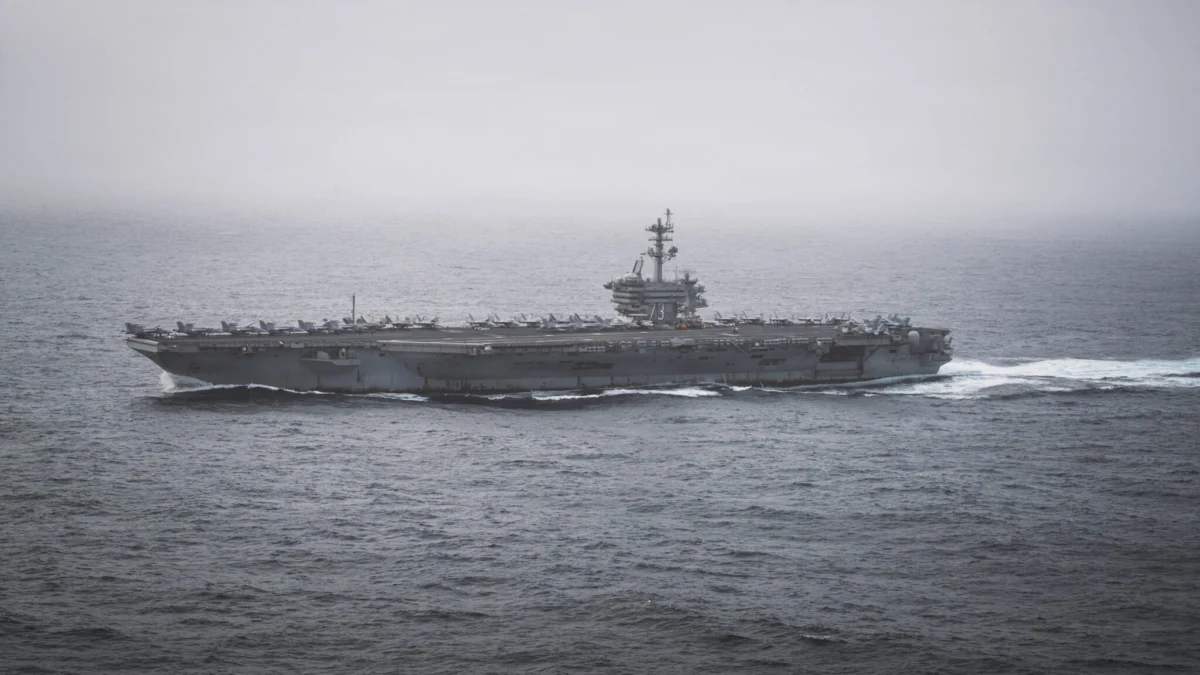
The nature of the conflict shifted dramatically this week when Iranian forces moved from targeting commercial shipping to directly engaging the United States Navy’s primary surface combatants. According to reports from U.S. Central Command (CENTCOM), Iranian military units launched a series of sophisticated missile salvos aimed at a U.S. Navy aircraft carrier and an accompanying destroyer operating in international waters.
While the U.S. vessels successfully intercepted the incoming threats using advanced shipboard defense systems, the intent behind the attack signals a departure from Tehran’s previous strategy of "plausible deniability." In immediate retaliation, the U.S. military conducted precision strikes against three Iranian oil tankers. These vessels were identified as key nodes in the "shadow network"—a clandestine fleet used by the Islamic Revolutionary Guard Corps (IRGC) to bypass international sanctions and fund its regional operations.
The exchange marks the first time in the current cycle of tensions that the U.S. has targeted Iranian state-linked commercial assets in direct response to an attack on American military hardware. This "tit-for-tat" escalation suggests that the previous rules of engagement, which largely focused on keeping the Strait of Hormuz open for neutral traffic, have been discarded in favor of a strategy of maximum economic and military attrition.
Chronology of Escalation: From Blockade to Direct Fire
The current crisis did not emerge in a vacuum but is the result of a multi-month escalatory spiral that began with the imposition of a stringent U.S. naval blockade intended to halt Iran’s illicit oil exports.
The Summer Stalemate
For several months, the conflict was defined by a grinding stalemate. Iran’s military attempted to close off the Strait of Hormuz—the world’s most vital oil transit point—through a combination of mine-laying, drone harassment, and the seizure of foreign-flagged tankers. However, the U.S. Navy, leading a multinational coalition, successfully shepherded a significant portion of global oil traffic through the narrow passage, preventing Tehran from achieving its goal of a total maritime shutdown.
Conversely, the U.S. failed to restore the "status quo ante." Iranian asymmetrical attacks on commercial vessels remained frequent enough to keep insurance premiums prohibitively high and global oil prices volatile. This "low-intensity" conflict effectively halved the usual traffic flows through the region.
The Shift to Land-Based Attacks
Earlier this week, the conflict spilled over onto land. Iranian-backed proxies and IRGC units launched a series of missile strikes targeting U.S. military installations and logistical hubs located around the Persian Gulf. These strikes were interpreted by analysts as a desperate attempt by Tehran to force a cessation of the naval blockade, which has begun to "strangle" the Iranian domestic economy.
The Saturday Engagement
The situation reached a breaking point on Saturday. Eschewing the use of proxies, Iran launched direct missile strikes from its mainland against a U.S. carrier strike group. This failed attempt to sink or damage a U.S. capital ship prompted the immediate American counter-strike against the IRGC’s "shadow fleet."
Supporting Data: The Economic and Technical Dimensions
The escalation is being driven by two primary factors: the deteriorating state of the Iranian economy and the introduction of advanced Russian missile technology into the theater.
The "Shadow Network" and the Economic Squeeze
The three tankers destroyed by U.S. forces were not merely commercial ships; they were vital financial lifelines. According to data from maritime tracking agencies, these vessels operated without transponders, frequently engaged in ship-to-ship transfers in the middle of the night, and utilized "flags of convenience" to hide their Iranian origin. The revenue generated from these "shadow" sales is estimated to account for a significant portion of the IRGC’s operational budget.
The U.S. Treasury Department has indicated that this is only the beginning. Plans for an "Economic D-Day" are reportedly in the final stages of development. These measures involve secondary sanctions aimed at any nation or financial institution—including major players in Asia—that facilitate Iran’s oil trade. The goal is to reduce Iranian exports to zero, a move that Tehran views as an existential threat.
The Russian Connection: Supersonic Threats
A critical development that has emboldened Tehran is the reported assistance from the Russian Federation. Reports from the Financial Times suggest that Moscow is secretly providing Iran with ramjet propulsion technology.
A ramjet system would allow Iran to develop supersonic cruise missiles capable of traveling at several times the speed of sound. Current Iranian cruise missiles are largely subsonic, making them susceptible to U.S. Aegis defense systems. However, a supersonic variant would drastically reduce the reaction time for U.S. commanders, potentially forcing American aircraft carriers to operate much further from the Iranian coast. This "anti-access/area denial" (A2/AD) capability would significantly weaken the effectiveness of the U.S. blockade.
Official Responses: Rhetoric and Resolve
The rhetoric from both Washington and Tehran has sharpened, leaving little room for diplomatic maneuver.
The American Stance
U.S. Central Command chief Admiral Brad Cooper issued a blunt warning following the destruction of the Iranian tankers. "Let the message to the IRGC be clear: If you shoot at two of our ships, we will impose an even higher economic cost—taking out three of yours," Cooper stated. He further emphasized that the U.S. Navy is prepared to "destroy Iran’s limited and exposed oil fleet" if the attacks continue.
The White House, while previously downplaying the conflict, has shifted its tone. Administration officials now characterize the naval blockade as a "necessary instrument of national power" to prevent Iranian regional hegemony. The Treasury Department’s vow of an "Economic D-Day" reinforces the notion that Washington is no longer seeking a return to the nuclear deal (JCPOA) but is instead pursuing a strategy of total economic isolation.
The Iranian Perspective
While Tehran has not officially confirmed the missile strikes on U.S. warships, state-run media has praised the "valiant defenders of the Persian Gulf" for challenging "arrogant imperialist powers." Iranian officials have publicly admitted that the economic conditions in the country are "dire," with inflation spiraling and fuel shortages becoming common.
Senior leadership in Tehran has suggested that "time is running out" for a diplomatic solution, framing their military actions as a legitimate defense against an illegal maritime siege.
Implications: The Risks of an Existential Squeeze
The current trajectory of the conflict suggests that the "maximum pressure" campaign may be reaching its logical—and most dangerous—conclusion.
The "Nothing to Lose" Scenario
Hamidreza Azizi, a senior Iran analyst at the International Crisis Group, warns that the U.S. strategy of increasing economic pressure may backfire. "The greater the squeeze on Iran, the greater the incentive to act," Azizi noted. If the Iranian leadership perceives the blockade as an existential threat to the regime’s survival, they may conclude that they have nothing left to lose.
In such a scenario, Tehran might opt for a "scorched earth" policy in the Strait of Hormuz, attempting to sink enough vessels to create a physical and environmental barrier that would take years to clear, effectively crashing the global economy along with their own.
The Potential for Miscalculation
The shift from attacking commercial tankers to attacking U.S. destroyers crosses a psychological threshold. While the Saturday strike failed, the margin for error is razor-thin. A successful strike that results in significant American casualties would likely trigger a massive U.S. air campaign against Iranian infrastructure, radar installations, and command centers.
Global Energy Instability
For the global community, the implications are profound. The Strait of Hormuz carries roughly 20% of the world’s oil consumption. Any further escalation that leads to a sustained closure of the strait would likely send oil prices into the triple digits, sparking a global recession. Furthermore, the involvement of Russian technology suggests that the Gulf has become a secondary theater for the broader geopolitical struggle between the West and the Moscow-Tehran-Beijing axis.
As the U.S. prepares its "Economic D-Day" and Iran eyes its new supersonic capabilities, the "small potatoes" of the Gulf have grown into a harvest of potential catastrophe. The international community now watches with bated breath to see if either side will blink, or if the next missile salvo will be the one that ignites a war no one can afford.