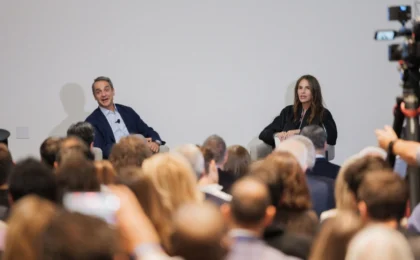
In an era where artificial intelligence is being integrated into the deepest crevices of our digital lives—from personal productivity suites to automated shopping assistants—Signal President Meredith Whittaker has issued a chilling counter-narrative. As the steward of one of the world’s most secure communication platforms, Whittaker’s perspective carries significant weight. Her recent remarks, delivered during an extensive interview with Bloomberg, strip away the anthropomorphic veneer often applied to AI, framing the current wave of generative models not as companions or assistants, but as potential vectors for unprecedented surveillance and privacy erosion.
Whittaker’s stance is clear: The convenience offered by large language models (LLMs) like ChatGPT, Claude, and Microsoft Copilot comes at the cost of personal agency and data sovereignty. As these systems gain "pervasive access" to our private lives, the fundamental architecture of digital privacy—specifically end-to-end encryption—faces an existential threat.
The Core Argument: AI as a Non-Sentient Statistical Engine
At the heart of Whittaker’s critique is the rejection of the "sentient AI" myth. While Silicon Valley marketing teams have spent billions positioning chatbots as intuitive, helpful, and almost human-like partners, Whittaker urges users to maintain a sober perspective.
"These are not your friends. These are not conscious beings. These are not sentient interlocutors," she stated. By stripping away the marketing gloss, Whittaker highlights the cold reality of how these models function: they are probabilistic engines designed to predict the next token based on a vast, ingested dataset.
Whittaker notes that while she occasionally utilizes AI for menial tasks like document formatting, she deliberately avoids engaging them for intellectual labor. Her reasoning is rooted in the preservation of cognitive autonomy. "I’m very serious about my thinking and writing, and I don’t want the process of working through an idea to be foreclosed or eclipsed by the response of a system that’s averaging what’s already out there."
This highlights a critical concern: the homogenization of human thought. If we rely on systems that function by "averaging" existing information, we risk entering a feedback loop where original, idiosyncratic, and challenging ideas are smoothed over by the statistical mediocrity of the training data.
Chronology of the Privacy Conflict
The tension between privacy-first advocates and AI developers has been escalating since the public release of ChatGPT in late 2022. To understand the gravity of Whittaker’s current warnings, one must look at the recent timeline of the industry’s push for total integration:
- Late 2022: The launch of ChatGPT sparks an AI arms race. Major tech firms begin prioritizing "integration" over "isolation."
- 2023: Privacy experts begin sounding alarms regarding the data-scraping practices used to train models. Signal maintains a strict stance on data minimization, refusing to store user metadata that could be harvested for training.
- 2024: AI companies begin marketing "Personalized Assistants" that require deep access to user calendars, emails, and browsing histories.
- Early 2025: Microsoft AI CEO Mustafa Suleyman publicly outlines a vision where Copilot acts as a proactive agent, managing complex personal tasks like holiday shopping by analyzing private conversations and financial data.
- June 2026: Meredith Whittaker delivers her critique, specifically targeting the "pervasive access" model, marking a significant line in the sand between AI-as-an-OS and secure messaging.
Supporting Data: The Cost of Convenience
The data landscape for AI training is fundamentally at odds with the privacy-centric architecture of Signal. Signal is built on the principle of "data minimization"—the idea that the less data a service has, the less it can lose, leak, or be compelled to surrender.
Conversely, the current AI business model relies on "data maximization." To function as a true "personal assistant," an AI needs:
- Contextual Awareness: Access to private emails and chats (to understand preferences).
- Temporal Tracking: Access to calendars and location history (to manage schedules).
- Financial Integration: Access to credit card and transaction history (to execute purchases).
When these datasets are aggregated, they create a "digital twin" of the user—a profile so accurate it can predict behavior with high precision. According to security researchers, this level of access creates a single point of failure. If an AI system is compromised, or if the provider is subpoenaed, the entirety of a user’s digital life is exposed. Whittaker’s warning is that this "convenience" acts as a backdoor that bypasses the security protections users have fought for decades to establish.

Official Responses and Industry Divergence
The industry response to these concerns has been a mix of dismissal and branding pivots. Proponents of deep AI integration, such as Microsoft’s Mustafa Suleyman, argue that the "friction" of manual digital tasks is a legacy problem that AI is uniquely qualified to solve. In their view, the user’s consent to share this data is the ultimate arbiter of privacy.
However, critics within the privacy community argue that "consent" in this context is a fallacy. When an AI service becomes a utility—necessary for work, commerce, or social interaction—the choice to "opt-out" effectively means choosing to be digitally illiterate or professionally disadvantaged.
Whittaker’s response is to advocate for a structural separation. She argues that we must distinguish between "tools" and "agents." A tool is a static piece of software that performs a discrete function; an agent is a persistent, intrusive entity that monitors everything. By inviting AI agents into our private channels, we are effectively inviting a corporate surveillance mechanism into our most intimate conversations.
Implications: The Death of Private Spaces?
The implications of Whittaker’s warning are profound for both the average user and the future of digital policy.
1. The End of E2EE Effectiveness
End-to-end encryption (E2EE) was designed to keep the "middleman"—the service provider—out of the conversation. However, if the user voluntarily grants an AI agent access to their local device or account, the encryption becomes moot. If the AI is "reading" your messages to provide shopping suggestions, it is, by definition, a man-in-the-middle.
2. The Normalization of Surveillance
We are currently witnessing a cultural shift where the constant monitoring of our behavior by algorithms is being reframed as "personalization." If users accept this, it may become impossible to advocate for privacy as a human right, as the surveillance will be presented as a service that the user requested rather than one that was imposed.
3. The Future of Signal
Signal faces a difficult road ahead. By refusing to play the "AI integration" game, they risk being seen as outdated or "less helpful" than their competitors. Yet, Whittaker’s comments suggest that Signal is doubling down on its identity as the last bastion of true digital privacy. Their strategy is to market privacy not as a restriction, but as a luxury—a secure environment where thoughts and ideas can be developed without being "averaged" or harvested by an LLM.
Conclusion: A Call for Digital Sobriety
Meredith Whittaker’s intervention serves as a necessary wake-up call. We are currently in a "Wild West" phase of AI integration where the long-term consequences of data exposure are being ignored in favor of short-term productivity gains.
The danger, as Whittaker highlights, is not just that these systems might make mistakes or hallucinate; it is that they are structurally designed to be omnipresent. When she says, "In the context of Signal, it would constitute a kind of a backdoor," she is identifying the point of no return. Once we grant these systems the keys to our digital kingdom, we may find that we have permanently compromised the privacy we once took for granted.
As the industry pushes for more integration, the burden falls on the user to demand better. Do we want digital assistants that know us better than we know ourselves, at the cost of our digital sovereignty? Or do we want to retain the right to be private, to be un-analyzed, and to think thoughts that haven’t been processed by a statistical average? Whittaker’s answer is clear: protect the space where your thoughts remain your own.