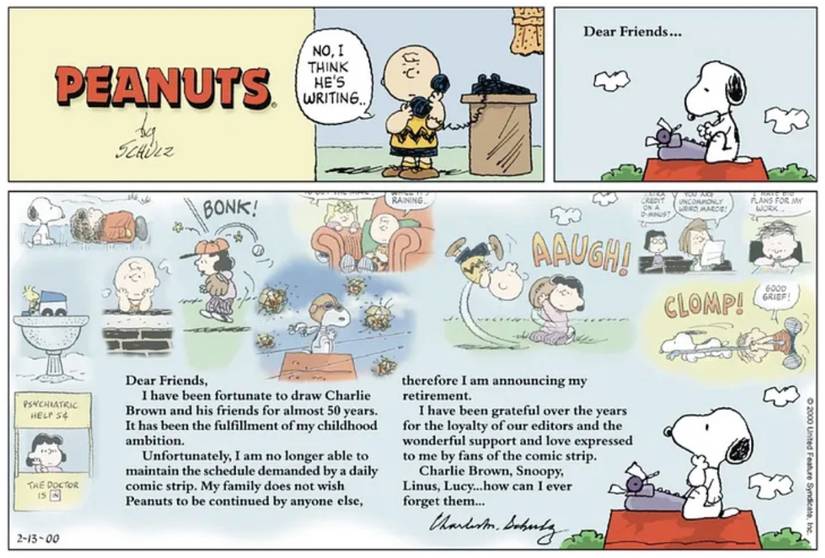
On February 12, 2000, the world lost one of its most influential creative voices when Charles M. Schulz passed away at the age of 77. In a twist of fate that felt scripted by the cartoonist himself, the final daily Peanuts comic strip appeared in newspapers the very next morning. While the logistics of syndication meant the strip had been completed weeks earlier, the timing served as a poignant, accidental benediction for a half-century of work.
Schulz had announced his retirement in December 1999 following a diagnosis of colorectal cancer and a series of strokes. He knew his time was limited, but he could not have known with absolute certainty that his final contribution to the medium would land on the day after his passing. Yet, as with much of his work, the moment was defined by a quiet, understated grace. Among his nearly 18,000 strips, one specific sequence from 1966 stands out—not for its humor, but for a piece of existential wisdom so profound that it seems to have eluded even its creator.
A Legacy of 18,000 Panels
To understand the weight of Schulz’s work, one must consider the sheer scale of his output. For 50 years, Peanuts was not merely a comic strip; it was a mirror held up to the human condition. While Snoopy provided flights of fancy and Linus offered theological comfort, the heart of the strip was always Charlie Brown—the archetypal "everyman" defined by his perpetual struggle against failure.
Schulz’s genius lay in his ability to imbue his characters with an adult-level melancholy wrapped in the innocent packaging of childhood. His strips were often sweet, occasionally whimsical, and frequently devastatingly deep. Among these, the February 1966 storyline regarding Charlie Brown’s ill-fated attempt at a school spelling bee remains a masterclass in character study.
The Chronology of a Spelling Bee
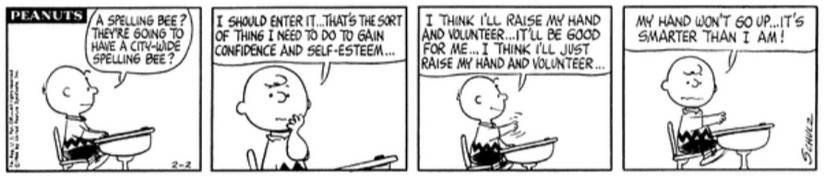
The spelling bee storyline began on February 2, 1966, and spanned 16 individual daily strips. In the narrative, Charlie Brown, driven by a desire for self-improvement and validation, volunteers for the competition. Predictably, his enthusiasm is met with skepticism by the rest of the gang, particularly Lucy van Pelt, who views his ambition as a setup for inevitable humiliation.

The sequence follows a familiar rhythm:
- February 2: The announcement of the spelling bee and Charlie Brown’s decision to volunteer.
- February 3: The exchange that would become the most profound moment in the strip’s history.
- February 4–20: The fallout of the competition, featuring Charlie Brown’s failure to spell the word "maze," his subsequent emotional breakdown, and his disciplinary trip to the principal’s office.
The storyline was a grounded, realistic look at the anxiety of being judged by one’s peers. When Charlie Brown eventually fails, his reaction is not one of outward anger at the world, but internal collapse. He puts his head on his desk, refuses to engage, and ultimately finds himself in the principal’s office, illustrating the thin line between childhood academic pressure and genuine emotional distress.
The Forgotten Wisdom
The zenith of this story occurred in the second strip of the arc. Lucy, ever the critic, confronts Charlie Brown about his decision to volunteer, questioning why he would subject himself to such a public potential for failure. Charlie Brown, pushed to his limit, erupts in defense of his own agency:
"Well, what’s wrong? What’s wrong with trying?! I can try, can’t I?"
He then follows this with a line that serves as the unofficial thesis statement for the entire Peanuts canon:

"What’s the good of living if you don’t try a few things?"
It is a remarkably simple, almost conversational sentence. Yet, it carries the weight of a Socratic inquiry. It is an argument for the inherent value of the human experience, suggesting that the act of "trying" is a prerequisite for a meaningful existence, regardless of whether that attempt results in triumph or disaster.
The Mystery of the Missing Quote
Perhaps the most intriguing aspect of this quote is that it seems to have been overlooked by the man who wrote it. When the storyline was adapted into the 1969 feature film A Boy Named Charlie Brown, Schulz himself oversaw the screenplay. The film expanded the spelling bee narrative to fill an 85-minute runtime, adding musical numbers and extended scenes. Yet, in the process of adaptation, this specific, life-affirming sentiment was left on the cutting room floor.
Why would a creator omit his most profound line of dialogue? Some scholars of the strip suggest that Schulz was deeply immersed in the "show, don’t tell" philosophy of visual storytelling. Others argue that for the characters themselves, the gravity of the statement is intentionally lost. They are children, and their existential crises are meant to be fleeting, even when they touch on universal truths.
However, there is a third, more likely possibility: Schulz simply didn’t realize the magnitude of what he had written. In his 50-year sprint to produce 18,000 strips, he was a craftsman who viewed his work as a daily job. He likely saw the line as a simple retort in a heated argument between two kids, rather than a manifesto on the nature of existence.
The Implications of "Trying"
The failure to recognize the quote’s brilliance in the film adaptation highlights the tension between art and the artist. We often look to authors and creators to provide the "meaning" of their work, but once a story is released into the public consciousness, it belongs to the reader.
This line, "What’s the good of living if you don’t try a few things?", has become a rallying cry for anyone who has ever felt like a "Charlie Brown"—the person who keeps lining up the football, even though they know Lucy will pull it away. It elevates the act of failure to a noble endeavor. It suggests that the person who never fails is also the person who never truly lives.
Supporting Perspectives: The Cultural Impact
The lasting power of this sentiment is evidenced by the continued academic and cultural interest in Peanuts. Sociologists have long pointed to the strip as a seminal influence on the American psyche, specifically regarding the acceptance of failure.
In a 2012 retrospective on the strip’s cultural impact, psychologists noted that Charlie Brown’s persistent optimism—despite his lack of success—provided a template for resilience for generations of American children. By normalizing the "failed try," Schulz gave his readers permission to be imperfect. The spelling bee arc is perhaps the purest distillation of this: Charlie Brown fails the spelling bee, he gets in trouble with his teacher, and he is humiliated by his friends, but he survives. He continues to live. He continues to try.
Conclusion: The Quiet Brilliance of the Everyman
Charles Schulz was not a philosopher in the traditional sense; he was a man with a pen and a deadline. Yet, his commitment to the "daily grind" allowed him to stumble upon truths that philosophers spend lifetimes trying to articulate.
The fact that the creator himself may have overlooked his own most brilliant line only adds to the charm of the Peanuts universe. It reinforces the idea that life is not about the grand, monumental statements we make, but about the small, often unnoticed attempts to navigate our own "mazes."
As we look back at the 50-year run of Peanuts, we see a body of work that asks us not to be perfect, not to be winners, but simply to participate. To try. Because, as Charlie Brown so succinctly put it, what is the alternative? Schulz spent his life trying, and in doing so, he left behind a legacy that continues to teach us how to live.