By Global Sports Desk
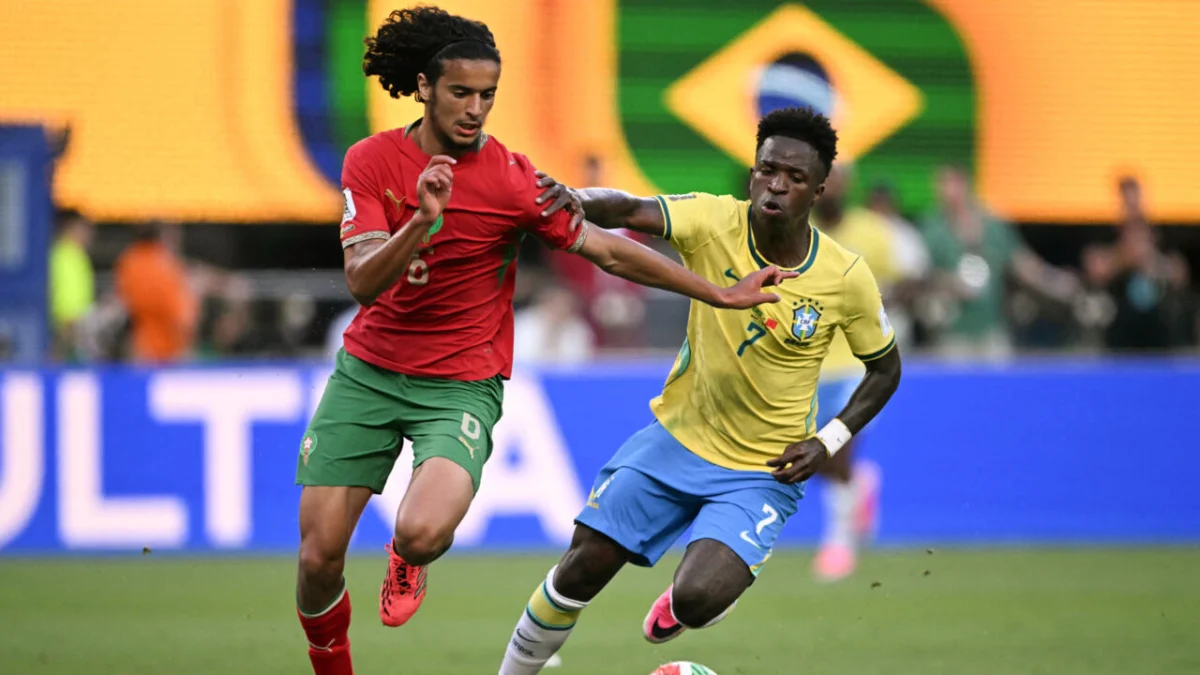
The quest for a record-extending sixth World Cup title began with a stark reminder of the challenges ahead for the Seleção. In a high-stakes Group C opener at the iconic MetLife Stadium in New Jersey, Brazil was held to a 1-1 draw by a technically disciplined and fearless Morocco side. While Vinicius Junior provided the individual brilliance required to salvage a point, the performance raised significant questions about Brazil’s tactical coherence under the stewardship of Carlo Ancelotti.
For a nation that has spent 24 years waiting to return to the summit of global football, the match served as a sobering reality check. Despite the presence of legendary figures like Ronaldo Nazário, Roberto Carlos, and Kaká in the stands—reminders of the glory of 2002—the current iteration of the Brazilian national team looked disjointed, struggling to break down a well-drilled Moroccan defensive block.
The Chronology: A Tale of Two Halves
The match opened with an atmosphere of electric anticipation, but it was the Atlas Lions who dictated the tempo early on. Morocco, buoyed by their historic semi-final run in the 2022 tournament, showed no signs of "big-game" nerves. Under the tactical guidance of Mohamed Ouahbi, the North Africans pressed high and disrupted Brazil’s rhythm, forcing turnovers in midfield.
The Breakthrough
The breakthrough arrived in the 21st minute, a moment of pure class that stunned the pro-Brazil crowd. Following a pinpoint through-ball from the creative engine Brahim Diaz, Ismael Saibari exploited a lapse in concentration between central defenders Marquinhos and Gabriel Magalhaes. Racing into the space behind the backline, the PSV Eindhoven forward displayed composure well beyond his years, executing a delicate chip over the rushing Alisson Becker. The stadium fell into a momentary hush, save for the vibrant pockets of Moroccan supporters who erupted in celebration.
The Vinicius Response
Brazil’s response was frantic, bordering on desperate, until the 32nd minute. Bruno Guimarães, tasked with pulling the strings in midfield, found Vinicius Junior on the left flank. The Real Madrid superstar took a touch to settle, cut inside onto his favored right foot, and unleashed a thunderous strike that curled into the far corner, evading the outstretched arms of Yassine Bounou. It was a goal born of individual genius, providing a vital lifeline for a team that had looked rudderless.
A Second-Half Standoff
The remainder of the match saw a tactical tug-of-war. Brazil pushed forward, searching for the winner, but found the Moroccan defensive wall increasingly difficult to penetrate. Lucas Paqueta forced a brilliant reflex save from Bounou with an acrobatic effort before the interval. In the second half, Igor Thiago and Raphinha both had sights on goal, but Bounou remained an immovable object between the posts.
In the dying embers of the match, Morocco nearly snatched all three points. A long-range rocket from Neil El Aynaoui forced a diving save from Alisson, who barely managed to parry the ball away before recovering just in time to block a follow-up effort from Chemsdine Talbi. It was a chaotic finale that left both sides breathless and served as a reminder that in an expanded 48-team tournament, no opponent can be underestimated.
Supporting Data: The Ancelotti Challenge
The statistical landscape of the match paints a picture of a Brazilian side struggling for clinical efficiency. Despite dominating possession for large swathes of the second half, the Seleção lacked the final-third precision that characterized their past championship teams.
- Tactical Shift: Carlo Ancelotti, the first foreign coach in Brazil’s illustrious history, is tasked with implementing a European-style discipline onto a squad traditionally defined by flair. However, the data from the South American qualifying campaign—where Brazil finished a disappointing fifth—suggests that this transition is far from complete.
- The Absence of a Legend: The elephant in the room remains the absence of Neymar. As the nation’s all-time record goalscorer, his influence extends beyond the scoresheet; he is the primary playmaker and the focal point of the team’s creative identity. Currently sidelined with a persistent calf injury and having not featured for the national team since 2023, his recovery is the single most important variable in Brazil’s World Cup narrative.
- Defensive Vulnerability: The ease with which Saibari bypassed the Marquinhos-Gabriel pairing will be a point of intense scrutiny for Ancelotti. With the tournament structure now encompassing 48 teams, the defensive lapses that might have been ignored in smaller tournaments are now potential fatal flaws.
Official Responses and Tactical Implications
In the post-match press conference, the sentiment within the Brazilian camp was one of guarded optimism, though there was no masking the disappointment of the result.
"We knew Morocco would be a difficult opponent," Ancelotti stated, speaking through an interpreter. "They are a team with high tactical intelligence and a strong transition game. We did not start with the intensity we needed, but I am proud of how the players reacted to going behind. We have a squad capable of winning this tournament, but we must improve our concentration in the defensive phases."
Mohamed Ouahbi, the Morocco head coach, was visibly proud of his side’s resilience. "I told my players before the game: if you respect Brazil too much, you have already lost. We came here to play our game, to take risks, and to show the world that Moroccan football has evolved. This draw is a testament to the belief in this dressing room."
Looking Ahead: Group C Dynamics
The implications of this draw are significant for Group C. Brazil must now regroup for their upcoming fixture against Haiti, a match they are expected to win, but one where the pressure will be immense. Any further slip-ups would put their qualification for the knockout stages at risk, a scenario that would be considered a national catastrophe in Brazil.
Meanwhile, Morocco’s clash with Scotland is now a pivotal fixture. Having secured a point against the favorites, the Atlas Lions will look to build momentum, knowing that a positive result against the Scots could all but guarantee their path to the next round.
The Broader Context: A Tournament in Flux
The 2026 World Cup is a tournament of firsts—the first to feature 48 teams, the first to be hosted across three nations, and the first time Brazil has entered a tournament with a foreign manager. The match in New Jersey underscored the unpredictable nature of this new format. With more teams participating, the gap between the traditional "footballing giants" and the rest of the world continues to shrink.
For the spectators at MetLife Stadium, the day was more than just a football match; it was a celebration of the sport’s global reach. From the second-hand jersey markets in Kibera, Kenya, to the bars of Rio de Janeiro, the excitement surrounding the tournament is palpable. However, as Brazil’s performance demonstrated, the path to the final is paved with obstacles.
The weight of history—24 years since the last triumph—sits heavy on the shoulders of the current generation. Whether Vinicius Junior can continue to be the catalyst for success, and whether Ancelotti can bridge the gap between his tactical philosophies and the Brazilian "Joga Bonito" spirit, remains the defining question of the tournament.
As the squad prepares for the next round, the mood in the Brazilian camp is one of quiet determination. There is work to be done, defensive lines to be tightened, and a nation’s expectations to be managed. The road to the final is long, and if this opening stalemate is any indication, the journey will be anything but predictable. Brazil remains a favorite, but in this expanded, highly competitive tournament, the crown is far from guaranteed.