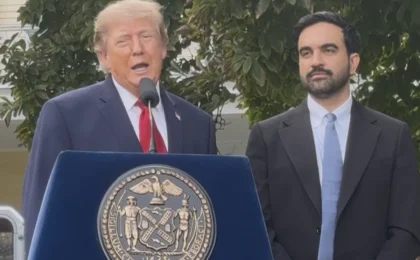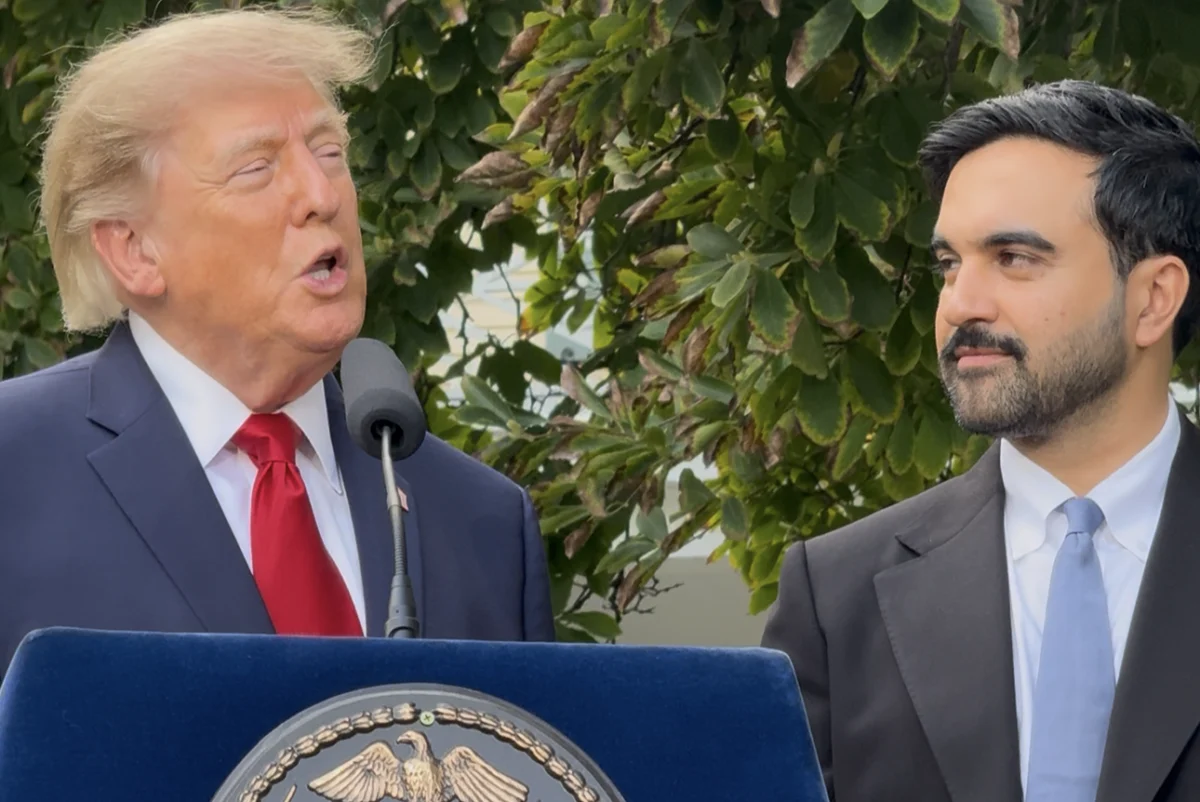
NEW YORK CITY — In a scene that perfectly encapsulated the friction between executive authority and municipal advocacy, President Donald Trump stood on the manicured lawn of Gracie Mansion on Monday alongside New York City Mayor Zohran Mamdani. The meeting, ostensibly a diplomatic visit to the nation’s largest city, quickly became a flashpoint for two of the most contentious issues defining the current administration: the escalating war on the press and the looming humanitarian and economic crisis surrounding Temporary Protected Status (TPS) for Haitian immigrants.
The visit highlighted a glaring contradiction in the Trump presidency. While Donald Trump has arguably been more accessible to the press than his recent predecessors—frequently engaging in "chopper talk," taking shouted questions, and appearing in media scrums on nearly 80% of his days in office—he simultaneously wields access as a weapon. At Gracie Mansion, this dichotomy was on full display as the President defended his recent decision to ban three major news organizations from the White House, while Mayor Mamdani pointedly used his own platform to insist on full media transparency.
Main Facts: A President at Odds with the Fourth Estate
The immediate catalyst for the day’s tension was the President’s Friday announcement that CNN, MS NOW, and Politico were officially banned from White House grounds. The administration cited the "constant ‘reporting’ [of] FAKE NEWS" as the justification for the move. By Monday morning, the media landscape had shifted into a defensive crouch. The three barred outlets filed a joint First Amendment lawsuit in federal court in Washington, D.C., alleging that the ban constitutes "viewpoint discrimination" and violates the due-process rights of the organizations and their journalists.
In a show of solidarity, other major networks and news agencies refused to provide White House pool coverage for the day. Because CNN was scheduled to handle the pool rotation, the collective refusal left the administration without its usual shadow of reporters, forcing the President to rely on his own social media channels and hand-picked outlets to disseminate his message—until he arrived at Gracie Mansion.
Mayor Zohran Mamdani, a figure often at odds with the President’s policies, sought to draw a clear line in the sand regarding democratic norms. "I told the President that we’re going to have all of the members of the press here on the lawn, and that is something that I believe in," Mamdani told reporters, standing just feet away from the President.
Chronology: A History of Media Exclusions and Legal Battles
The current ban is not an isolated incident but rather the latest escalation in a decade-long conflict between Trump and the press. To understand the gravity of the current lawsuit, one must look at the timeline of executive-media relations:
- 2018: The White House revoked the press credentials of then-CNN correspondent Jim Acosta following a heated press conference. The move was overturned by a federal judge who ruled that the administration had violated Acosta’s Fifth Amendment due-process rights.
- February 2025: In a move that signaled a more aggressive approach to semantic control, the administration barred the Associated Press (AP) from the Oval Office and other small-pool events. The catalyst was the AP’s refusal to adopt the administration’s mandated terminology, "Gulf of America," in place of the geographically and internationally recognized "Gulf of Mexico."
- June 2025: While a lower court initially ordered the AP’s access restored, the D.C. Circuit Court of Appeals overruled the decision, granting the executive branch broader discretion over internal White House access.
- Present Day (2026/2027): The ban on CNN, MS NOW, and Politico represents the most sweeping exclusion of mainstream media to date, prompting the current federal lawsuit.
Trump, for his part, remained undeterred by the legal challenges. "I really think I have an obligation not to allow them into another very special house," Trump said, referring to the White House. "This is a special house, Gracie Mansion. Well, the White House is the most special of all houses."
Supporting Data: The High Stakes of TPS for New York City
While the press ban dominated the headlines, the private discussions between Mamdani and Trump centered on a policy with profound economic implications for New York City: Temporary Protected Status (TPS).
TPS is a humanitarian program that allows nationals of countries devastated by war, natural disasters, or extraordinary conditions to live and work in the United States. Haiti has held this status since the catastrophic 2010 earthquake. However, the Trump administration has moved aggressively to terminate these protections, arguing that the conditions that necessitated the status have been resolved.
The data suggests that ending TPS for Haitians would deal a significant blow to New York City’s infrastructure, particularly in the healthcare sector:
- Population Concentration: New York City is home to the second-largest Haitian population in the U.S. (behind Miami), with over 160,000 residents concentrated primarily in Brooklyn neighborhoods like Flatbush and East Flatbush.
- The Healthcare Workforce: According to the Center for Migration Studies, New York State has approximately 7,000 Haitian TPS holders working as nursing assistants and home caregivers.
- Dependency on Immigrant Labor: The city’s healthcare workforce is 57% immigrant. Among home health aides—a sector already facing a labor shortage—nearly three-quarters are immigrants.
The termination of TPS status, which officially cut off work authorization for hundreds of thousands of Haitians on July 24, has already had practical consequences. New York City Hall was recently forced to terminate Haitian employees who had no other legal path to work authorization, a move Mamdani described as "devastating" for both the families and the city’s operations.
Official Responses: Conflicting Visions of Stability
During the visit, reporter Katie Honan of The City questioned the President on his stance regarding the Haitian community. Mayor Mamdani stepped in to frame the issue in the economic terms he had used during their private meeting. He noted that "pastors, developers, executives in healthcare and hospitality" have all expressed grave concern over the loss of the Haitian workforce.
Mamdani argued that by controlling TPS, the President "can either deliver or deny stability" to those who have built lives and careers in New York over the last 15 years.
Trump’s response was characteristically ambiguous. "The mayor feels very strongly about [TPS]," Trump said. "I feel strongly about a lot of things. I feel strongly about taking care of people, and that’s what we do. We’re doing a good job of it."
This rhetoric stands in stark contrast to the administration’s legal maneuvers. In June 2026, the Supreme Court ruled that the Department of Homeland Security (DHS) could proceed with cutting off protections for an estimated 330,000 to 350,000 Haitians nationwide. This followed a series of lower-court battles where judges initially blocked the termination, citing evidence that the decision may have been motivated by political or racial bias—a claim currently being litigated in a new federal lawsuit.
Implications: The Road Ahead for the First Amendment and the Economy
The meeting at Gracie Mansion serves as a microcosm of the broader struggles facing the American republic.
Constitutional Implications
The joint lawsuit by CNN, MS NOW, and Politico will likely become a landmark First Amendment case. If the courts uphold the President’s right to ban specific outlets based on their coverage, it could fundamentally alter the relationship between the government and the press, moving toward a model where access is granted only as a reward for favorable reporting. The "viewpoint discrimination" argument is central here; while the White House has the right to regulate the manner of access, the First Amendment generally prohibits the government from punishing speakers based on the content of their speech.
Economic and Humanitarian Fallout
For New York City, the stakes of the TPS debate are existential. If the administration does not provide a path to residency or a renewal of status, the city faces the loss of thousands of essential workers in a healthcare system already stretched to its limits. The "stability" Mamdani spoke of is not just for the immigrants themselves, but for the elderly and infirm New Yorkers who rely on Haitian caregivers.
Political Strategy
Finally, the meeting revealed the tactical nature of both leaders. Mamdani, by inviting Trump to Gracie Mansion and insisting on press presence, successfully forced the President into a public confrontation over democratic norms and local economic needs. Trump, by accepting the invitation and reminiscing about his "fond memories" of the mansion, attempted to maintain his image as a populist leader of the people, even as he systematically dismantled the protections and access those people rely on.
As the President departed the "City House" for the "White House," the questions left on the lawn of Gracie Mansion remained unanswered. Whether through the courts or through executive order, the coming months will determine if the "stability" the President claims to champion will be extended to the press that covers him and the immigrants who power the nation’s greatest city.