By International Affairs Desk
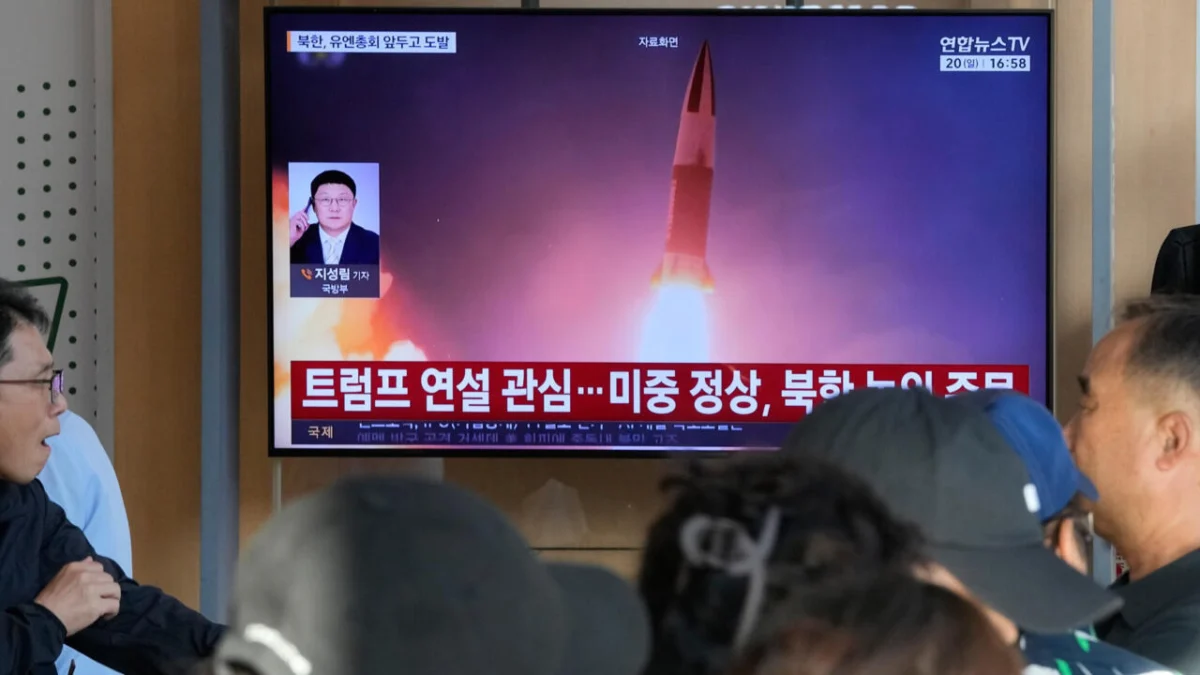
In a fresh escalation of regional instability, North Korea fired two short-range ballistic missiles into the waters off its eastern coast on Sunday, marking the second such provocation within a single week. The launch, detected by South Korea’s military, underscores Pyongyang’s continued disregard for international sanctions and signals an aggressive posture following its public rejection of recent United Nations resolutions aimed at curbing its nuclear ambitions.
The launches come at a time of heightened geopolitical friction, as the Kim Jong Un regime increasingly frames its nuclear program as an irreversible and "absolute" reality. By continuing to test delivery systems, Pyongyang is not only challenging the sovereignty of its neighbors but also daring the international community to respond to what it considers a permanent status as a nuclear-armed state.
The Sunday Provocations: A Technical Overview
South Korea’s Joint Chiefs of Staff (JCS) reported that the first missile was launched at approximately 3:00 p.m. local time (06:00 GMT) from the vicinity of Wonsan. The projectile traveled roughly 450 kilometers (280 miles) before splashing down in the East Sea, also known as the Sea of Japan.
Less than three hours later, at 5:50 p.m., the JCS detected a second launch from the same region. This missile demonstrated greater range and sophistication, flying over 600 kilometers (370 miles). The increased distance has prompted a rigorous technical assessment by South Korean and United States intelligence agencies, who are currently analyzing telemetry data to determine the specific class of the weapon and its potential payload capabilities.
The synchronization and rapid succession of these launches suggest a calculated effort by the North Korean military to test its operational readiness and demonstrate its ability to strike targets across the Korean Peninsula with minimal warning.
Chronology of Escalation: A Week of Defiance
The Sunday launches are not isolated incidents but rather the latest chapters in a volatile week for Northeast Asian security.

- Eight Days Prior: North Korea conducted a series of drills involving long-range artillery and multiple short-range ballistic missiles. State media, the Korean Central News Agency (KCNA), boasted that the weapons hit their targets with "100 percent accuracy," framing the exercise as a display of unified firepower.
- The IAEA General Conference: Throughout the week, the International Atomic Energy Agency (IAEA) held its General Conference, where the topic of North Korea’s nuclear program took center stage. In response to mounting international pressure and a resolution demanding a halt to its nuclear activities, a spokesperson for the North Korean Foreign Ministry dismissed the proceedings as a manifestation of "hostile forces."
- The Sunday Launches: Following the week of diplomatic friction, the regime utilized the Wonsan launch site to conduct the two-part ballistic test, reinforcing its rejection of the international order.
The "Absolute" Nuclear Doctrine: Pyongyang’s New Rhetoric
At the heart of the current crisis is a fundamental shift in how North Korea articulates its nuclear identity. Pyongyang has moved away from seeking diplomatic leverage through denuclearization talks, instead codifying its nuclear status into its "supreme law."
A foreign ministry spokesperson stated categorically that the IAEA’s recent resolution carries "no effect" on the Democratic People’s Republic of Korea (DPRK). The official stance is that the country’s nuclear deterrent is "irreversibly and permanently fixed." This hardline rhetoric is echoed by Kim Yo Jong, the influential sister of leader Kim Jong Un, who has characterized those who still hope for the denuclearization of the peninsula as "idiots."
This rhetoric is not merely performative; it serves to domesticate the narrative that the nuclear arsenal is the sole guarantor of the regime’s survival. By branding the nuclear program as "absolute," the leadership has effectively closed the door on conventional disarmament negotiations, at least under the current political climate.
Supporting Data: Assessing the Arsenal
The disparity in estimates regarding North Korea’s nuclear stockpile highlights the difficulty of intelligence gathering in one of the world’s most reclusive nations.
- The Trump Administration Estimate: In August, U.S. President Donald Trump suggested that North Korea possessed 57 "very powerful" nuclear weapons.
- South Korean Intelligence: Conversely, Seoul’s intelligence services have provided a more alarming estimate, suggesting the stockpile sits between 80 and 120 warheads.
The variance in these numbers, while significant, is secondary to the qualitative advancement of the missiles used to deliver these warheads. Whether it is 50 or 120, the regime’s ability to project force through short-range ballistic missiles—which are difficult to intercept and capable of being launched on short notice—presents a constant, existential threat to Seoul and U.S. military assets stationed in the region.
Official Responses: A Region on Edge
The international reaction to the Sunday launches was swift and condemnatory.
South Korea’s Stance
The South Korean presidential National Security Office convened an emergency meeting immediately following the first launch. The government issued a statement condemning the firings as a "grave act" that flagrantly violates UN Security Council resolutions. Seoul has called for an immediate cessation of all such activities, emphasizing that these actions undermine regional peace and security.

Japan’s Protest
Japan, which sits within range of North Korea’s short-range arsenal, lodged a "stern protest" through diplomatic channels. Tokyo’s government condemned the launches, characterizing them as a direct threat to the safety of the Japanese people and the stability of the Indo-Pacific region.
The Trilateral Cooperation
The JCS confirmed that South Korea, the United States, and Japan have been collaborating closely, "tracking and sharing relevant developments from the initial stage of the launch." This level of trilateral intelligence sharing is critical, as it allows the three nations to maintain a comprehensive picture of North Korean military maneuvers despite the regime’s attempts at concealment.
Implications: A Looming Security Crisis
The implications of these recurring launches are profound. First, they demonstrate the failure of existing international sanctions to deter North Korean military development. While the UN continues to pass resolutions, Pyongyang has effectively bypassed these barriers by accelerating its domestic R&D programs.
Second, the psychological warfare inherent in these tests cannot be ignored. By firing missiles into the sea near their neighbors, the North is signaling that it is prepared to move from a state of posturing to a state of active confrontation should it perceive a threat to its sovereignty.
Finally, the upcoming months will be critical. With the U.S. political landscape in flux and regional elections looming in South Korea, Pyongyang may see a window of opportunity to further escalate, hoping to solidify its "nuclear-armed" status before the international community can find a unified strategy to address the challenge.
As the smoke clears from the Wonsan launch site, the global community is left with a stark reality: North Korea is no longer interested in bargaining away its weapons. Instead, it is actively building a future where it expects the world to accept its nuclear capability as a permanent, immovable feature of the global security architecture. Whether this leads to a new era of containment or a dangerous miscalculation remains the defining question of the decade.