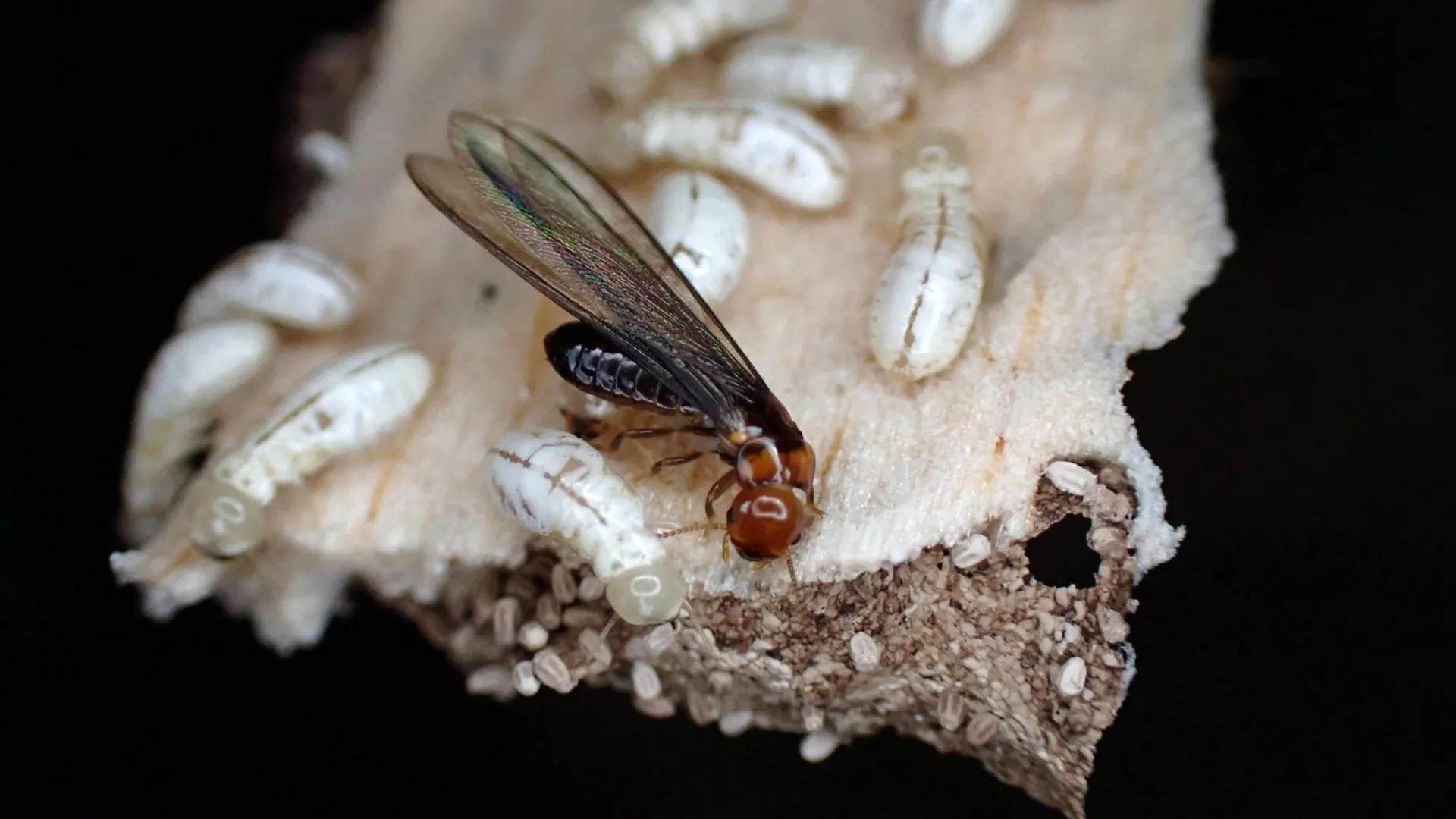
For homeowners, the most terrifying aspect of a drywood termite infestation is not the damage itself, but the utter invisibility of the enemy. Unlike their subterranean cousins, which must maintain a moisture-rich connection to the soil, drywood termites are masters of interior concealment. They can spend entire life cycles deep within the structural heart of a home—carving intricate, hollow galleries through floor joists, wall studs, and heirloom furniture—without ever breaking the surface.
For decades, the standard remedy for a severe infestation has been the "nuclear option": whole-structure fumigation. This process is invasive, expensive, and requires residents to vacate their homes for days while toxic gases permeate every crevice. However, a series of breakthrough studies conducted by researchers at the University of California, Riverside (UCR), is beginning to shift the paradigm. By weaponizing the termites’ own biological necessities against them, scientists are developing precision tools that promise to make these pests much harder to hide.
The Achilles’ Heel: Turning Molting Against the Colony
At the core of the UCR team’s research is a simple, unavoidable biological fact: termites must molt to grow. Because insects possess a rigid, chitin-based exoskeleton rather than an internal skeleton, they are trapped within a suit of armor that does not stretch. As a termite grows, it must periodically shed this shell and produce a new one.
A landmark study published in 2025 in the Journal of Economic Entomology identified a potent tool for disrupting this process: bistrifluron. As a chitin synthesis inhibitor, bistrifluron does not act as a traditional, fast-acting neurotoxin. Instead, it prevents the termite from manufacturing the essential proteins required for its next exoskeleton.
"Once the termites reach a certain stage, they have to molt. They cannot avoid that," explains Dong-Hwan Choe, a professor of entomology at UCR and the senior author of the study. "With a lethal dose of this chemical, they’ll try to shed their old exoskeleton but won’t have a new one ready to protect them."
The laboratory results were striking. In experiments where termites were given a choice between treated and untreated wood, bistrifluron achieved a 95.7% mortality rate. When exposed continuously, that figure climbed to 99%. Crucially, the chemical is highly selective; because it targets the unique biological pathway of chitin synthesis—a process fundamental to insects but distinct from the physiology of humans and other mammals—it offers a significantly more environmentally focused profile than traditional fumigants.
Chronology of a Scientific Shift
The journey toward this new treatment strategy has been a multi-year effort to understand the social and biological mechanics of the Incisitermes minor, or the western drywood termite.
- Early 2024: UCR researchers began investigating the potential of naturally occurring chemicals, specifically pinene, to act as a "lure" for termites. This initial research demonstrated that pinene, a fragrant compound found in trees, could effectively draw termites toward localized treatment zones, boosting the efficacy of insecticides.
- April 2025: Following successful laboratory trials, the University of California filed a patent application for the integration of alpha or beta pinene into localized insecticide injections, signaling a shift toward commercial viability.
- Mid-2025: The publication of the bistrifluron study in the Journal of Economic Entomology provided the first major proof-of-concept for chitin synthesis inhibitors as a stand-alone, highly efficient localized control agent.
- October 2025: The university’s patent application was formally published, outlining a future where pest control technicians might use "lure-and-kill" tactics to space treatment points further apart, reducing labor costs and chemical volume.
- 2026: Researchers released high-resolution imagery and video documenting "proctodeal trophallaxis"—a social feeding behavior where termites share gut contents. This served as the "smoking gun" for why localized treatments are so effective: they are spread through the colony via social interaction.
Supporting Data: The Power of Social Transmission
One of the most significant findings in the UCR research is the "trojan horse" effect. Termites are intensely social creatures that rely on constant interaction to maintain colony health. They share food and nutrients through a process called trophallaxis, which is essential for passing on the gut microbes required to digest cellulose.
In the 2025 study, researchers discovered that this social cooperation is the termite’s undoing. When a small group of termites was exposed to bistrifluron and then introduced to a colony, the chemical began to circulate within 24 to 48 hours. Remarkably, in groups where only 5% of the individuals had been exposed, the entire colony reached 100% mortality within 90 days.
This indicates that a single, strategically placed dose can cascade through a hidden colony, reaching individuals that never directly touched the treated wood. This creates a "secondary kill" effect that makes localized treatment a viable alternative to whole-house fumigation.
Official Perspectives and Expert Analysis
Nicholas Poulos, a doctoral student in UCR’s Department of Entomology and the corresponding author of the bistrifluron paper, emphasizes that while the laboratory data is promising, the transition to the field requires a change in how we view pest control.
"It’s specific to insects and can’t harm humans," Poulos noted, highlighting the safety benefits of moving away from broad-spectrum gaseous fumigants. However, he remains pragmatic about the challenges ahead. "We are working to make it more feasible for practical application in real-life scenarios," he added, specifically noting that the current use of acetone as a solvent—used in the lab for precision—is unsuitable for home environments due to odor and flammability.
Dr. Choe adds that the goal is not necessarily to replace fumigation entirely, but to provide a "low-impact" alternative. "Structural fumigation remains one of the most effective methods for eliminating drywood termite infestations throughout an entire building," Choe acknowledges. "But it is disruptive. Low-impact strategies like this one will become an attractive option in many cases, potentially providing residual protection that fumigation lacks."
Implications for Future Pest Management
The broader implications of the UCR research extend beyond just killing termites; they involve better diagnostics. Currently, one of the biggest hurdles in termite control is distinguishing between an active infestation and "legacy evidence"—old fecal pellets left behind long after a colony has died.
New research from the UCR team suggests that the microbial signatures within termite droppings act as a "biological clock." By measuring the decline of bacterial DNA in these pellets, researchers have identified a way to determine exactly how old an infestation is. This diagnostic tool could prevent homeowners from paying for expensive, unnecessary treatments when a colony has already vacated the premises.
Furthermore, the global nature of this problem cannot be overstated. Western drywood termites are a major structural pest in California, but through the international trade of lumber and furniture, they have established invasive populations in places as diverse as Japan, Australia, Hawaii, and even parts of the eastern United States.
As the climate shifts, the habitats suitable for these termites are expanding. The development of targeted, social-based, and biologically-informed treatments is not merely a convenience—it is a necessity for protecting global infrastructure.
The Path Forward
The UCR team’s work represents a shift toward "smart" pest control. By combining:
- Chitin Synthesis Inhibitors (Bistrifluron): To exploit the biological necessity of molting.
- Chemical Lures (Pinene): To guide treatment to where it is needed most.
- Microbial Diagnostics: To ensure treatments are applied only when active colonies are present.
The future of home protection may soon rely on these subtle, science-based interventions rather than the blunt, disruptive tools of the past. For the homeowner, this means that the "silent saboteurs" living behind their walls may finally have met their match—not through a massive, house-wide intervention, but through a precision strike that uses the termites’ own social life to secure their destruction.