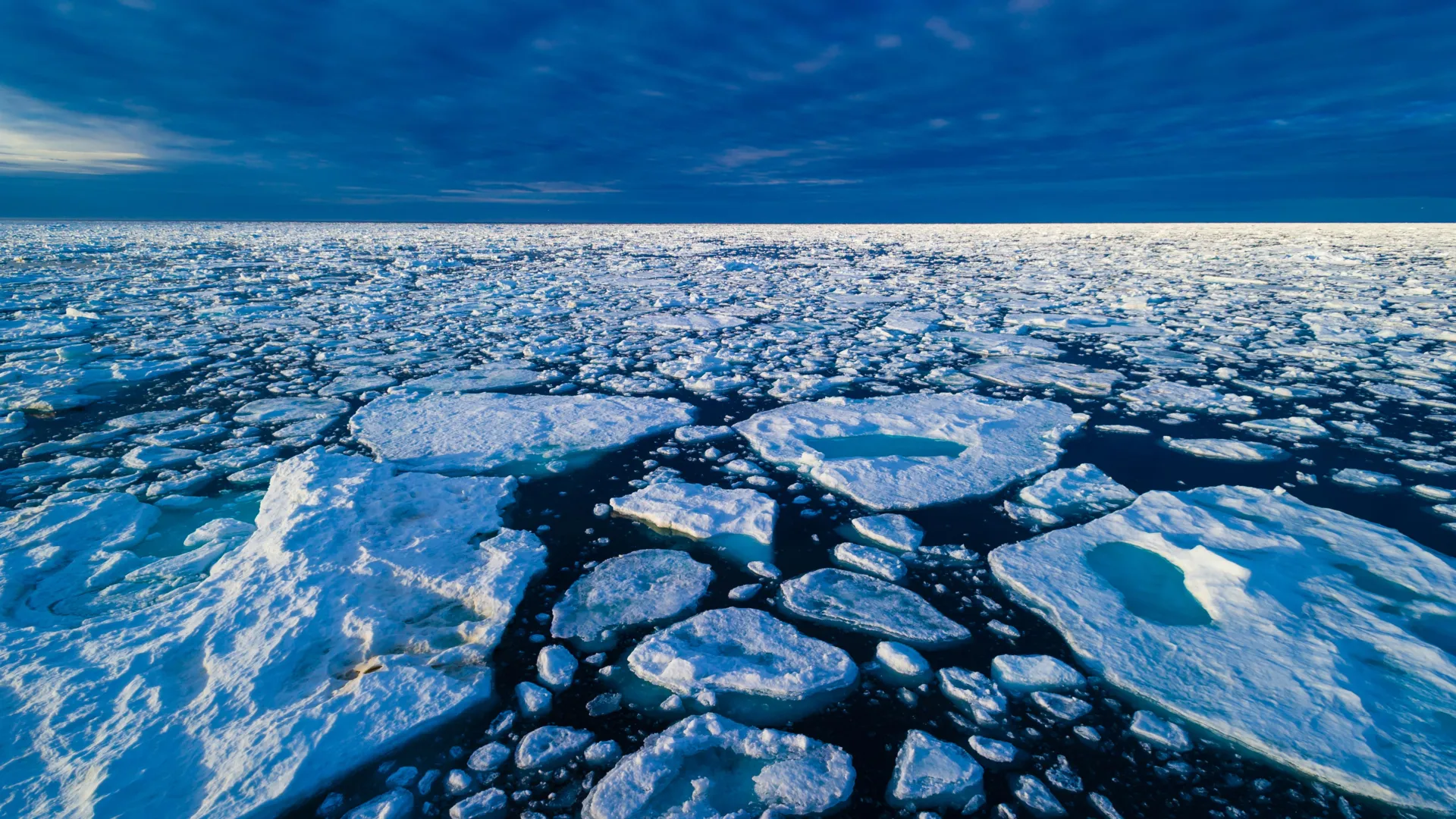
For decades, climate scientists have operated under a frustrating discrepancy: the Arctic sea ice is moving, but it rarely follows the path predicted by wind patterns alone. While meteorologists have long relied on wind-driven models to forecast the drift of frozen ocean expanses, those models have consistently overestimated the speed of ice travel and failed to accurately map the diffusion of ice floes across the polar basin.
New research led by the University of California, Riverside (UCR), has finally pinpointed the culprit. It is not necessarily an unseen ocean current or an error in satellite telemetry; rather, it is a basic, mechanical interaction: the relentless, iterative collision of individual ice slabs. By treating sea ice not as a fluid sheet, but as a dynamic, granular system—akin to grains moving through a silo—researchers have unlocked a more precise understanding of how the Arctic’s frozen skin behaves in a warming world.
The Granular Nature of the Arctic
To understand the significance of this study, published in Physical Review Letters, one must first dismantle the common perception of Arctic sea ice as a singular, monolithic plate. In reality, the Arctic is a mosaic of "floes"—discrete, floating slabs that range in size from small, room-sized fragments to massive, multi-kilometer-wide continents of ice.
These floes are in constant, restless motion. They are shoved by atmospheric currents and dragged by the friction of the underlying ocean. Historically, predictive models have treated this ice field as a "continuum"—a continuous material where wind force translates linearly into motion. However, observations from the Fram Strait, a critical gateway between Greenland and the Svalbard archipelago, have consistently defied these continuum models. The ice moves at erratic speeds and spreads across the sea at a pace far slower than the wind would suggest.
The research team, led by Bryan Shaddy—formerly a UCR undergraduate and now affiliated with the University of Southern California—alongside UCR materials scientist Alex Greaney and Associate Professor of Mechanical Engineering Bhargav Rallabandi, argues that the "missing ingredient" in climate forecasting is the energy lost during inter-floe collisions.
Chronology of a Discovery
The journey to this discovery began by re-evaluating the physical principles governing granular matter. The team posited that if the Arctic could be modeled as a "crowded field" of colliding objects rather than a continuous sheet, the chaotic, non-linear movement of the ice might finally be quantified.
- Hypothesis Formulation: The researchers theorized that the energy transferred during a collision between two floes acts as a "braking" mechanism. As wind pushes the ice, it doesn’t just move forward; it bumps into its neighbor, dissipating kinetic energy into heat and lateral movement.
- Computational Modeling: The team constructed a simulation that treated floes as individual particles floating on water, subjected to both the drag of the ocean and the turbulent, unpredictable force of wind.
- Validation via the Fram Strait: To test the model, the researchers utilized real-world data from the Fram Strait. This region serves as a "bottleneck" for Arctic ice, making it the perfect laboratory to observe how ice density impacts movement.
- Correlation of Findings: By applying their collision-based model to the Fram Strait data, the team successfully replicated three previously "unexplainable" phenomena: the rate of ice spreading, the variance in individual floe velocities, and the temporal patterns of ice motion over scales ranging from hours to days.
Supporting Data: Why Collisions Matter
The mathematical beauty of the study lies in its simplicity. By introducing the "collision parameter," the researchers were able to explain complex, large-scale behavior using only local, small-scale interactions.
In dense ice fields, the frequency of collisions is high. As the wind increases in velocity, the floes do not accelerate indefinitely. Instead, they hit their neighbors more frequently. Every collision represents a loss of momentum, effectively capping the speed at which the ice field can drift. This explains why, in many instances, ice fields appear "sluggish" despite high-velocity winds.
The model further demonstrates that the "diffusion" of ice—how it spreads across the ocean—is fundamentally regulated by the geometry of the floes. As the Arctic continues to warm and the ice becomes thinner and more fragmented, the frequency and nature of these collisions change. The study provides the mathematical framework to calculate these changes, allowing scientists to move beyond "average" wind models and into the realm of dynamic, particle-based physics.
Official Perspectives: The Experts Speak
Bhargav Rallabandi, the lead mechanical engineer on the project, emphasizes that the discovery is a triumph of physics over complexity. "If you get a lot of ice floes together in the same place with some wind, they bump into each other and transfer energy to neighbors," Rallabandi explained. "We showed that that’s the only ingredient you need to explain these observations."
For climate modelers, this is a significant development. Current global climate models (GCMs) are restricted by computational limits; they cannot track every individual floe in the Arctic. Consequently, they use "parameterizations" to estimate how ice behaves. The UCR study provides a more accurate physical basis for these parameterizations. By understanding the physics of collisions, scientists can now build better "coarse-grained" models that capture the complex, emergent behavior of the Arctic ice pack without needing to track millions of individual chunks of ice.
Implications for Climate Science and Beyond
The implications of this research are twofold: immediate utility in climate prediction and long-term scientific application in other fields.
Improving Climate Forecasting
As the Arctic undergoes rapid transition due to anthropogenic climate change, the ability to predict the movement of ice is vital. Sea ice is a primary regulator of the Earth’s climate; it reflects sunlight back into space and creates a barrier between the cold atmosphere and the warmer ocean.
If the ice spreads more easily, it moves into warmer waters, where it melts faster. Conversely, if collisions keep the ice densely packed, it may persist longer in certain regions. The UCR model provides a tool for researchers to simulate these scenarios. By inputting different ice densities and floe sizes, scientists can better predict how changing Arctic conditions will influence global sea levels, ocean circulation, and weather patterns.
Physics Beyond the Polar Circle
Perhaps the most intriguing aspect of the study is its universality. The physics of colliding objects under a "noisy" or unpredictable force is not unique to the Arctic. Rallabandi and his team believe the same principles apply to a vast array of disparate systems:
- Avalanches and Landslides: The flow of rock and snow can be modeled as a collection of colliding particles.
- Materials Science: Understanding how particles move within a dense matrix is essential for developing new high-strength materials.
- 3D Printing: The ink used in advanced 3D printing often contains suspended particles. Understanding how these particles collide and settle is key to creating high-resolution, durable prints.
"The model is not restricted to ice," Rallabandi noted. "It just needs a noisy source of force and the things that are moving to experience collisions."
Conclusion
The UC Riverside research represents a shift in how we view the Arctic. By looking past the macro-scale wind patterns and focusing on the micro-scale mechanical interactions of ice floes, the team has solved a decades-old puzzle in glaciology.
While the study does not claim to predict the exact fate of the Arctic—a task that remains subject to the volatile nature of global carbon emissions and atmospheric temperature—it provides the necessary physics to ensure our models are grounded in reality. In the search for truth within the rapidly changing Arctic, the most profound answers are often found in the most basic of interactions: the simple, rhythmic, and chaotic collision of one piece of ice against another.