In the vast, ink-stained lexicon of 20th-century American culture, few icons resonate with the quiet, persistent melancholy of Charlie Brown. As the central figure of Charles Schulz’s Peanuts, the "round-headed kid" has spent over seven decades serving as a mirror for our own insecurities, failures, and, perhaps most importantly, our resilience. While Peanuts is often celebrated for its whimsical innocence—the warm comfort of a puppy or the simplicity of a blanket—the true genius of the strip lies in its profound, often accidental, philosophical depth.
Among the thousands of panels produced by Schulz, one particular sentiment stands above the rest. It is not merely a funny line; it is a definitive manifesto on the modern condition. To understand Charlie Brown is to understand that his greatest quote is not found in a moment of accidental wisdom, but in a moment of deliberate, weary self-awareness: "I’ve developed a new philosophy… I only dread one day at a time."
The Chronology of Melancholy: From 1966 to the Silver Screen
The evolution of Charlie Brown’s philosophy is a masterclass in character development. In the early years of Peanuts, Charlie Brown was a more reactive character, often serving as the straight man to the more overt antics of his peers. However, as the 1960s progressed, Schulz began to lean into the character’s internal life.
The origin of his definitive life philosophy can be traced back to a 1966 comic strip. In a scene that has since become iconic, Charlie Brown and Linus van Pelt are found leaning against their customary brick wall—a structural motif that represents the immovable obstacles of life. Linus, ever the philosopher, observes, "Life is difficult, isn’t it, Charlie Brown?"

Charlie Brown, with the weight of the world on his shoulders, replies, "Yes, it is." He then follows with the line that would define his legacy: "But I’ve developed a new philosophy… I only dread one day at a time."
The longevity of this sentiment is evidenced by its migration from the printed page to the screen. In the 1969 feature film A Boy Named Charlie Brown, written by Schulz himself, the scene is recreated with faithful precision. The fact that Schulz chose to preserve this specific exchange for a medium as expansive as cinema underscores its importance. It wasn’t a throwaway gag; it was a core pillar of the Peanuts universe.
Supporting Data: The Anatomy of a "Loser"
To understand why this specific quote resonates so deeply, one must first look at the data of Charlie Brown’s existence. He is, by almost any metric, a chronic underachiever. He is the kid who never wins a baseball game; he is the romantic who sends valentines that are never returned; he is the eternal victim of Lucy van Pelt’s football trick.
Yet, characterizing him merely as a "loser" misses the point. The "data" of his life—his persistent failure—is the crucible in which his optimism is tested. If Charlie Brown were a nihilist, he would quit. He would stop playing baseball. He would stop trying to kick the football. But he doesn’t.

This is where the "dread one day at a time" quote functions as a psychological defense mechanism. It is a form of radical acceptance. By acknowledging that his life is inherently difficult, he removes the pressure of the long-term goal. He isn’t trying to "win" the war; he is simply trying to survive the next twenty-four hours. This makes him, in many ways, the most relatable character in comic history. In an era of intense pressure to achieve, to "win," and to optimize, the idea that one might simply settle for "dreading one day at a time" is a strangely comforting, subversive act of self-preservation.
The Philosophical Implications: A Study in Stoicism
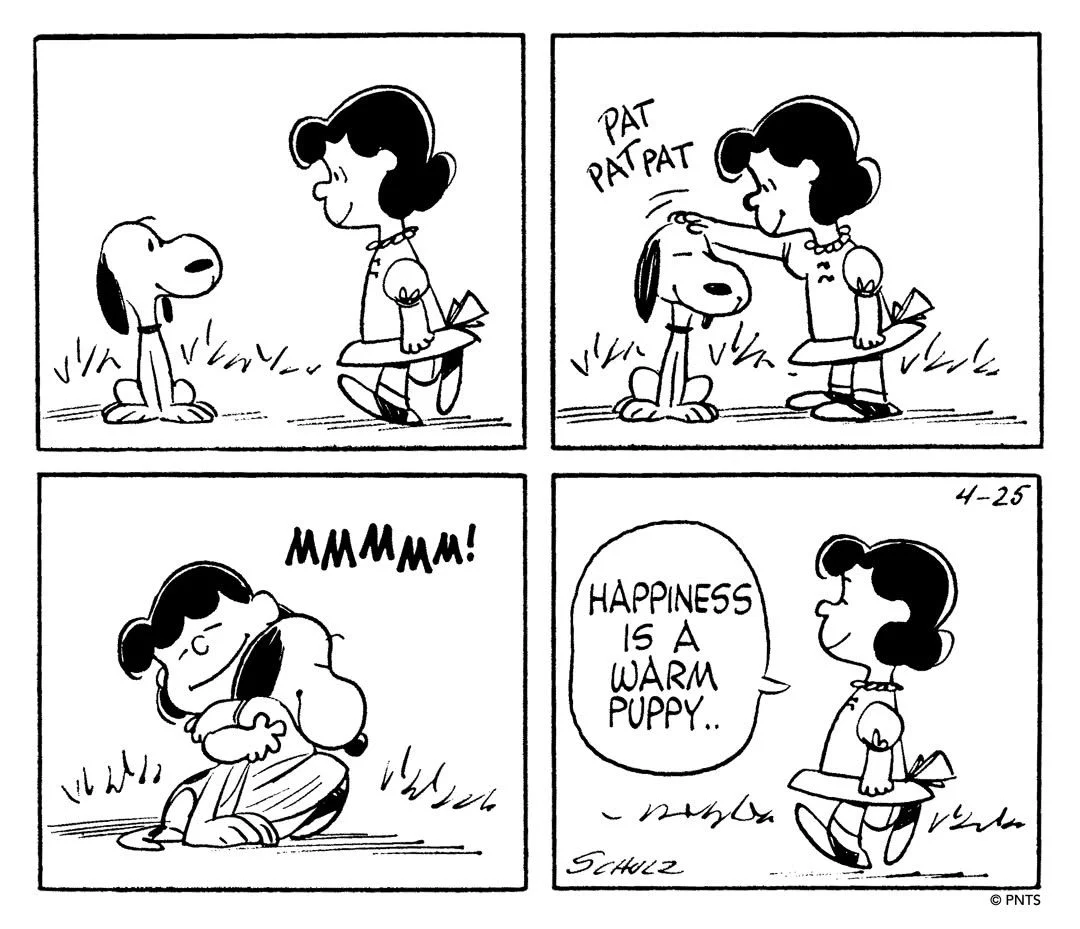
When comparing Charlie Brown to other iconic characters, the distinction between "accidental brilliance" and "intentional philosophy" becomes clear. Consider Lucy’s famous line, "Happiness is a warm puppy." That is a profound observation about sensory comfort, but it is often delivered with a sense of authoritative certainty.
Charlie Brown’s "dread" quote, conversely, is steeped in irony. It is a play on the classic recovery mantra "one day at a time." By substituting "dread" for "live," Charlie Brown acknowledges his own nature. He is a person who anticipates failure. But by limiting that anticipation to a single day, he effectively manages his anxiety.
This aligns closely with the principles of Stoicism. The Stoics argued that we should focus only on what is within our control and that we should not suffer in anticipation of the future. While Charlie Brown might not be a scholar of Marcus Aurelius, his strategy of compartmentalizing his anxiety is a practical application of these ancient teachings. He knows the football will be pulled away; he knows the game will be lost. But he chooses to stand at the line of scrimmage anyway.

Official Perspectives: Charles Schulz’s Legacy
Charles Schulz was famously private about the direct "meanings" behind his strips, preferring to let the characters speak for themselves. However, the recurring nature of the "brick wall" conversations suggests a deliberate thematic focus.
In interviews, Schulz often noted that he felt a great deal of kinship with Charlie Brown. He described the character as a reflection of his own insecurities and the "everyman" struggles he faced in his youth. The transition from the 1966 strip to the 1969 film suggests that Schulz viewed this specific philosophy as a defining characteristic of his protagonist. It was his way of saying that life is, at its core, a struggle—but one that is worth enduring.
The Modern Implications: Why We Still Need Charlie Brown
In the context of the 21st century, where the "grind culture" and the constant performance of success are ubiquitous, Charlie Brown’s admission of dread feels revolutionary. We are constantly told to manifest, to optimize, and to reach for the stars. Charlie Brown, in his eternal, round-headed mediocrity, gives us permission to be tired.
He gives us permission to admit that life is difficult.
The quote remains relevant because it touches on the fundamental human experience of managing expectations. When we set our sights too far into the future, we invite catastrophe. When we focus on the manageable, discrete chunks of time—the "one day at a time" approach—we find the strength to keep showing up to the football, regardless of whether or not we actually kick it.
Conclusion: The Persistence of the Round-Headed Kid
Ultimately, Charlie Brown’s "new philosophy" is not a sign of defeat; it is a sign of endurance. It is the hallmark of someone who has stared into the void of disappointment and decided to continue existing anyway.
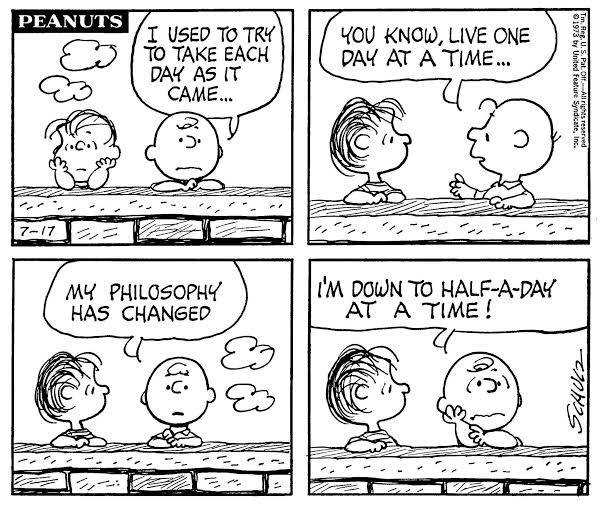
Whether it is the 1973 strip where he laments being down to "half-a-day at a time" or the 1966 classic regarding the dread of a single day, the message remains the same: life is hard, but it is lived in the present. By acknowledging the dread, Charlie Brown paradoxically conquers it. He remains the most persistent character in fiction, not because he succeeds, but because he refuses to stop trying, even when the deck is stacked against him.
Perhaps that is the ultimate lesson of Peanuts. We may all be Charlie Browns at some point—standing on the field, watching the football being pulled away, feeling the sting of rejection or the weight of the world. But as long as we keep showing up, as long as we take it one day—or even one half-day—at a time, we are winning the only game that truly matters. We are surviving. And in the world of Charlie Brown, that is more than enough.