In the modern automotive landscape, where the industry is dominated by the race for longer range, faster charging, and increasingly complex digital cockpits, two legendary figures have chosen to look in the opposite direction. At the recent Salone Auto Torino, design maestro Fabrizio Giugiaro and entrepreneur Lapo Elkann unveiled a pair of one-off, bespoke interpretations of the Fiat Topolino: the Top.L and the Top.J.
These projects, brought to life through the creative crucible of Giugiaro’s GFG Style studio, serve as a potent manifesto. They argue that the future of urban mobility—specifically the sub-$15,000 electric city car—does not have to be a compromise of character. By transforming Fiat’s most accessible EV into a canvas for high-end design, the duo has challenged the industry’s perception of "budget" transportation.
The Philosophy of the Project: Emotion Meets Accessibility
The Fiat Topolino, in its standard form, is a utilitarian tool—a light quadricycle designed for the tight, historic streets of European cities and the burgeoning micro-mobility markets in the United States. However, the Top.L and Top.J iterations are not concerned with utility. They are concerned with the "soul" of the car.
"The goal was to push a small, accessible car as far as emotion and creativity would allow," Fabrizio Giugiaro stated during the unveiling. The collaborative effort between the veteran designer and the flamboyant brand ambassador Lapo Elkann was built on a simple premise: a car’s size should never dictate its emotional resonance.
The Top.L: A Study in Irreverent Speed
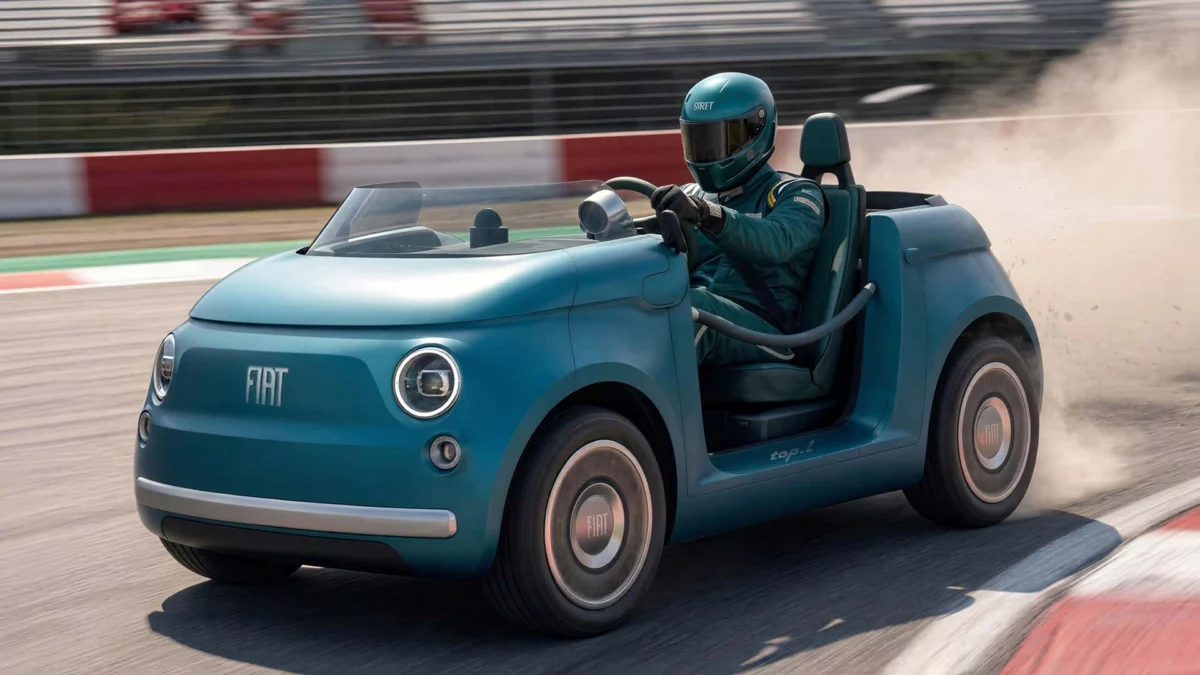
The Top.L (standing for "Love") is an exercise in minimalism. The studio stripped the production Topolino down to its bare essentials, converting it into a roofless, two-seat speedster. Featuring a dramatically cut-down windshield and a matte aquamarine finish, the car evokes the spirit of 1950s sports cars.
Giugiaro openly cites the Porsche 550 Spyder—famously dubbed "Little Bastard" by James Dean—as a spiritual influence. While the Top.L lacks the flat-four engine and raw speed of a mid-century racer, it captures the attitude. It is a design statement built for the modern urbanite who wishes to be seen, proving that in a city environment, style is a more potent currency than horsepower.
The Top.J: A Tribute to Heritage
If the Top.L is about love, the Top.J (standing for "Joy") is a testament to family legacy and vibrant design. Measuring a mere 8.3 feet in length, the Top.J miraculously accommodates four passengers, with the rear pair seated in a rearward-facing configuration.
The vehicle is finished in a striking blue and green livery, a direct homage to the Ferrari 166 MM once owned by Gianni Agnelli, Lapo Elkann’s grandfather. The choice of colors is deliberate, reflecting a long-standing tradition within the Agnelli family to commission vehicles that stand out from the drab palette of standard production cars. The cabin, a mix of high-quality foam and leather, creates a tactile environment that feels miles away from the hard plastics typically found in budget EVs.
Chronology of a Design Collaboration
The journey to the Top.L and Top.J was not a sudden decision, but rather the culmination of a broader shift in how Fiat is positioning its micromobility portfolio.
- 2023: Fiat gains significant market traction with the launch of the production Topolino, capitalizing on the "quadricycle" craze sparked by the Citroën Ami.
- Early 2024: Rumors of Abarth-tuned performance variants begin to circulate, signaling that Fiat is looking to inject "sportiness" into the brand’s smallest offering.
- Mid-2024: The collaboration between GFG Style and Lapo Elkann is formalized, with the intent to create a "styling showcase" that transcends the standard production model.
- Salone Auto Torino (Late 2024): The Top.L and Top.J make their global debut, immediately capturing the attention of the design world and shifting the conversation around what an L6e-class vehicle can represent.
Supporting Data: The Reality of the "Light Quadricycle"
To understand why these one-offs are so radical, one must look at the constraints of the base vehicle. The production Fiat Topolino is not a car in the traditional sense; it is a light quadricycle.
Performance and Legal Constraints
- US Market Status: Currently, the Topolino is not street-legal for high-speed use in the US. It is marketed as an off-road or campus/neighborhood vehicle with a capped speed of approximately 19 mph.
- The 2026 Shift: Fiat has announced a dealer-installed "Street Legal Conversion Kit" slated for late 2026. This kit will reclassify the vehicle as a Low-Speed Vehicle (LSV), allowing for a top speed of 25 mph and permitting usage on roads with speed limits of 35 mph or less.
- Pricing: With an entry price point hovering around $14,985, the Topolino is positioned as a mass-market solution for short-range commuting.
- European Classification: In Europe, the vehicle is categorized under the L6e class. The Top.J’s four-seat configuration presents a technical hurdle; current regulations for the L6e class restrict passenger capacity to two. Consequently, the Top.J remains a pure design exercise, exempt from the bureaucratic red tape that would otherwise prevent its production.
Official Responses and Strategic Implications
The industry response to the Top.L and Top.J has been largely positive, with many analysts viewing these models as a masterclass in brand repositioning.
Lapo Elkann, known for his unconventional approach to luxury and automotive design, described the project as a "necessary disruption." According to Elkann, the collaboration is not merely about creating two unique cars, but about establishing a long-term design language that could inform future Fiat releases. "Top.J is for joy, Top.L is for love—free, irreverent, and authentic," he noted.
For GFG Style, the project serves as a showcase for their capability to bridge the gap between "cheap" and "chic." By utilizing high-end materials like Alcantara and premium leather in a cabin that would otherwise be sparse, they have provided a blueprint for how entry-level EVs can offer a sense of occasion.
The Broader Market Implications
The implications of this collaboration are significant:
- The Rise of Personalization: The success of the Top.L and Top.J suggests that there is a massive, untapped market for custom, high-fashion versions of small EVs. As the market for EVs saturates, personalization will become the primary differentiator.
- Urban Integration: By proving that a tiny, low-speed vehicle can look "cool," designers are helping to destigmatize the use of micro-cars in urban environments. This is crucial for cities looking to reduce congestion and carbon footprints.
- Future-Proofing the Brand: The ongoing collaboration between Giugiaro and Elkann hints that Fiat is preparing for a future where the Topolino isn’t just a budget car, but a lifestyle accessory. While no further projects have been explicitly named, the duo’s statement that this is the "start of a longer collaboration" has sparked widespread speculation about a potential limited-edition, design-focused production run.
Motor1’s Take: A New Paradigm for Micromobility
The Top.L and Top.J represent a shift in the automotive narrative. For too long, the industry has equated "inexpensive" with "boring." Designers have been tasked with making cars cheap, but rarely have they been tasked with making them desirable at such a low price point.
Giugiaro and Elkann have succeeded where others have failed by focusing on the intangible. They have stripped away the focus on range anxiety and charging speeds and replaced it with an focus on heritage, tactile luxury, and pure, unadulterated style.
Whether or not these specific designs ever reach the assembly line is, in many ways, irrelevant. Their true value lies in the precedent they set. They demonstrate that the constraints of the L6e quadricycle segment are not a cage, but a platform. For buyers in crowded cities, the promise of a vehicle that is not only cheap and eco-friendly but also a legitimate "design statement" could be the catalyst needed to shift the public perception of the electric city car.
As we look toward 2026 and the introduction of the Street Legal Conversion Kit, the Topolino is set to become a more practical tool for the average driver. However, thanks to the vision of GFG Style, it is also poised to become an icon of urban fashion. The era of the "disposable" city car is ending; the era of the "desirable" micro-car has just begun.