In an era of cinema often defined by rapid-fire editing and sensory overload, Casey Affleck’s latest directorial effort, Company, serves as a meditative counter-current. Premiering in competition at the Venice Film Festival, the film is a deliberate exercise in restraint, functioning as an anthology of the human spirit. By weaving together disparate threads of existence across three distinct centuries—1903, 1953, and 1975—Affleck crafts a tapestry that examines the universal weight of grief, the sting of regret, and the elusive nature of forgiveness.
The film, which boasts a stellar ensemble cast including Nick Nolte, Adelaide Clemens, Ben Mendelsohn, Scoot McNairy, Emily Alyn Lind, Caylee Cowan, and Atticus Affleck, eschews spectacle in favor of the "two-shot." Through these intimate frames, Affleck invites the audience to listen, rather than merely observe, challenging the viewer to find truth in the silence between words.
A Chronology of Echoes: The Structure of ‘Company’
Company operates on a structural level that mirrors the oral tradition of storytelling. Rather than a linear progression, the narrative jumps through time, connecting lives through shared geography and parallel isolation.
The Winter of 1975
The narrative anchor of the film is set in the mid-70s, where we meet Tom (Nick Nolte), an aging, solitary figure living in a remote, snow-blanketed cabin. Tom is a man who has retreated from the world, not out of malice, but perhaps from a profound, existential exhaustion. His hermetic existence is interrupted when he discovers a young woman, Alice (Caylee Cowan), collapsed in the snow outside his door. After bringing her into the warmth of his home, the film shifts into a chamber drama. Alice begins to recount a story set decades earlier, effectively folding the history of 1903 into the present of 1975.
The Farmstead of 1903
Within Alice’s narrative, the audience is transported to an isolated farmstead at the turn of the century. Here, we meet Rebecca (Adelaide Clemens) and a partner (Scoot McNairy), a couple whose lives are disrupted by the arrival of a mysterious drifter named Caleb (Atticus Affleck). Much like Tom in 1975, this couple finds themselves playing host to a stranger rescued from the elements. The tension here is palpable; Caleb carries the braggadocio of a world traveler, balanced precariously against an underlying, unspoken insecurity. For Rebecca, Caleb represents both a threat to her domestic stability and a mirror to her own unvoiced desires.
Cinematic Philosophy: The Power of the Still Frame
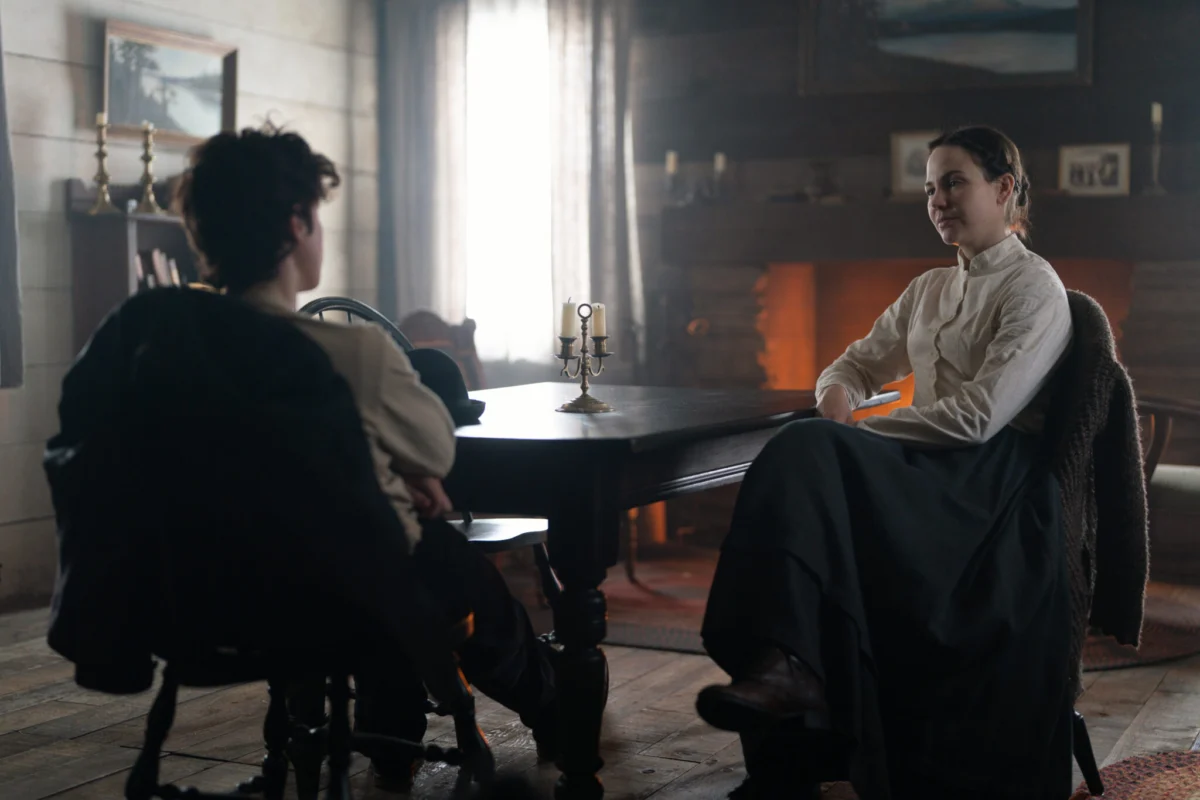
Central to the film’s success is the visual language developed by Affleck and cinematographer Marcell Rév. Eschewing the conventional coverage—where scenes are broken down into a series of close-ups—the production relies on long, static takes that capture the actors’ entire physicality.
The Intimacy of the Two-Shot
For veteran actor Nick Nolte, the directorial style was a revelation. "When Casey sets up the camera, you know by the angles that he’s shooting from that it’s going to be much more intimate," Nolte notes. "It was the script, and it was so delicate. It had these silences and gaps, and the storytelling was obvious. I just found that intriguing. It wasn’t like any script that normally comes in."
This sentiment is echoed by Adelaide Clemens, who emphasizes the technical difficulty and emotional payoff of this approach. "Directors will often do a two-shot, but then they’ll cover it as well," Clemens explains. "But if you have two actors who are in an environment where they’re supported, then you can have a really powerful scene, and you can see our whole bodies. We tell this whole story from the shins up."
The decision to film in this manner requires an immense level of trust between director and performer. Clemens notes that because Affleck is an Oscar-winning actor himself, he understands the vulnerability required to sustain a performance without the "safety net" of rapid editing. "It wouldn’t be executed in the way it was if we didn’t have Casey trusting us," she adds.
The Performance of Silence
The success of Company rests heavily on the faces of its actors. In the segments involving Tom and Alice, the camera lingers on Nolte’s face as he listens. His performance is a masterclass in internal processing; he is not simply waiting for his turn to speak, but actively embodying the character’s evolution as the story unfolds.
"It was really about listening, just really listening to the story," Nolte says of his process. He characterizes his role not as a typical hermit, but as a man who has made a conscious, lifelong choice to step away from humanity. "I looked at him as somebody that wanted to not be with humanity in general. He was a reclusive, and he lived in isolation, and he’d probably be a trapper."
In the 1903 timeline, the dynamic shifts. Clemens, who approaches the role of Rebecca with a "Buddha-like" stillness and maternal depth, provides a grounding force for the erratic energy of Atticus Affleck’s Caleb. According to Clemens, working with the younger Affleck was a transformative experience. "He was well-prepared, and he rehearsed intensely," she says. "But his performance was natural and didn’t feel like a performance… He was amazing."
Implications: The Vitality of the Veteran Actor
Perhaps the most poignant aspect of Company is the platform it provides for Nick Nolte, who at 86 remains one of the most compelling faces in American cinema. In an industry notoriously unkind to aging, the film stands as a testament to the idea that performance is not merely a job, but a vital necessity for the artist.
"I’m 86, and [I’m] real limited in the kind of roles I can play now, but I find that without the work, there just isn’t any reason to keep on going," Nolte says candidly. For the veteran actor, the act of performance is inextricably linked to the act of living. "You know your creativity is tied into it, and as long as I’m physically capable, I encourage them to consider me. I haven’t thought about retiring."
This focus on the veteran performer aligns with the broader themes of the film: the transmission of knowledge from one generation to the next and the enduring power of a story well-told. By centering his film on the act of listening, Affleck argues that there is profound value in the experiences of those who have seen the most.
Conclusion: A Legacy of Storytelling
Company is not a film that demands to be understood; it is a film that asks to be experienced. Through its meticulous framing, its reliance on the quiet interplay between actors, and its exploration of isolation across time, Casey Affleck has created a work that feels both ancient and immediate.
As the film makes its way from the Venice Film Festival to global audiences, its primary legacy may be the validation of a slower, more deliberate form of filmmaking. In a world that often demands we look away, Company forces us to look closer—at the person sitting across from us, at the stories they carry, and at the silence that binds us all together. Whether in the snowy isolation of 1975 or the dusty farmsteads of 1903, the film reminds us that the fundamental human need to share our stories remains the one constant in an ever-changing world.