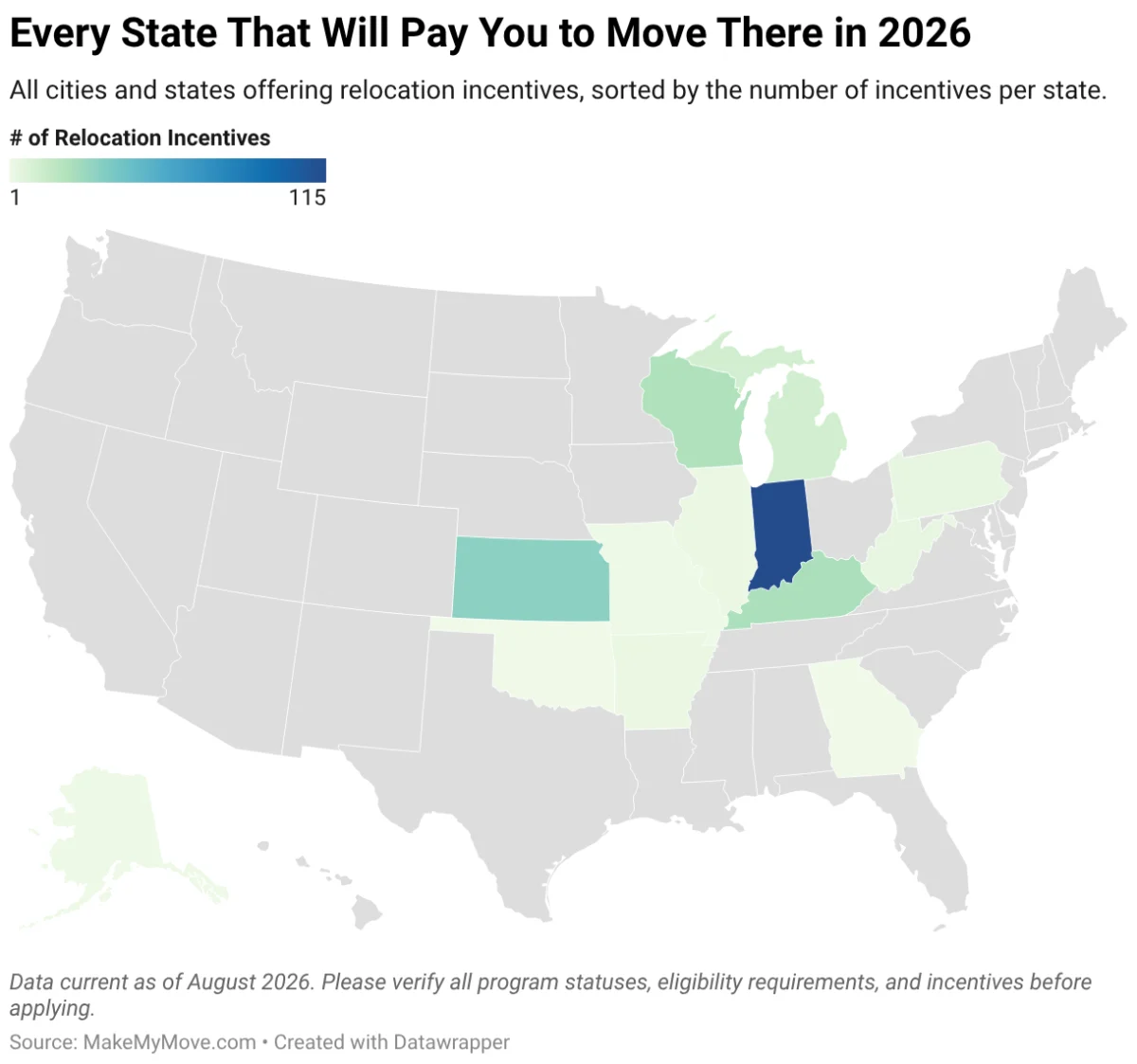
In an era defined by the permanence of remote work and the relentless climb of the national cost of living, a new trend has emerged in the American housing market: the "incentivized migration." With approximately 22% of the workforce operating remotely as of mid-2026, cities and states across the U.S. are competing to attract talent by offering tangible financial rewards.
What was once a niche experiment for struggling small towns has evolved into a sophisticated economic strategy. From cash stipends and mortgage subsidies to free outdoor equipment and coworking memberships, these programs represent a fundamental shift in how local governments view population growth. Whether you are seeking a change of scenery or a way to lower your monthly expenses, these 13 destinations offer more than just a new address—they offer a fresh start with a bonus.
The Evolution of Relocation Incentives
The logic behind these programs is straightforward: by importing remote workers—who typically earn higher-than-average salaries and contribute to the local tax base without requiring local infrastructure expansion—municipalities can revitalize stagnant economies. These programs, often managed through platforms like MakeMyMove, have matured significantly. In the past, incentives were often nominal; today, they frequently reach or exceed $20,000 in total value.
1. Alaska: The Original Pioneer
Alaska remains the gold standard for state-sponsored incentives. The Permanent Fund Dividend (PFD), established in 1982, distributes a share of the state’s mineral royalties to residents. While subject to legislative debate and annual budget fluctuations, the PFD remains a foundational pillar of Alaskan life. For 2026, residents can expect approximately $1,000 per person, supplemented by energy rebates. Beyond the PFD, programs like Choose Ketchikan offer practical perks, such as free fiber-optic internet, to sweeten the transition to the Last Frontier.
2. Arkansas: Combining Cash with Wilderness
Arkansas has positioned itself as a premier destination for those seeking an outdoor-centric lifestyle. Cities such as Texarkana and West Memphis offer aggressive packages exceeding $10,000. These programs are designed for remote workers who value wilderness access, providing not only cash but also high-quality outdoor gear and community integration events, such as dinners with local leadership, to ensure newcomers feel at home immediately.
3. Georgia: The "Move to Meaningful" Initiative
Columbus, Georgia, has turned its "Move to Meaningful" program into a model for success. After a pilot launch in 2024, the city renewed its commitment in 2026 due to an overwhelming influx of over 7,000 initial applicants. The program offers $5,000 in direct cash alongside a suite of lifestyle perks, including six months of complimentary coworking space, which helps foster the social connections often missing in remote work.
4. Indiana: A Hub for Diverse Opportunities
Indiana boasts over 100 localized incentive programs. Because the state offers everything from urban living in Indianapolis to the rolling hills of the south, the packages vary wildly. Cities like Noblesville and regions like Floyd County are currently offering incentives up to $15,000, while smaller towns like Angola have reached the $20,000 mark. These initiatives are highly targeted, often focusing on professionals who are ready to invest in local real estate.
5. Illinois: Revitalizing the Heartland
The Jacksonville region in Southwestern Illinois is leading the charge in the Midwest. Towns like Pittsfield and Jacksonville are offering up to $9,000 in relocation assistance. These packages are specifically structured to bridge the gap between urban remote work and the affordability of the prairie lifestyle, including three months of free internet—an essential for the modern digital nomad.
6. Kansas: The "Choose Topeka" Model
Kansas has been at the forefront of rural population stabilization for over a decade. The Choose Topeka initiative is perhaps the most famous, successfully reversing population declines in Shawnee County. By partnering with local employers, the program provides robust financial support. Buhler, located near Wichita, currently leads the state with packages worth up to $15,500.
7. Kentucky: Bourbon, Bluegrass, and Bonuses
Kentucky is leaning into its cultural identity to attract new residents. Eight distinct programs operate across the state, with Mayfield offering the most lucrative package at $8,800. These incentives are often complemented by local cultural benefits, including music lessons and community integration, acknowledging that retention depends on more than just a paycheck.
8. Michigan: The Rust Belt Renaissance
Michigan is aggressively marketing its affordable, revitalized downtowns. Programs like Make Michigan Home target professionals in high-growth sectors such as IT and healthcare. By offering down-payment assistance alongside cash stipends, the state is successfully converting transient remote workers into long-term homeowners.
9. Missouri: The Mercer County Advantage
Mercer County offers a glimpse into the future of rural remote work incentives. Through late 2026, the county is providing a $6,500 package that includes cash, gym memberships, and a year of high-speed internet. This "all-inclusive" approach aims to remove the barriers that typically prevent people from moving to more isolated, affordable regions.
10. Oklahoma: The Tulsa Remote Phenomenon
Tulsa Remote is perhaps the most recognized program in the country, having brought over 4,000 people to the city since 2018. The program offers $10,000 in total incentives, distributed either as a lump sum for home buyers or via monthly disbursements for renters. The success of Tulsa Remote has generated tens of millions of dollars in local economic activity, proving that the model is sustainable at scale.
11. Pennsylvania: Western PA’s Strategic Growth
Western Pennsylvania is utilizing relocation incentives to capitalize on its proximity to major markets like Pittsburgh and Cleveland. Cities such as Sharon and Hermitage offer up to $8,400. These programs focus heavily on the "live-work-play" aspect, bundling cash with golf memberships and other local recreational perks.
12. West Virginia: The $20,000 Opportunity
Ascend West Virginia is currently the most lucrative program in the nation, offering a total value of $20,000. The program targets the Greenbrier Valley and Morgantown areas, among others. Beyond the $12,000 cash portion, the program provides professional development and high-end outdoor equipment, positioning the state as the ultimate destination for the "outdoor-remote" professional.
13. Wisconsin: Lake Life and Financial Support
Wisconsin is leveraging its natural beauty and low cost of living to draw in residents. Cities including Fond du Lac and Eau Claire offer up to $11,500. These packages are unique in their focus on family support, often including child-care assistance and educational resources, which sets them apart from programs focused solely on single young professionals.
Supporting Data and Economic Implications
The financial impact of these programs is not purely anecdotal. Research indicates that for every dollar spent on these incentives, the return on investment through local income taxes, property taxes, and increased consumer spending is significant. However, there are risks. Critics argue that such programs can drive up local real estate prices, potentially pricing out long-term residents.
Furthermore, the "transient nature" of remote workers remains a concern. To mitigate this, most programs now require a two-year commitment to residency. If a resident moves before the contract ends, they are often required to repay the prorated amount of the incentive.
Official Responses and Perspectives
Local mayors and economic development boards across these 13 states emphasize that the goal is "community building," not just "population filling." In Tulsa, for example, the program’s organizers have stressed that the creation of a community, through coworking spaces and social events, is what keeps participants in the city long after the cash incentives have been exhausted. Conversely, in Alaska, the PFD is viewed as a "citizen dividend," a right of residency that reinforces the social contract between the state and its people.
Final Thoughts: A Calculated Risk
If you are considering a move, these incentives should be viewed as a "cherry on top" rather than the sole reason for relocation. The most successful moves are those where the city aligns with your personal and professional values. Before applying:
- Verify Eligibility: Most programs require proof of remote employment or a job offer in a specific industry.
- Calculate the True Cost: Use mortgage and rental affordability calculators to ensure that the cost of living—even with the incentive—fits your long-term budget.
- Due Diligence: Visit the location, spend time in the neighborhoods, and research the local tax laws.
As remote work continues to redefine the American landscape, these 13 states are providing a roadmap for how cities can reclaim their vitality in the 21st century. The opportunity to get paid to move is real, but the true reward lies in finding a community that supports your lifestyle for years to come.