In a landmark ruling that signals a further erosion of civil liberties in Hong Kong, the Court of First Instance delivered a guilty verdict on Friday against prominent activists Chow Hang-tung, Lee Cheuk-yan, and the now-disbanded Hong Kong Alliance in Support of Patriotic Democratic Movements of China. The defendants were found guilty of "incitement to subversion" under the Beijing-imposed National Security Law (NSL), a charge that could see them imprisoned for up to a decade.
The ruling, delivered by a panel of three NSL-designated judges, effectively criminalizes the act of memory. By labeling the annual June 4 vigils—which for three decades served as the world’s most visible tribute to the victims of the 1989 Tiananmen Square massacre—as a subversive act, the court has solidified the legal infrastructure necessary to silence political dissent in the territory.
The Legal Logic of Subversion
The crux of the prosecution’s case, and the judges’ subsequent ruling, rested on the interpretation of the phrase "the end of one-party dictatorship." For years, this slogan was the rallying cry of the Hong Kong Alliance.
During the trial, the judges argued that because the 2018 amendment to Article 1 of the Chinese Constitution explicitly enshrines the leadership of the Chinese Communist Party (CCP) as the defining feature of "socialism with Chinese characteristics," any challenge to that leadership is inherently a challenge to China’s "basic system." The court concluded that there can be no "natural end" to CCP rule; therefore, advocating for such an outcome constitutes a direct incitement to overthrow state power.
Chow Hang-tung and Lee Cheuk-yan had mounted a vigorous defense, citing Article 2 of the Chinese Constitution, which states that "all power in the People’s Republic of China belongs to the people." They argued that their advocacy was a legitimate exercise of political expression protected by the constitutional framework. The court, however, dismissed this defense, ruling that the Constitution must be read as a cohesive whole where the CCP’s leadership is the non-negotiable foundation of the state.
Crucially, the court addressed the constitutional friction between mainland Chinese law and the "One Country, Two Systems" framework. Despite Article 18 of Hong Kong’s Basic Law—which limits the application of national laws within the city—the judges asserted that the Chinese Constitution serves as the ultimate source of legal authority for Hong Kong. This interpretation effectively erodes the legal buffer that once separated Hong Kong’s common law system from the mainland’s political-legal structure.
Chronology of a Disappearing Movement
The legal assault on the Hong Kong Alliance and its leaders was not an isolated event but the culmination of a systematic campaign that began in the immediate aftermath of the 2019 pro-democracy protests.
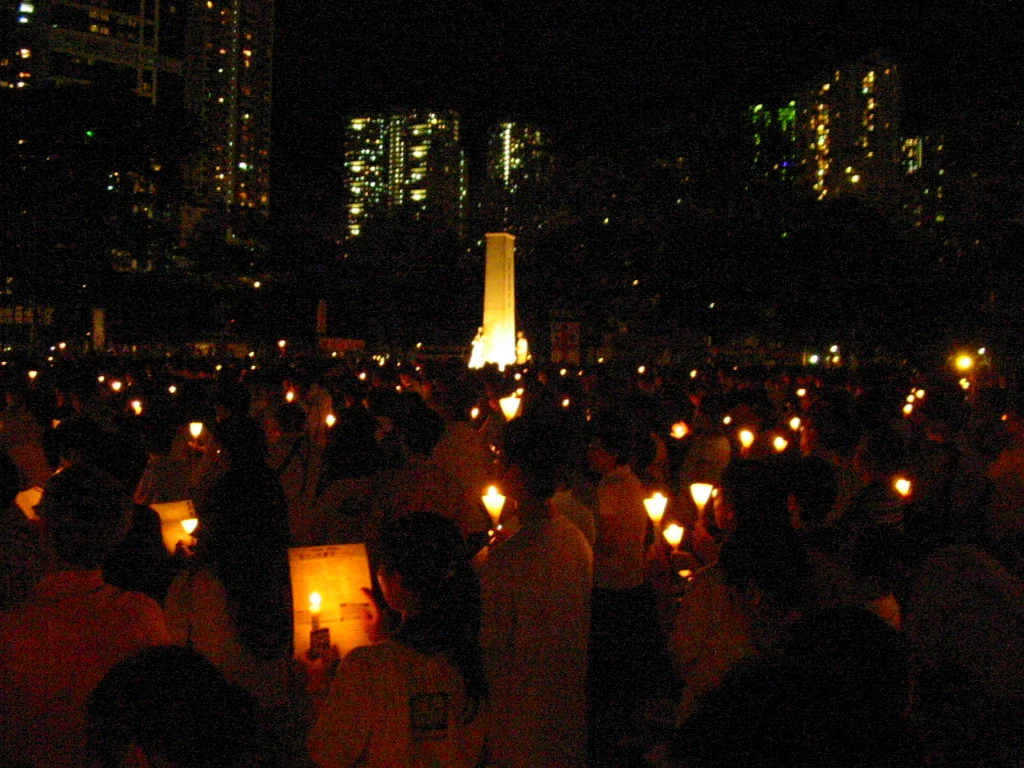
- 1989–2020: The Hong Kong Alliance holds annual candlelight vigils in Victoria Park, drawing tens of thousands of participants to honor those killed in the 1989 Beijing crackdown.
- February 28, 2020: Lee Cheuk-yan is arrested in connection with unauthorized assemblies, marking the beginning of a long period of incarceration for the veteran labor leader.
- September 8, 2021: Chow Hang-tung is arrested on charges of "incitement to subversion" under the NSL. She remains in custody for over 1,800 days awaiting the final verdict.
- September 2021: The Hong Kong government moves to disband the Alliance, citing national security concerns. The organization is forced to cease operations.
- November 2025: Former Chief Executive Carrie Lam’s administration formally bans multiple organizations for alleged subversive activities, stripping away the remaining infrastructure of the pro-democracy camp.
- August 2026: The Court of First Instance hands down the guilty verdict, solidifying the legal precedent that equates public commemoration of historical events with state subversion.
Supporting Data and The Human Cost
The human toll of this legal crusade is profound. Chow Hang-tung, a barrister by trade, spent 1,808 days in pre-trial detention before this week’s verdict. Her prolonged confinement is emblematic of the "new normal" in Hong Kong, where the pre-trial period often functions as a punitive measure in itself.
Lee Cheuk-yan, a former legislator and founding figure of the Hong Kong Confederation of Trade Unions, has been a fixture of the city’s pro-democracy movement for decades. His transition from a public voice for worker rights to a prisoner of the state reflects the broader shift in Hong Kong’s political climate. While fellow activist Albert Ho Chun-yan chose to plead guilty earlier in the process, the decision of Chow and Lee to contest the charges turned the trial into a high-stakes debate over the definition of the Chinese state and the limits of political speech.
The Alliance, as an organizational defendant, represents the death of civil society. By targeting the group itself, the government has ensured that no legal entity remains to organize even the most modest memorial services, effectively creating a "memory vacuum" regarding the events of 1989.
Official Responses and the Governance Divide
The response to the verdict highlights the stark divide between the Hong Kong government and international human rights monitors.
The Hong Kong Government’s Stance
Chief Executive John Lee and his administration have lauded the ruling as a necessary step in protecting national security. In a statement released shortly after the verdict, the government reiterated that the defendants were engaged in activities explicitly hostile to the CCP. The administration characterized the verdict as a triumph of the rule of law, arguing that "no one is above the law" and that the "incitement to subversion" charge was applied correctly to protect the constitutional order of the nation.
International and Human Rights Criticism
In contrast, international observers have condemned the ruling as a final nail in the coffin of Hong Kong’s once-vibrant political scene. Amnesty International described the verdict as "dismaying," framing it as part of a "deliberate campaign to erase Chinese history."
The human rights group noted that the prosecution of these individuals is not merely about past actions, but about controlling the future of collective memory in the region. By criminalizing the June 4 vigils, the state is attempting to ensure that future generations in Hong Kong remain unacquainted with the history of the 1989 protests, thereby consolidating ideological control.
Implications: A New Era of Legal Certainty
The implications of this ruling extend far beyond the defendants. For the legal community in Hong Kong, the judgment sets a dangerous precedent. It suggests that the NSL can be used to reach back into historical activities—even those that were legal at the time—and re-characterize them as threats to the state.
Furthermore, the court’s reliance on the 2018 constitutional amendment to justify the suppression of dissent suggests that the "One Country, Two Systems" model is being aggressively reinterpreted. The judiciary’s willingness to look past the Basic Law toward the mainland’s constitutional framework indicates that the firewall between the two legal systems has been substantially breached.
As the city moves forward, the "chilling effect" is palpable. The disappearance of the Hong Kong Alliance and the conviction of its leaders signals that the space for organized advocacy has been effectively extinguished. For the people of Hong Kong, the ruling serves as a stark reminder that the history they once commemorated is now treated as a threat to the current order, and the laws they once relied upon for protection have been repurposed as tools of state consolidation.
The conviction of Chow, Lee, and their associates is not just a conclusion to a trial; it is a definitive marker of a political transition, where the memory of the past is being actively rewritten to serve the security requirements of the present.