For nearly a century, the field of paleontology operated under a fundamental, near-dogmatic assumption: the process of fossilization is a great eraser of biological history. As organic tissues are replaced by minerals over millions of years, the delicate molecular architecture of life—proteins, DNA, and soft tissues—was thought to be systematically obliterated. Scientists operated under the belief that once a creature died and was entombed in sediment, its internal biological "hard drive" was wiped clean, leaving behind only the cold, stony impressions of its external form.
However, a groundbreaking study led by the University of Liverpool has shattered this long-standing paradigm. By deploying cutting-edge analytical chemistry on a remarkably preserved Edmontosaurus fossil, researchers have provided what many are calling definitive evidence that original organic molecules can survive the crushing weight of deep time. This discovery does more than just confirm the presence of ancient proteins; it offers a new roadmap for understanding the evolutionary relationships and biological mysteries of the Mesozoic era.
A Scientific Cold Case: The Three-Decade Debate
The debate regarding the survival of ancient biomolecules has been one of the most contentious issues in modern paleontology. For over 30 years, sporadic claims of "soft tissue" or "fossil proteins" in dinosaur bones were met with intense skepticism. Critics consistently argued that any organic material detected within a fossil was likely the result of modern contamination—microbes, soil leaching, or residue from human handling—rather than an authentic remnant of a prehistoric creature.
The prevailing view was simple: proteins like collagen, the structural backbone of vertebrate bone, are biologically unstable. They are susceptible to hydrolysis and microbial degradation. To find them in a specimen dating back to the Cretaceous period—tens of millions of years ago—seemed chemically impossible. This skepticism created a high bar for any researcher claiming to have found genuine prehistoric organics. Proving that a molecule was "original" rather than an interloper required more than just visual evidence; it required the precision of modern analytical chemistry.
The Subject: An Edmontosaurus from Hell Creek
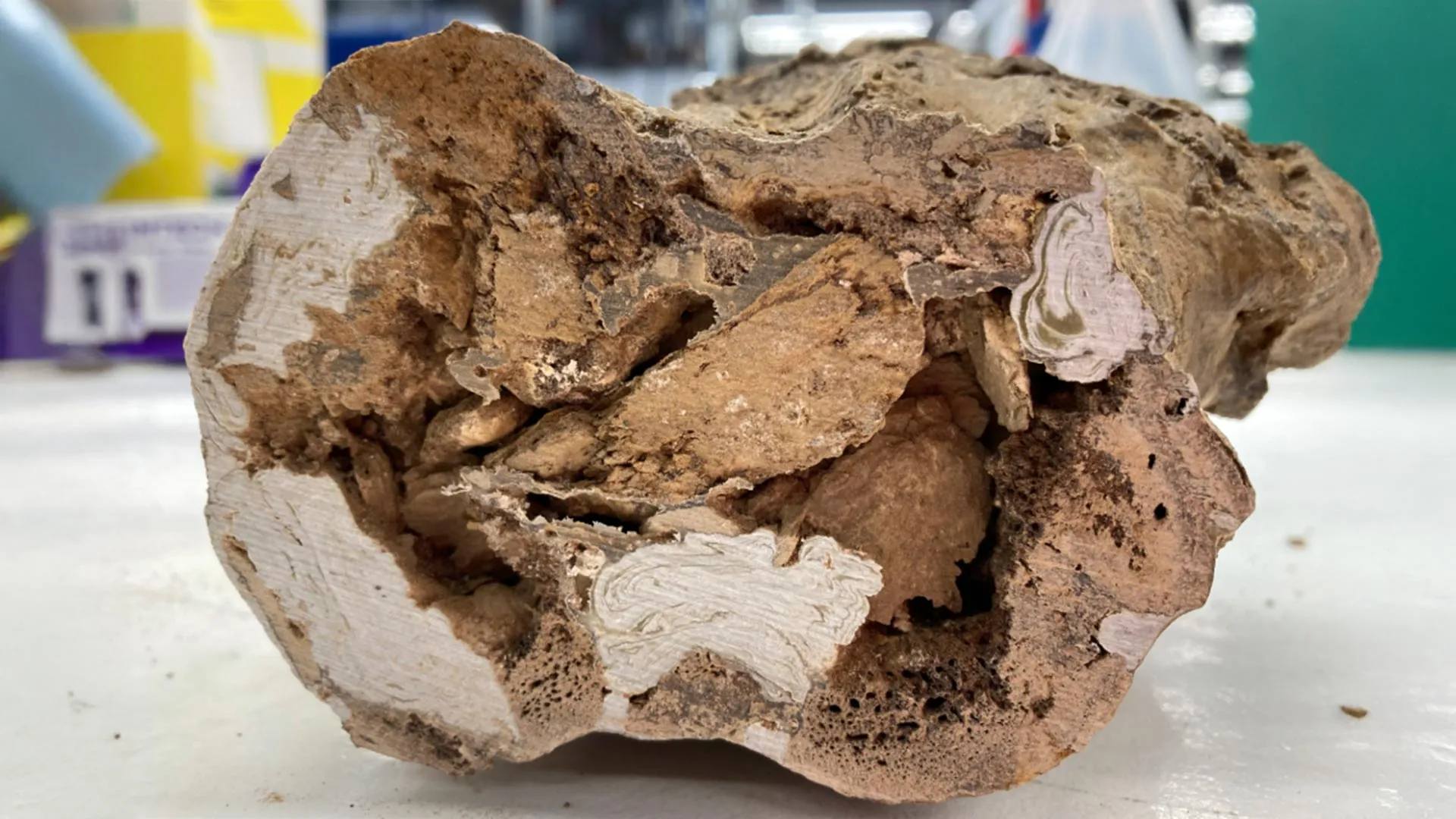
The focus of this landmark study, published in the journal Analytical Chemistry, was an exceptionally well-preserved sacrum—a fused group of vertebrae connecting the spine to the pelvis—of an Edmontosaurus, a genus of duck-billed dinosaur. The specimen, weighing 22 kilograms, was unearthed from the Hell Creek Formation in South Dakota.
The Hell Creek Formation is a legendary geological site for paleontologists, known for preserving the final chapters of the dinosaur age. The specific environmental conditions of this site, combined with the structural integrity of the sacrum, provided a rare "window" into the past. Once brought into the University of Liverpool’s collections, the fossil became the centerpiece of a multi-institutional effort to determine whether the rock truly held the secrets of the beast it once was.
The Analytical Arsenal: Mass Spectrometry and Beyond
To move beyond the realm of speculation, the research team utilized an array of advanced analytical techniques designed to identify molecules with extreme precision. The methodology was a masterclass in multidisciplinary science, involving specialists from the University of Liverpool, the University of California, Los Angeles (UCLA), and the Materials Innovation Factory.
The Role of Mass Spectrometry
At the heart of the investigation was mass spectrometry. This technique functions by ionizing chemical species and sorting the ions based on their mass-to-charge ratio. By measuring the chemical properties of the material within the bone, researchers could search for "molecular signatures"—specific patterns that match known structural proteins.
Confirming the "Smoking Gun": Hydroxyproline
The research was bolstered by the contribution of scientists from UCLA, who employed tandem mass spectrometry. This refined technique allowed the team to quantify the presence of hydroxyproline, an amino acid that is a vital component of collagen. Because hydroxyproline is specific to collagen in bone tissue, its detection serves as a chemical "smoking gun." The presence of this specific amino acid within the fossilized bone provided undeniable evidence that the researchers were looking at decayed, ancient collagen, rather than modern environmental contaminants.
Identification of Collagen Alpha-1
Further validation came from the Centre for Proteome Research at the University of Liverpool. By conducting rigorous protein sequencing, the team identified fragments of collagen alpha-1, the primary form of collagen found in vertebrate bone. The convergence of these multiple, high-resolution techniques provided a robust, multi-layered verification that the organic remnants were, in fact, endogenous to the Edmontosaurus specimen.
Official Perspectives: Implications for the Future
Professor Steve Taylor, chair of the Mass Spectrometry Research Group at the University of Liverpool’s Department of Electrical Engineering & Electronics, emphasized the gravity of these findings. In his assessment of the project, Professor Taylor highlighted three major implications for the scientific community:
- Refuting the Contamination Hypothesis: "This research shows beyond doubt that organic biomolecules, such as proteins like collagen, appear to be present in some fossils," Taylor stated. By successfully isolating and identifying the protein fragments, the study provides a strong rebuttal to the argument that all ancient organic finds are merely modern intrusions.
- Revisiting Historical Archives: One of the most intriguing aspects of the study is its call to action regarding historical data. "Our results suggest that cross-polarized light microscopy images of fossil bones, collected for a century, should be revisited," Taylor noted. If these century-old images contain recognizable patches of preserved collagen, museums worldwide may already possess a vast, untapped library of fossils ripe for molecular analysis.
- Solving the Persistence Mystery: Perhaps the most profound takeaway is the question of survival. If proteins are theoretically destined to break down, how did these fragments endure for tens of millions of years? "The findings inform the intriguing mystery of how these proteins have managed to persist in fossils for so long," says Taylor. Solving this mystery could lead to a new understanding of fossilization chemistry.
A New Frontier: Molecular Paleontology
The implications of this study extend far beyond a single dinosaur sacrum. If scientists can routinely extract and sequence protein fragments from Mesozoic fossils, the study of extinct life could shift from being purely anatomical to being deeply molecular.
Mapping Evolutionary Relationships
Traditional paleontology relies on morphological analysis—comparing the shape of bones, teeth, and skulls to determine how dinosaur species evolved. While effective, this method has limitations when fossils are fragmented or when species share similar physical traits due to convergent evolution. Molecular data offers a higher degree of granularity. By comparing amino acid sequences from ancient fossils, researchers could potentially construct much more accurate "family trees," identifying biological relationships that remain obscured by the limitations of skeletal anatomy alone.
Opening the Archive
The suggestion that cross-polarized light microscopy can act as a screening tool is a game-changer. For decades, paleontologists have used this technique to study the microscopic structure of bone. If these existing, readily available images can identify "promising" fossils for mass spectrometry, the cost and labor associated with future research could be significantly reduced. It effectively turns thousands of fossils currently sitting in drawers into potential sources of genetic and biological data.
The Unanswered Questions
Despite the success of the Liverpool-led study, the findings open a new chapter of inquiry rather than closing the book. The primary mystery remains: the mechanism of preservation. Proteins are complex chains of amino acids that are naturally prone to decay. What unique chemical environment—perhaps the specific mineral interaction within the Hell Creek sediments—allowed these collagen fragments to survive the geological epoch?
Further research will likely focus on the geochemistry of the fossil site. Scientists will need to investigate how mineral precipitation might "shield" organic molecules from microbial attack and oxidative degradation. Furthermore, the team hopes to apply these methods to other specimens, testing whether this preservation is a fluke of the Edmontosaurus or a widespread phenomenon that has simply gone unnoticed until now.
Conclusion: A Paradigm Shift
The work conducted by the University of Liverpool and its partners marks a definitive turn in the history of paleontology. By utilizing the precision of modern mass spectrometry to bridge the gap between geology and biology, the team has turned the tide in a thirty-year debate. We are no longer limited to the "stone" aspect of fossils; we are beginning to access the "biological" aspect as well.
As we look toward the future, the integration of molecular analysis into paleontology promises to reveal a richer, more nuanced view of the Mesozoic world. We are moving toward a future where we can not only describe what these creatures looked like, but also glimpse the very molecules that gave them life. The study of the Edmontosaurus sacrum serves as a powerful reminder that in science, long-held assumptions are often just waiting to be challenged by the next wave of technological innovation. The bones of the past are speaking, and finally, we have the tools to listen.