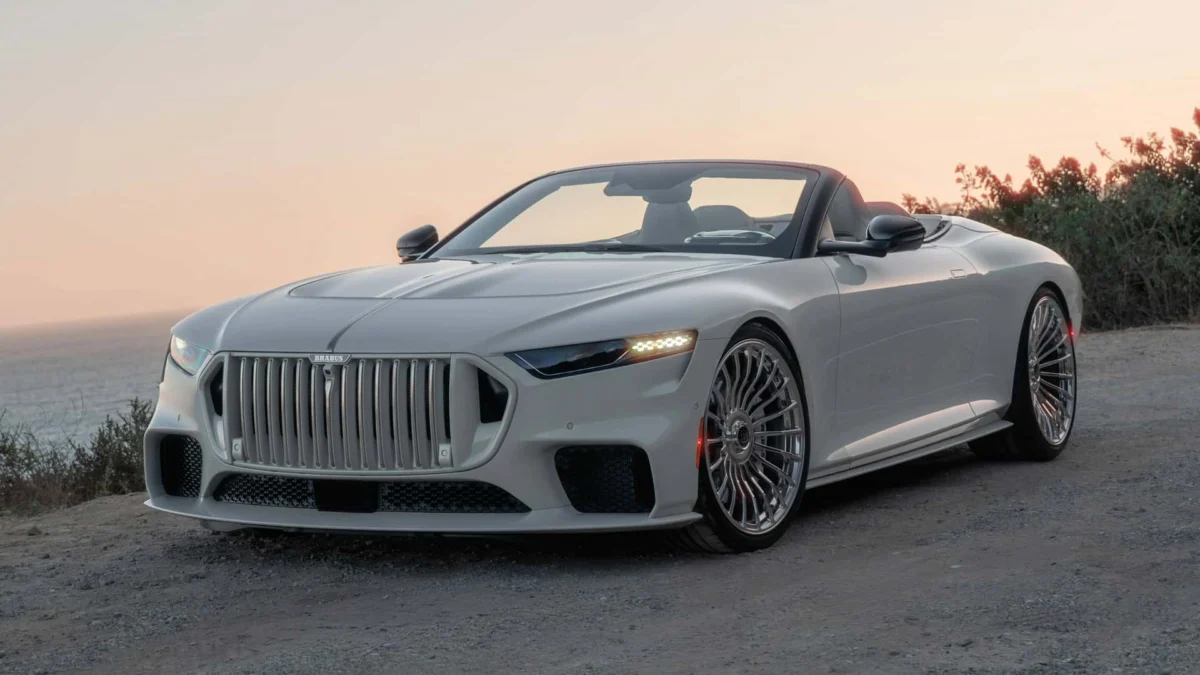
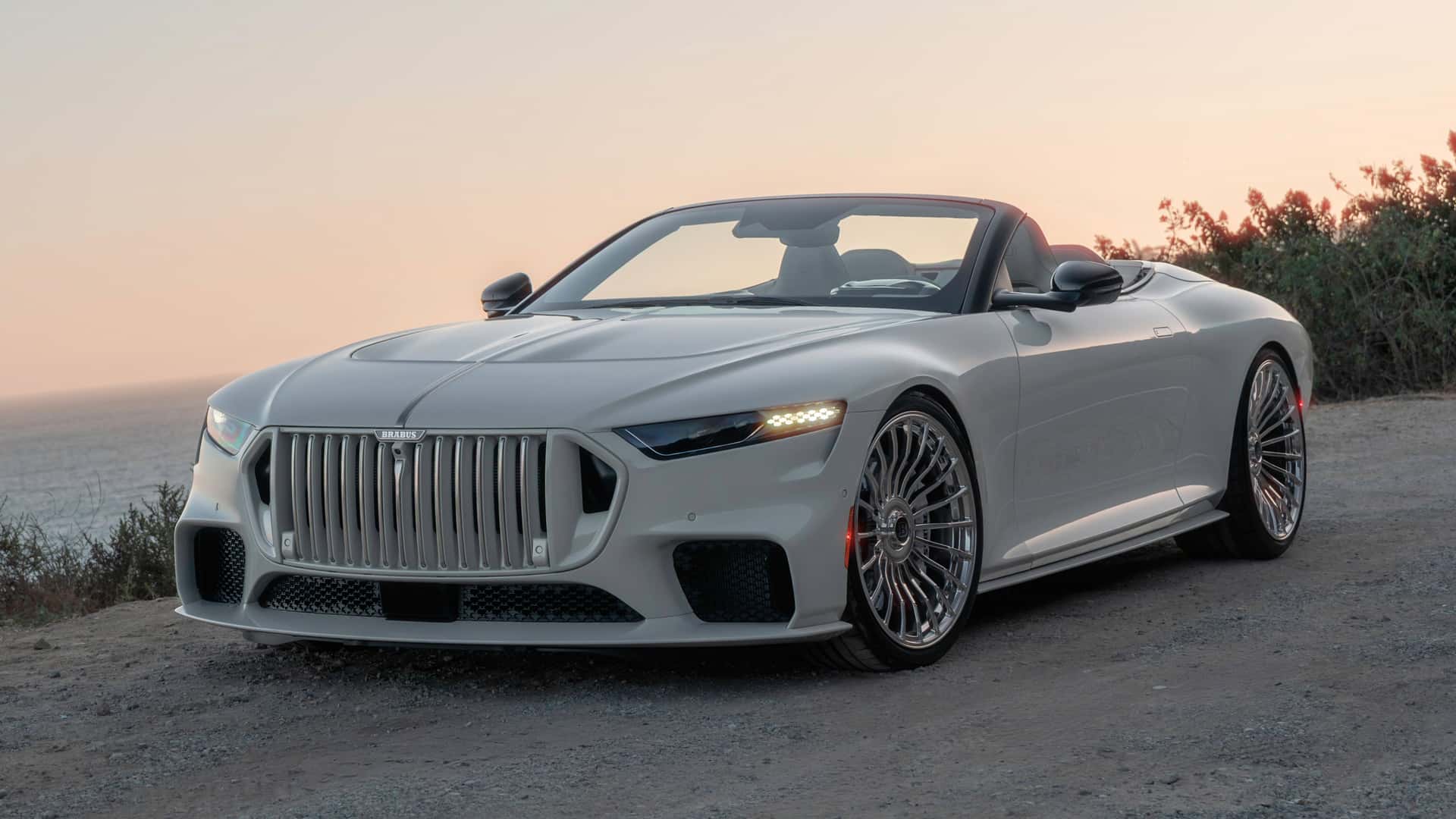
The automotive world witnessed a seismic shift in high-performance coachbuilding on August 14, as the sun set over the iconic backdrop of The Quail, A Motorsports Gathering. Amidst a collection of the world’s rarest machinery, Brabus—the legendary German tuner turned elite manufacturer—unveiled its latest masterpiece: the Brabus Bodo Cabriolet.
A spiritual and mechanical successor to the already formidable Bodo Hyper-GT coupe, this open-top iteration is not merely a convertible; it is a carbon-fiber-clad statement of intent. With 1,000 horsepower channeled through a highly evolved V12 heart, the Bodo Cabriolet represents the absolute zenith of what occurs when unlimited resources meet uncompromising German engineering.
The Genesis of the Bodo: A Chronology of Hyper-GT Evolution
The journey to the Bodo Cabriolet began in the high-stakes laboratories of Bottrop, Germany. Brabus, long known for transforming Mercedes-Benz vehicles into record-shattering super-sedans, shifted its focus toward total, bespoke vehicle architecture.
- The Conceptual Phase: The Bodo project was born from a desire to push beyond simple engine tuning. It required a donor chassis capable of handling four-digit horsepower figures while maintaining the grace of a grand tourer. The Aston Martin Vanquish Volante was selected as the foundational skeleton, providing the essential cabin architecture and mechanical geometry.
- Engineering Redesign: Throughout 2023 and early 2024, the Brabus engineering team began stripping the donor chassis. Every panel was replaced with custom-molded, pre-preg carbon fiber, significantly altering the vehicle’s aerodynamics and weight distribution.
- The Reveal: The coupe variant set the industry ablaze earlier this year, but the Cabriolet was kept under wraps until the Pebble Beach Concours d’Elegance festivities. Its debut at The Quail was not just a product launch; it was a demonstration of Brabus’s newfound status as a boutique manufacturer of ultra-limited, million-dollar hypercars.
Technical Specifications: The Anatomy of a Thousand Horses
Under the elongated, sculpted hood of the Bodo Cabriolet lies a masterpiece of forced induction. The Aston Martin-sourced 5.2-liter twin-turbo V12 has been extensively reworked. By upgrading the turbochargers, optimizing the intake system, and rewriting the ECU software, Brabus has unlocked a staggering 1,000 horsepower and 885 pound-feet of torque.
Powertrain and Dynamics
The power delivery is managed by an eight-speed automatic transmission, refined to handle the immense torque without sacrificing the smoothness expected of a grand tourer. A high-performance limited-slip differential ensures that the power is distributed efficiently to the rear wheels, allowing the vehicle to balance raw acceleration with sophisticated road manners.
Lightweight Construction
Despite its massive presence and complex hardware, the Bodo Cabriolet remains surprisingly agile. Its dry weight is capped at 3,911 pounds—a feat achieved through the extensive use of lightweight carbon fiber. The dimensions are imposing: at 199.3 inches long and 79.8 inches wide, the car commands space, yet its 51.3-inch height gives it a low, predatory stance.
Aerodynamics and Contact Patch
The car sits on custom 22-inch Brabus Monoblock Z-GT wheels, which are not merely aesthetic choices; they are engineered to provide maximum cooling to the massive braking system. The active aerodynamics package is a highlight, featuring an integrated front carbon spoiler and an electrically extendable rear wing that adjusts based on speed and driving mode, ensuring downforce is maintained at the car’s 223-mph limit.
Performance Metrics: Defying the Laws of Physics
In the rarefied air of the hypercar segment, the Bodo Cabriolet stands as a genuine speed machine. While many coachbuilt specials are designed solely for static display, the Bodo is a functional weapon.
- 0–60 mph: 3.0 seconds.
- 0–62 mph (100 km/h): 3.0 seconds (precise calibration).
- 0–186 mph (300 km/h): 23.9 seconds.
- Top Speed: Electronically capped at 223 mph.
These figures place the Bodo in direct competition with the most elite open-top vehicles currently available. Unlike many other tuned vehicles, the Bodo’s performance is linear and accessible, designed to be capable on both winding coastal roads and the unrestricted stretches of the German autobahn.
Official Perspectives: The Philosophy of Brabus
Brabus CEO Constantin Buschmann has been instrumental in shifting the brand’s identity toward "bespoke luxury." In his remarks at the Monterey unveiling, Buschmann framed the Bodo Cabriolet as an intensely personal project.
"This car was created in every detail as I would have driven it," Buschmann noted, emphasizing that the Bodo is not a vehicle built for the market, but for the collector who values the specific vision of the builder.
For Brabus, the Bodo project serves as a "halo" for the company. It demonstrates that the firm is no longer just an aftermarket shop, but a complete manufacturer capable of taking an existing platform and re-engineering it from the ground up to meet the demands of the world’s most discerning clientele. The decision to limit production to just 77 units—shared between the coupe and the cabriolet—underscores the exclusivity of the project. It ensures that the Bodo will remain a rarity on the road, destined primarily for private collections and high-end concours lawns.
Implications for the Hyper-GT Market
The arrival of the Bodo Cabriolet marks a significant pivot in the automotive luxury sector. We are seeing a shift away from mass-produced "supercars" toward "coachbuilt experiences."
1. The Stewardship Model
Ownership of a Bodo is not merely a purchase; it is an entry into a lifecycle of stewardship. Brabus provides bespoke servicing and access to a global network of specialized technicians who understand the intricate, modified nature of the vehicle. This creates a high barrier to entry, ensuring that the cars are maintained to the standard required for such high-performance hardware.
2. The Legacy of the Donor Chassis
By utilizing the Aston Martin Vanquish architecture, Brabus acknowledges that there is a timeless quality to the GT layout that modern, mid-engine hypercars often lack. The Bodo preserves the classic "long-hood, short-deck" silhouette that defined the greatest grand tourers of the 20th century, effectively "future-proofing" the design while updating the mechanicals to 21st-century standards.
3. Investment and Collectibility
With a base price of €1,077,000 (roughly $1.17 million USD), the Bodo enters a market dominated by marques like Pagani, Koenigsegg, and the elite "tailor-made" divisions of Ferrari and McLaren. Its value proposition lies in its scarcity and the prestige of the Brabus name, which has become a blue-chip brand in the automotive aftermarket world.
Conclusion: A New Standard for Open-Top Grand Touring
The Brabus Bodo Cabriolet is a testament to the fact that passion, when backed by engineering excellence, can produce results that defy expectation. It bridges the gap between the classic luxury of the British GT and the raw, unbridled power of a German hyper-tuner.
As the industry moves toward electrification and standardized, software-defined vehicles, the Bodo stands as a defiant, gasoline-powered monument to the internal combustion engine. It is loud, it is fast, and it is unapologetically excessive. For the 77 individuals who will eventually secure one, the Bodo will represent more than just a car; it will be a piece of rolling sculpture, a high-speed time capsule of the peak of internal combustion engineering, and a crowning achievement for one of the most respected names in the automotive world.
Whether it is being driven through the winding roads of the Alps or showcased at a premier event in Pebble Beach, the Bodo Cabriolet commands attention. It proves that while the roof may be gone, the ambition of Brabus has never been higher.