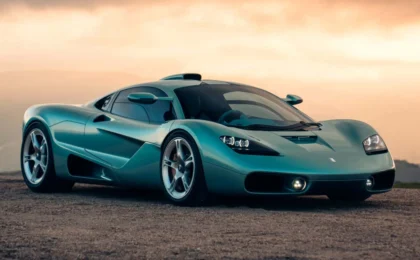
In the high-stakes theater of Monterey Car Week, where hyper-expensive, tech-laden electric hypercars often fight for the spotlight, Gordon Murray Special Vehicles (GMSV) has delivered a masterclass in automotive purity. At the prestigious The Quail, A Motorsports Gathering, the company officially pulled the wraps off the S1—a machine that serves as both a spiritual successor to the legendary McLaren F1 and a refined, long-distance evolution of the track-focused S1 LM.
For enthusiasts who lament the industry’s shift toward heavy electrification and digital intervention, the S1 arrives as a defiant, lightweight, and analog-focused statement. It is a car built on the philosophy that true driving pleasure is found not in software, but in the tactile connection between the driver, the road, and a naturally aspirated V12 engine.
The Philosophy: Engineering for the Enthusiast
The S1 is the latest chapter in the prolific career of Professor Gordon Murray, CBE. Having masterminded the McLaren F1 in the early 1990s—a car still widely regarded as the greatest road-going vehicle ever produced—Murray has spent the last decade perfecting his own vision of the "ultimate" driver’s car through his boutique firm, Gordon Murray Automotive (GMA).
The S1 is specifically designed for "long-distance touring." While the S1 LM was engineered to conquer circuits with clinical precision, the S1 is meant to traverse continents. By retaining the iconic three-seat layout—with the driver positioned centrally for optimal visibility and balance—and a naturally aspirated Cosworth-developed V12, the S1 captures the spirit of the F1 while utilizing modern manufacturing breakthroughs.
Chronology of Development: From Track to Grand Tourer
The development of the S1 did not happen in a vacuum. It is the result of a deliberate, iterative process that began with the T.50, Murray’s "clean sheet" supercar.
- The Foundation (T.50 & T.33): The project began with the T.50, which introduced the world to the 12,000-rpm Cosworth V12. This was followed by the T.33, a car that distilled the F1-inspired ethos into a more usable, daily-drivable package.
- The Track Crucible (S1 LM): GMA then pushed the platform to its limits with the S1 LM, a track-only special designed for downforce, rigidity, and raw speed.
- The Refinement (The S1): The current S1 takes the chassis of the LM but reverses the "track-focused" engineering. Engineers removed the aggressive, fixed aerodynamic hardware, opting instead for a cleaner, slipperier body profile that utilizes active rear aerodynamics to maintain stability at high speeds without the drag penalty of a massive wing.
Technical Specifications: The Anatomy of a Masterpiece
The Heart: A 4.2-Liter V12 Symphony
At the center of the S1 lies a masterpiece of internal combustion: a custom-built 4.2-liter Cosworth V12 engine. This engine is not merely a power unit; it is a sensory experience.
- Output: The engine produces up to 681 horsepower.
- Redline: It screams to a dizzying 12,100 rpm.
- Torque: 369 pound-feet of torque is available, with the power curve tuned to ensure that the car is punchy at low revs, making it an excellent companion for mountain passes or highway cruising.
- Internal Components: To achieve such high revs, the engine utilizes silicon carbide-coated lightweight pistons, titanium valves, and titanium connecting rods. A dry-sump oiling system ensures the engine remains lubricated even under the high-G forces of spirited driving.
Chassis and Drivetrain
The S1 sits on a carbon fiber monocoque that is directly related to the S1 LM, but with critical adjustments for comfort. The ride height has been raised by approximately 0.4 inches, and the suspension geometry has been softened to soak up road imperfections. Despite these comfort-oriented modifications, the car maintains a weight profile that undercuts most modern supercars, staying in the same featherweight class as the T.33 and T.50.
Power is routed through a six-speed manual gearbox. Unlike the close-ratio gearboxes found in track cars, the S1 features a taller sixth gear, allowing for relaxed high-speed cruising. The gear-shift linkage has been engineered with straighter cable routing to ensure that every throw is crisp, mechanical, and deeply satisfying.
Design and Interior: The Art of the Cabin
Every exterior panel on the S1 is bespoke. The design team focused on a "clean" aesthetic, removing the clutter of race-inspired splitters and side skirts. The front intake houses auxiliary main-beam lamps, a subtle nod to Murray’s 1992 Monaco show car.

The interior is where the "Touring" nature of the S1 truly shines. While it retains the three-seat layout—which puts the driver in the middle, flanked by two passengers slightly set back—the cabin environment has been elevated:
- Acoustics: Extra insulation has been added to reduce road noise during long trips.
- Materials: The cabin is swathed in premium leather and bespoke fabrics, eschewing the stripped-out carbon aesthetic of the track-only variants.
- Utility: The S1 introduces dihedral doors with drop-down glass windows, a significant upgrade over the Lexan ticket windows of the S1 LM, making it much easier to enter and exit at coffee shops or hotels.
- Display: The engine bay itself is presented as a display case. The Inconel exhaust system is paired with a 24-carat gold-plated heat shield, a direct homage to the heat-shielding techniques used on the original McLaren F1.
Official Responses and Strategic Vision
Professor Gordon Murray, during the presentation at The Quail, emphasized that the S1 was built to solve a specific problem: the loss of soul in modern performance vehicles.
"This is a car you could drive along the coast from Los Angeles to Monterey in real comfort," Murray stated. "You can still enjoy every gearshift, every corner, and every note of the V12 when the road opens up, but you won’t arrive at your destination feeling like you’ve just finished a stint at Le Mans."
GMSV has confirmed that production will be strictly limited to 64 units worldwide. Each car is individually commissioned, allowing owners to customize everything from the upholstery to the exterior paintwork. While the price remains undisclosed, the interest generated by the T.50 and the recent auction records for F1-inspired vehicles suggests that the S1 is already oversubscribed.
Implications for the Supercar Market
The launch of the S1 signals a significant shift in the luxury automotive market. For years, manufacturers have engaged in an "arms race" of horsepower and battery density. Gordon Murray’s decision to move in the opposite direction—focusing on weight reduction, mechanical feedback, and atmospheric engine response—has proven to be a winning strategy.
The S1 suggests that there is a massive, untapped demand for "analog" driving experiences. In a world where autonomous driving and hybrid assistance are becoming the standard, the S1 stands as a guardian of the classic driver’s car. It proves that a manufacturer does not need to chase 1,000 horsepower or 0-60 times in the two-second range to be relevant. Instead, by prioritizing the quality of the driving experience, GMSV has created a vehicle that is likely to become a collector’s piece the moment it leaves the factory.
Future Outlook
As GMA moves into the final testing phases of its other projects, such as the track-only T.50s Niki Lauda, the S1 provides the perfect "road-going" balance to the brand’s portfolio. It offers the performance of a supercar with the usability of a grand tourer, bridging the gap between the raw, terrifying power of the track and the refined demands of the open road.
The S1 is not just a car; it is a testament to the idea that the internal combustion engine, when engineered with the right hands, still has a long and glorious future ahead of it. As the automotive world navigates the transition toward a post-ICE future, the S1 serves as a definitive "final word"—or at least, a very loud, very high-revving middle finger to the status quo.
For the 64 individuals who will eventually take delivery of their S1, the car will be more than a mode of transport; it will be an opportunity to participate in the final, golden era of the analog supercar.