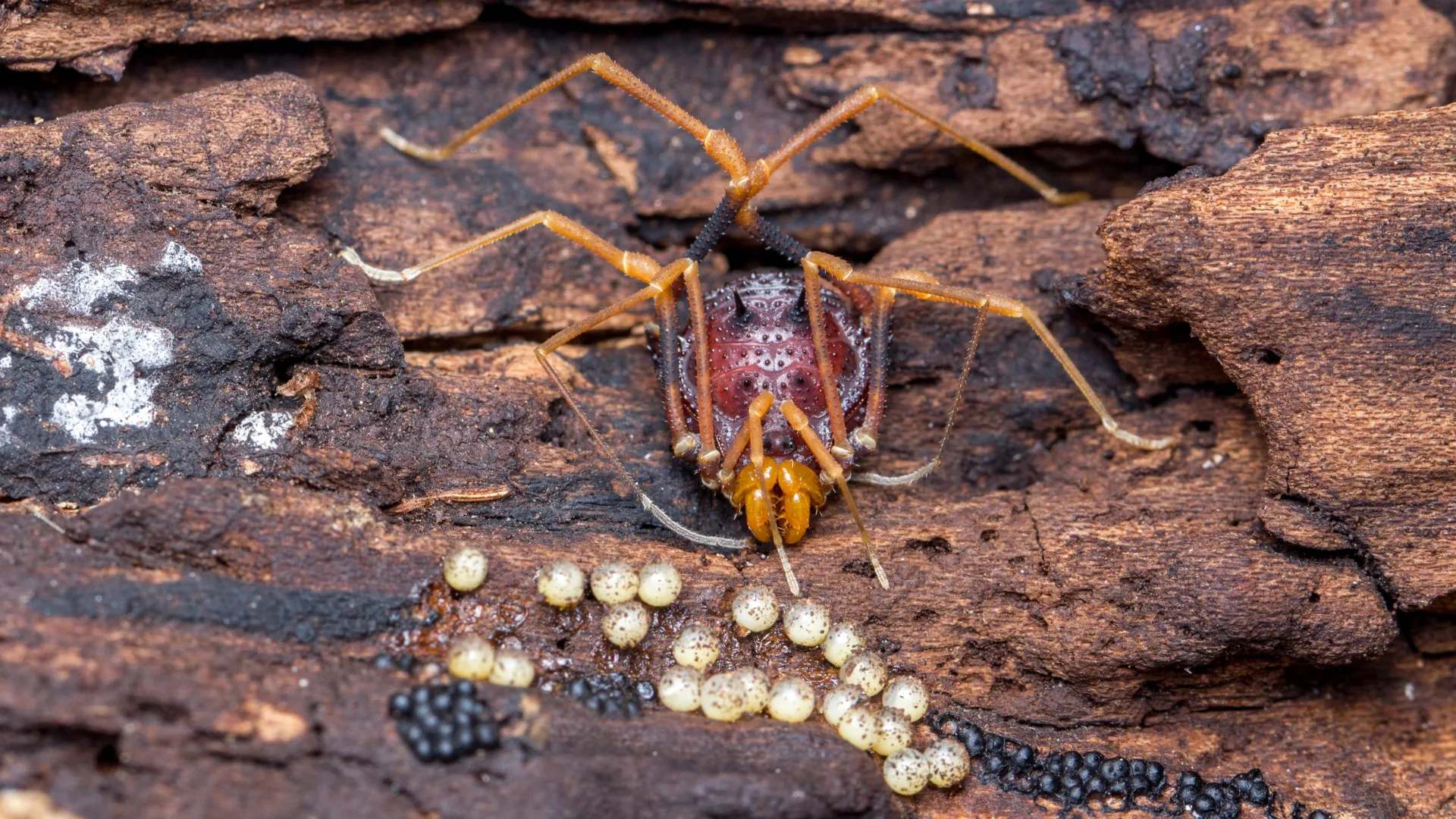
In the quiet corners of the natural world, a hidden drama of parental devotion has been playing out for millions of years. Harvestmen—the long-legged, spider-like arachnids often mistaken for daddy longlegs—exhibit a complex, shifting landscape of maternal and paternal care that has long baffled evolutionary biologists. Now, a groundbreaking study published in the Zoological Journal of the Linnean Society has shed new light on this phenomenon, revealing that parental guarding is far more fluid and evolutionary "volatile" than previously imagined.
By bridging the gap between nearly three decades of traditional field research and the expansive, real-time data provided by citizen science platform iNaturalist, an international team led by researchers at the University of São Paulo has successfully reconstructed the evolutionary history of parenting within the superfamily Gonyleptoidea. The findings demonstrate that parental care in these creatures has appeared, vanished, and re-emerged repeatedly throughout history, offering a rare window into the selective pressures that drive the evolution of fatherhood.
The Evolutionary Tapestry of Care
The study challenges the traditional view of parental care as a linear, once-in-a-lifetime evolutionary innovation. Instead, the data suggests that for harvestmen, parenting is an adaptive strategy that can be "switched on" or "switched off" depending on the environmental and sexual pressures acting upon a species.
The research team found that maternal care in harvestmen follows a path similar to that observed in various insect groups: it tends to emerge from lineages that previously exhibited no parental care. Paternal care, however, tells a more complex story. It appears to arise through two distinct evolutionary routes: either directly from species with no history of parental care or as a transition from species where females already performed the guarding duties.
This secondary route—where paternal care evolves from maternal care—is particularly intriguing to researchers. The study proposes that this transition is likely driven by "enhanced fecundity," a form of sexual selection. In this scenario, females exhibit a preference for males who are already tending to eggs, effectively turning a protective behavior into a competitive advantage for the male. By acting as a father, the male becomes more attractive to potential mates, creating a self-reinforcing cycle that promotes the evolution of paternal care.
A History of Discovery: Chronology of the Research
The synthesis of this study represents the culmination of a massive data-collection effort that spans generations.
- 1936–2025: The Traditional Era: For nearly 90 years, scientific understanding of harvestman parenting was limited to the slow, methodical pace of academic fieldwork and museum visits. By 2025, the total number of documented species exhibiting parental guarding stood at just 80.
- The Digital Turning Point: Recognizing the limitations of relying solely on physical expeditions, the research team turned to iNaturalist. After witnessing the platform’s success in ornithological research, the team realized that the vast, decentralized network of nature enthusiasts could provide the scale needed to analyze large-scale evolutionary patterns.
- The "Two-Day" Breakthrough: The transition from traditional data gathering to digital synthesis was instantaneous. In a move that shocked the research community, lead author Glauco Machado and his team conducted a targeted search on iNaturalist that took only two days. This brief digital excavation yielded 62 new, previously undocumented records of parental care—nearly doubling the global knowledge base in a single weekend.
- Future Trajectories: With this new dataset, the team was able to perform a phylogenetic reconstruction of the Gonyleptoidea superfamily, marking the first time such an analysis has been completed for this group.
Supporting Data: Why Harvestmen are the "Model Organism"
To understand why this study matters, one must look at the diversity of the subjects. There are more than 6,900 identified species of harvestmen. While they represent a relatively small fraction (0.6%) of total arthropod diversity, they are disproportionately represented in the study of fatherhood.
Harvestmen account for more than 50% of all independently evolved examples of paternal care known across the entire arthropod subphylum. This makes them the ultimate "natural laboratory." Because the behavior has evolved so many times independently, scientists can perform comparative analyses to identify the exact environmental and social factors that trigger the development of parenting.
The influx of data from iNaturalist was not just a quantitative boost; it was a qualitative transformation. Before the integration of citizen science, many species were represented by only a single geographic data point, often collected decades ago. The new records provide high-resolution, georeferenced evidence, allowing researchers to correlate parental behaviors with specific climates, elevations, and ecological niches.
Official Perspectives: The Role of the Scientist
Dr. Glauco Machado, the lead author of the study, views this collaboration between experts and amateurs as a paradigm shift for biology.
"It’s very rare in nature, paternal care, and this behavior evolved many times independently," Machado noted. "So, by looking at harvestmen, we can explore questions related to the factors that led to the evolution of this behavior. In many species where males care for the offspring alone, the caring activity is a sexually selected behavior, which means that females prefer males that are already caring for the eggs."
However, Machado is quick to temper the excitement of the digital revolution with a reminder of the foundational role of the taxonomist. "I think taxonomists’ role in modern science is more important than ever," he emphasized. "We cannot preserve a species that doesn’t have a name. And names are provided by taxonomists. So, it’s very important."
The study underscores that while citizen scientists can capture the photograph, the expert eye is still required to distinguish between true parental care—such as guarding eggs from predators—and "mate guarding," a behavior where males stay near females to prevent other males from mating with them. Without the specialized training of a taxonomist to verify these distinctions, the data would lose its scientific rigor.
Implications for the Future of Biological Research
The implications of this study extend far beyond the study of arachnids. By demonstrating that high-level evolutionary research can be accelerated through open-access, volunteer-driven platforms, the team has provided a blueprint for other researchers working in the Global South and in regions where funding for extensive field travel is limited.
Democratizing Science
The ability to access tens of thousands of observations without the prohibitive costs of international travel or museum maintenance is a game-changer. For researchers in developing nations, platforms like iNaturalist represent a democratization of data. They allow scientists to conduct global-scale meta-analyses from a local office, effectively leveling the playing field in biological research.
Addressing Sampling Bias
The study does acknowledge significant limitations, most notably "sampling bias." Humans are naturally more likely to photograph an animal that is doing something "interesting," such as guarding eggs. Species that provide no care and stay hidden in the leaf litter are inevitably underrepresented. However, the researchers argue that by quantifying these biases and creating a much larger baseline, they are better equipped to correct for them in future modeling.
A New Model for Evolutionary Studies
The success of the harvestmen project serves as a call to action for other biologists. As the researchers noted, the model is applicable to insects, frogs, and countless other groups where parental care is present but understudied.
By integrating the enthusiasm of the global community with the analytical rigor of the academic world, science is entering a new era. The "digital age" of biology is not replacing the scientist; rather, it is giving them the tools to see patterns that were once buried in the noise of the vast, undocumented natural world. As we continue to refine these collaborative models, we move closer to solving the most persistent mysteries of life’s evolutionary history, one observation at a time.