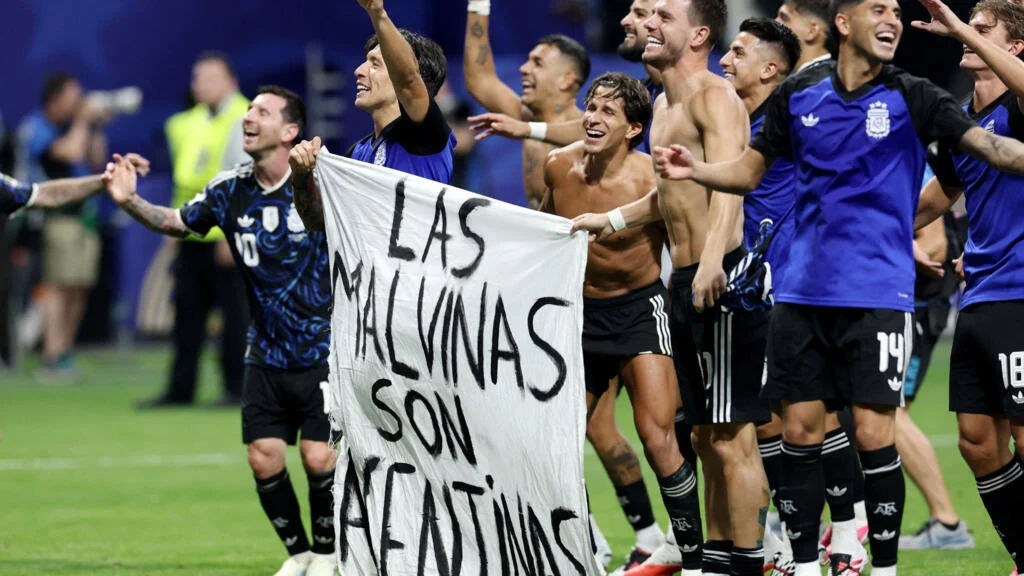
The intersection of sport and geopolitics reached a flashpoint this week as members of the Argentine national football team ignited a firestorm of international controversy. Following a hard-fought 2-1 victory over England in Atlanta, Argentine players Giovani Lo Celso and Lisandro Martinez were captured on camera brandishing a banner that read "Las Malvinas Son Argentinas" ("The Falklands are Argentine").
The act, which took place on the pitch during post-match celebrations, has drawn sharp condemnation from British officials who are now calling for a formal investigation by FIFA. Conversely, in Buenos Aires, the gesture has been heralded by many as a poignant assertion of national identity and historical truth, highlighting the persistent, raw nerve that the South Atlantic islands remain in the collective Argentine consciousness.
The Chronology of the Incident
The incident unfolded in the immediate aftermath of the high-stakes quarter-final match in Atlanta. As the Argentine squad began their celebrations, a homemade, white banner—originally displayed by fans in the front row of the stadium—caught the eye of the players. According to reports from the Argentine newspaper Clarin, midfielder Giovani Lo Celso approached the supporters to request the flag.
Once in possession of the banner, Lo Celso and centre-back Lisandro Martinez proceeded to hold it aloft, displaying the message to the crowd and the cameras. The players were filmed singing and celebrating with the banner for several minutes before it was eventually left on the pitch. The imagery was captured by a Reuters photographer, and the subsequent dissemination of the photos across global media outlets prompted an immediate reaction from both the British government and international football governing bodies.
A Legacy of Conflict: The Historical Context
To understand the intensity of the reaction, one must look back to the spring of 1982. The sovereignty of the archipelago—known as the Falklands to the British and the Malvinas to the Argentines—remains the most contentious issue in the bilateral relationship between the two nations.
The 1982 conflict, triggered by an Argentine military junta, lasted 74 days and claimed the lives of 649 Argentine soldiers and 255 British personnel, alongside three islanders. For Argentina, the islands are considered an integral part of their national territory, illegally occupied by a foreign power. For the United Kingdom, the islands are a self-governing Overseas Territory whose inhabitants have repeatedly expressed their desire to remain under British sovereignty.
This historical trauma explains why a simple piece of fabric in a stadium can resonate so deeply. As Argentine team talisman Lionel Messi alluded to after the match, "When you play a match of that magnitude, so many things come into play. History weighs on a game like that."
Official Responses: FIFA and the British Government
The regulatory framework governing international football is clear regarding political displays. FIFA’s Stadium Code of Conduct explicitly prohibits "banners, flags, flyers, apparel and other paraphernalia that are of a political, offensive, and/or discriminatory nature" inside venues.
The British Stance
The British government has wasted no time in demanding a formal inquiry. Peter Kyle, the UK’s Business Minister, stated on BBC Radio that the incident requires a thorough investigation, emphasizing that the World Cup should be a space kept free from the volatility of international politics.
The call for action became more aggressive with Liberal Democrat leader Ed Davey. In a formal letter to FIFA President Gianni Infantino, Davey argued that the players’ actions were not merely political, but an "insult to the people of the islands." Davey went as far as to call for the disqualification of the players involved from participating in the upcoming final, arguing that such behavior undermines the spirit of fair play and mutual respect required in international competition.
FIFA’s Silence
As of Thursday, FIFA has maintained a position of cautious silence. While the organization has not issued a public statement or a formal sanction, the historical precedent suggests that the players could face significant penalties. Similar actions by professional footballers in the past—ranging from political slogans on undershirts to the display of nationalistic banners—have frequently resulted in heavy fines, warnings, or even match suspensions. Whether FIFA chooses to exercise its authority in this instance will likely depend on the pressure applied by the British delegation and the legal interpretation of the banner as "political" versus "patriotic."
Public Sentiment in Buenos Aires: A Matter of Sovereignty
In the streets of Buenos Aires, the perspective is starkly different from that of Westminster. Near the monument dedicated to the Argentine soldiers who died in the 1982 conflict, the consensus among locals is one of pride rather than provocation.
For many Argentines, the players are not simply athletes; they are public figures whose voices carry the weight of national sentiment. Martin Aguirre, a 30-year-old local, expressed a sentiment shared by many: "It is very important that players, as public figures, give their opinion, especially on issues that are so sensitive for us."
Aguirre and others view the risk taken by Lo Celso and Martinez—knowing they could face disciplinary action—as an act of courage. "We really appreciate the gestures by Licha and Lo Celso," he added, "because even though they know they could face a sanction, they still raised that flag."
Federico Schenone, 52, dismissed the idea that the gesture was inherently "political." Instead, he categorized it as a "matter of history and legitimacy." In this view, the banner is not a protest against the British people, but an affirmation of what they believe to be an indisputable territorial right.
The Broader Implications for International Sport
The incident serves as a microcosm of a larger challenge facing international sports organizations: how to balance the freedom of expression of athletes against the requirement for political neutrality in global tournaments.
The Slippery Slope of Political Expression
FIFA has long struggled with the "politics in sport" dilemma. While the organization champions "social responsibility" campaigns, it draws a hard line at territorial or sovereign disputes. The difficulty for FIFA lies in the fact that, for many nations, there is no distinction between national identity and political history.
If FIFA chooses to punish the Argentine players, they risk alienating a massive, passionate fanbase and appearing to take a side in a geopolitical dispute. If they choose to ignore the incident, they undermine their own regulations and set a precedent that could lead to an influx of political messaging in future matches.
The Impact on the World Cup Final
The immediate pressure is on the upcoming final. With demands for disqualification circulating in British media, the pressure on the Argentine team is immense. The squad is now forced to manage the psychological burden of a looming investigation while preparing for the most important match of their careers.
Furthermore, the diplomatic friction created by this incident could have long-term consequences for the relationship between the two football associations. Historically, the football rivalry between Argentina and England has been one of the most intense in the sport, fueled by the 1986 "Hand of God" match and the lingering shadow of the Falklands conflict. This latest episode has only served to sharpen those edges, ensuring that any future meetings between the two sides will carry an even heavier burden of history.
Conclusion
The display of the "Las Malvinas Son Argentinas" banner is more than just a violation of stadium conduct; it is a manifestation of a conflict that has refused to fade over four decades. For the British, it is a diplomatic affront that warrants strict disciplinary measures. For the Argentine players and their supporters, it is a necessary act of remembrance and an assertion of sovereign identity.
As FIFA deliberates, the world watches to see if the organization will prioritize its rules on neutrality or attempt to navigate the complex, often volatile, intersection of national history and global sport. Regardless of the outcome of the investigation, the incident has once again proven that in the world of professional football, the pitch is never just a field of play—it is a stage where the ghosts of history are always present.