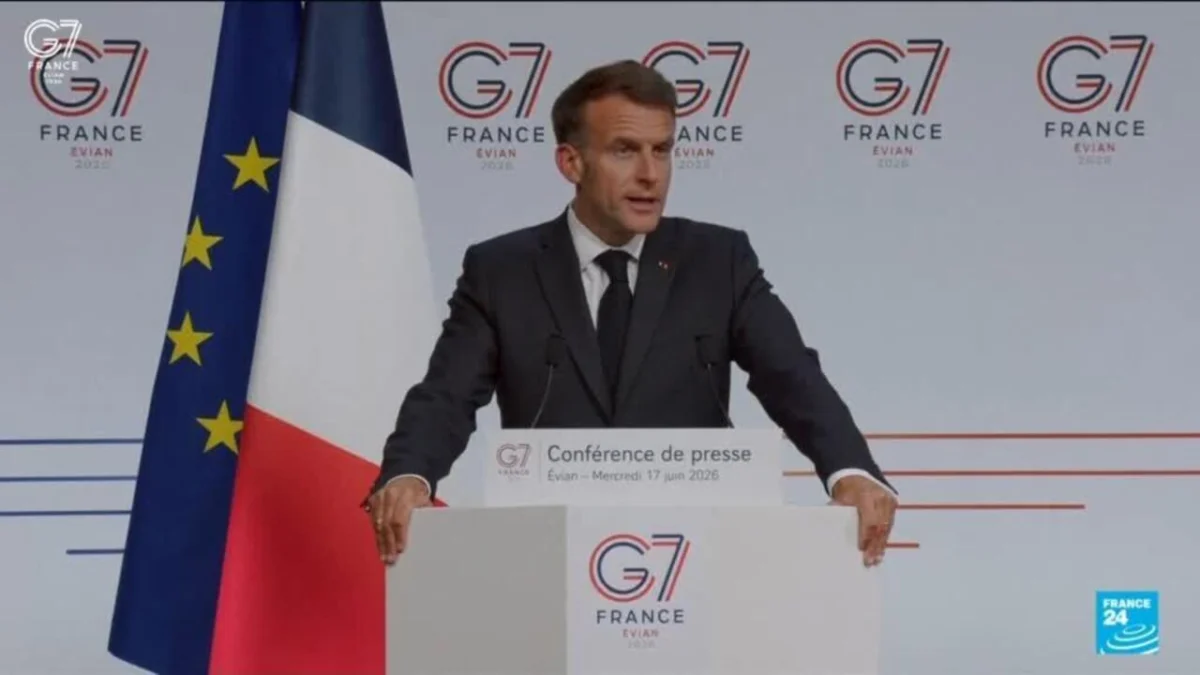
The recent G7 summit, hosted amidst a backdrop of intensifying geopolitical rivalries and economic uncertainty, has been hailed by French President Emmanuel Macron as a resounding success. By securing breakthrough agreements on the two most pressing crises of the era—the ongoing conflict in Ukraine and the persistent threat of Iranian nuclear proliferation—the G7 leaders have attempted to project a unified front against global instability.
I. Main Facts: A Unified Front in a Fractured World
The 2026 G7 summit reached its conclusion today with a joint communiqué that signals a significant hardening of the bloc’s stance on international security. Gathering in a climate of heightened anxiety regarding European sovereignty and Middle Eastern stability, the leaders of the world’s seven largest advanced economies managed to bypass internal frictions to deliver a coherent policy package.
The primary achievement of the summit was the crystallization of a long-term financial and military support framework for Ukraine. Recognizing that the war has entered a critical phase, the G7 committed to a multi-year assistance program that goes beyond mere tactical support, aiming to solidify Ukraine’s defense industry and economic resilience against future aggression.
Simultaneously, the summit addressed the looming shadow of Iran’s nuclear ambitions. In a move that surprised some diplomatic observers, the G7 issued a stern, unified warning to Tehran, effectively aligning their domestic sanction regimes and diplomatic messaging. President Macron, who has spent months navigating the delicate balance between hardline containment and the maintenance of diplomatic channels, emerged as the summit’s primary architect of this consensus.
II. Chronology: The Road to Consensus
The success of the 2026 summit was not a foregone conclusion. The lead-up to the event was marked by significant skepticism regarding the bloc’s ability to maintain a common policy, particularly given the shifting political landscapes within member states.
- June 14th: Pre-summit negotiations in Brussels were characterized by deep divisions regarding the scale of military aid packages to be announced. Analysts noted that "aid fatigue" in several G7 capitals threatened to derail the summit’s potential for a unified declaration.
- June 15th: The arrival of G7 leaders coincided with a flurry of clandestine bilateral meetings. President Macron held a critical one-on-one with U.S. representatives to synchronize their approach to Iran, aiming to bridge the gap between Washington’s maximum-pressure strategy and Europe’s more nuanced, engagement-heavy outlook.
- June 16th: The "Ukraine Session." Intelligence briefings provided by NATO partners highlighted the urgency of the frontline situation. This served as a catalyst, compelling the leaders to set aside domestic political calculations in favor of a unified funding mechanism.
- June 17th: The final day saw the drafting of the joint communiqué. After intense late-night deliberations, a compromise was reached. The resulting policy shifts on Ukraine and Iran were finalized, allowing the French presidency to declare the summit a victory for multilateral diplomacy.
III. Supporting Data: The Cost of Global Stability
To understand the weight of the G7’s commitments, one must look at the data underpinning the summit’s outcomes.
The Economic Burden of Defense
The announced support package for Ukraine is estimated at $120 billion over the next two years. This capital is intended to serve three distinct functions:
- Military Procurement: 40% of the fund is earmarked for the immediate purchase of air defense systems and artillery.
- Infrastructure Reconstruction: 30% is allocated to the repair of the energy grid, which has been systematically targeted by aerial bombardments.
- Economic Stabilization: 30% will act as a liquidity injection to prevent the collapse of the Ukrainian state budget.
The Iranian Variable
The G7’s focus on Iran is backed by recent data from the International Atomic Energy Agency (IAEA), which indicates that Tehran has reached a enrichment threshold of 84%. This proximity to weapons-grade material has made the G7’s coordinated sanction approach—aimed at cutting off access to dual-use technologies—a top priority. Trade data shows that G7 nations have effectively reduced direct trade with Iranian entities linked to the IRGC by 18% compared to the previous fiscal year, a trend the summit aims to accelerate to 30% by 2027.
IV. Official Responses: Divergent Perspectives, Shared Goals
The summit’s conclusion triggered a wide array of official responses, reflecting the complex domestic political landscapes of the member nations.

Emmanuel Macron’s Assessment:
President Macron was unequivocal in his post-summit briefing. "We have proven that the G7 is not a relic of the past, but an engine for the future," he stated. He emphasized that the consensus on Ukraine was "a victory for the rule of law over the rule of force." Regarding Iran, he noted that the G7 "did not close the door to diplomacy, but we have ensured that the cost of inaction for Tehran has become prohibitive."
The View from Washington:
The White House characterized the outcome as a "triumph of collective security." While some U.S. lawmakers expressed concern over the financial burden, the administration underscored that the cost of a Russian victory in Ukraine would be exponentially higher in terms of long-term global defense spending.
The Iranian Perspective:
Tehran’s response was characteristically defiant. The Iranian Foreign Ministry issued a statement dismissing the G7’s warnings as "politically motivated fabrications." They criticized the summit as a "gathering of failing colonial powers" and pledged to continue their nuclear program for "peaceful, scientific purposes."
European Union Leadership:
Commission officials in Brussels welcomed the synchronization of the G7 policies, noting that it provides the EU with the necessary political cover to enact more robust sanctions without fearing the fragmentation of the transatlantic alliance.
V. Implications: What Lies Ahead?
The 2026 G7 summit has set the course for the next eighteen months of international relations. However, the true test lies in the implementation of these high-level commitments.
1. The Resilience of the Ukraine Support Mechanism
The primary implication of the summit is that the war in Ukraine will continue to consume a significant portion of the G7’s diplomatic and fiscal bandwidth. The challenge will be "burden-sharing." As inflation continues to impact domestic economies, keeping the public onboard with large-scale foreign aid will require immense political dexterity from leaders.
2. The Strategic Pivot to the Middle East
By prioritizing the Iranian nuclear threat, the G7 has signaled that it can no longer afford to treat the Middle East as a secondary theater. The potential for a regional arms race—should Iran finalize a breakout capability—poses an existential threat to global oil markets and regional security. The G7’s move to harmonize their sanction regimes will likely trigger a new era of "economic warfare," where the G7 uses the financial system to isolate Iran while attempting to prevent a wider kinetic conflict.
3. The Future of the G7 Model
Finally, the summit raises questions about the future of the G7 itself. While successful in this instance, the group remains a "club of the wealthy" in an increasingly multipolar world. The exclusion of emerging powers like India, Brazil, or South Africa from these critical decisions may, in the long run, diminish the G7’s legitimacy as the ultimate arbiter of global governance.
For now, President Macron can claim a victory. He has navigated the treacherous waters of international diplomacy to deliver a result that, at the very least, buys the West more time. But as the ink dries on the final communiqué, the real-world consequences—from the trenches of the Donbas to the centrifuge halls in Natanz—will ultimately determine whether this summit is remembered as a historic turning point or merely a temporary stay against the chaos of an unraveling global order.