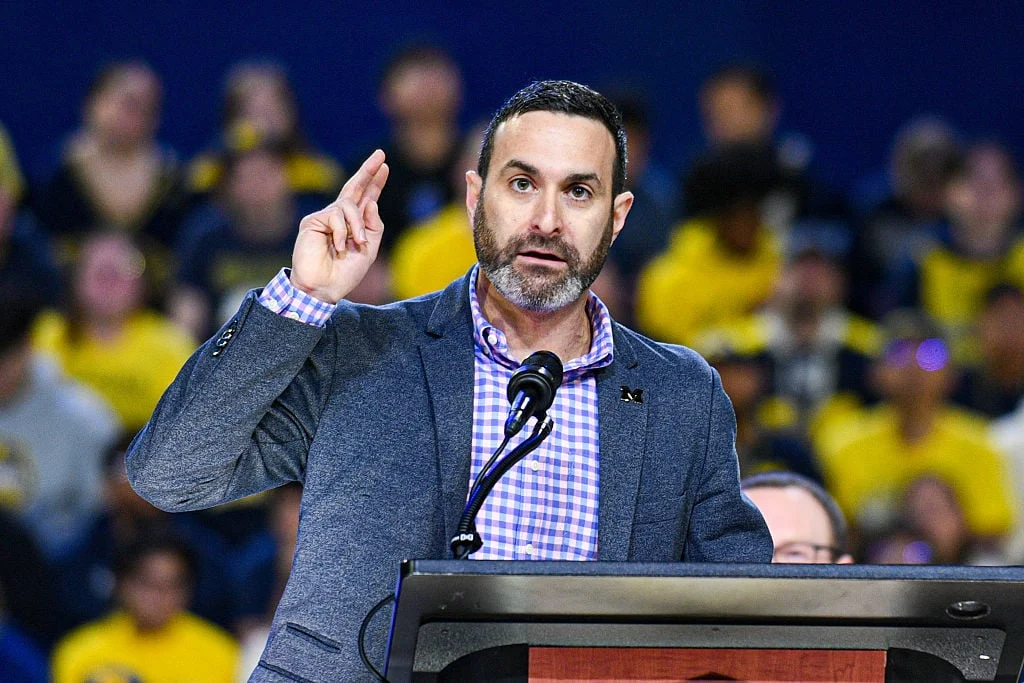
The governing body of one of the nation’s most prestigious public institutions, the University of Michigan Board of Regents, has been thrust into a period of profound turbulence. At the center of the controversy is Regent Jordan Acker, whose tenure—marked by years of political maneuvering and policy oversight—has been abruptly overshadowed by a scandal involving the use of vulgar, sexually explicit language directed at a student and a prominent political strategist.
Following an independent investigation that confirmed the authenticity of messages previously dismissed by Acker as “fake,” the regent has issued a public apology. However, the tepid nature of his contrition, combined with his refusal to step down before his term expires, has ignited a firestorm of criticism from faculty, students, and political allies alike.
The Genesis of the Scandal: From Slack to Scrutiny
The controversy first broke in April 2026, when The Guardian published a bombshell report detailing a series of messages sent by Acker within a private digital workspace. The messages, which were captured in screenshots, featured Acker making graphic, sexualized comments regarding the physical appearance and conduct of a female student at the university, as well as a Democratic party strategist.
The initial response from Acker’s legal counsel was one of total denial. Representatives for the regent claimed that the messages were fabricated and that their client had never utilized the platform in question. Acker himself doubled down on this narrative, publicly dismissing the allegations as a smear campaign.
However, as investigative pressure mounted and a formal review was launched by the university, the digital trail proved insurmountable. The internal probe concluded that the messages were indeed sent from Acker’s account, effectively dismantling his initial defense and leaving his reputation in tatters.
A Chronology of a Political Collapse
The timeline of the Acker scandal reflects a rapid erosion of public trust:
- April 2026: The Guardian publishes screenshots of messages sent by Acker, sparking immediate outrage within the University of Michigan community. Acker’s legal team denies the authenticity of the messages, and Acker labels the reports "fake."
- Late April 2026: Under intense public pressure and following calls for transparency from faculty unions and student organizations, the University of Michigan initiates an independent investigation into the claims.
- May–June 2026: The investigation proceeds behind closed doors, reviewing digital metadata and communications. During this period, Acker suffers a significant political blow, losing his re-election bid to remain on the Board of Regents.
- June 2026: The university confirms the findings of the investigation, validating the reports of the lewd comments.
- Late June 2026: During a scheduled Board of Regents meeting, Acker offers his first public acknowledgment of the incident, though he stops short of detailing the specific nature of his offenses.
The Anatomy of an Apology: A Study in Ambiguity
The climax of the ordeal occurred during a recent regents’ meeting, where Acker addressed the board and the public regarding the findings of the investigation. His statement, intended to serve as a bridge to reconciliation, instead drew criticism for its lack of specificity and its defensive undertones.
“For those who have been hurt, disappointed, frustrated, or angry, I understand why,” Acker stated. “I do not ask for sympathy. I do not ask anyone to excuse my mistakes. I only ask that my apology be heard as sincere.”
Observers, including journalists from Bridge Michigan, noted that Acker’s remarks were conspicuously devoid of a direct apology for the specific acts of sexual harassment he was accused of. Instead of addressing the harm caused to the specific individuals involved, he pivoted to a broader critique of the media and his political detractors.
“Much has been said and written about me,” Acker remarked. “Some of it I believe has been unfair, some of it has felt like a deliberate attempt to define me by my worst moments and mistakes, but today is not about that. Today is about accountability.”
For many, this phrasing—characterizing the exposure of his own behavior as a “deliberate attempt to define” him—was seen as a failure to take full ownership of his actions. By framing the scrutiny as a personal attack rather than a necessary consequence of his conduct, Acker has struggled to regain the moral authority required of a public official.

Supporting Data and the Impact on Governance
The University of Michigan Board of Regents is a constitutionally established body with broad powers to govern the university, including the appointment of the president and the setting of tuition rates. When a regent is embroiled in a scandal of this nature, it compromises the board’s ability to act as a fiduciary representative of the student body.
The university, which has long prided itself on its commitment to Title IX compliance and the protection of students from harassment, finds itself in a precarious position. The fact that a sitting regent was found to have engaged in sexualized discourse regarding a student sends a chilling message to the campus community.
Furthermore, the financial and political implications are non-trivial. Acker, a Democrat who has served on the board since 2019, was already a “lame duck” official following his recent primary election defeat. With six months remaining in his term, the board faces a period of legislative paralysis. While some have called for an immediate resignation, Acker has shown no intention of stepping down early, meaning he will continue to wield a vote on university policy through the remainder of the year.
Implications for Higher Education Ethics
The Acker case serves as a broader case study in the evolving standards of ethics for university administrators and governing boards. In an era where digital communication is increasingly scrutinized and “private” chats are often subject to public record requests or investigative subpoenas, the line between private conduct and professional suitability has blurred.
The Problem of Digital Accountability
The reliance on Slack screenshots by investigative journalists highlights a new reality for public officials: digital permanence. The defense that a message was "out of context" or "sent in a private capacity" is increasingly viewed as insufficient by the public, particularly when the content involves the disparagement of the very students the official is sworn to protect.
The Erosion of Political Norms
Acker’s attempt to paint himself as a victim of a “deliberate attempt to define” him by his mistakes is a common political tactic, but one that is increasingly ineffective in the face of verified misconduct. In the academic sector, where integrity and the creation of a safe learning environment are paramount, such rhetoric is often perceived as an insult to the intelligence of the constituents.
The Future of the Board
With Acker’s term winding down, the University of Michigan Board of Regents is looking toward a transition. The scandal has provided a rallying cry for those who advocate for more rigorous ethical vetting of candidates for public university boards. The incident will likely influence upcoming electoral cycles, with voters placing a higher premium on character and professional conduct in their selection of regents.
Conclusion: A Lingering Shadow
As Jordan Acker prepares to exit his role as a regent, the shadow of his final months in office will undoubtedly linger. His apology, while formal, has failed to satisfy those who feel that his actions fundamentally violated the trust placed in him by the people of Michigan.
The university now faces the task of moving forward while ensuring that such incidents do not occur again. The institutional response—from the independent investigation to the public reporting of the results—demonstrates that the university is committed to a level of transparency that, in this instance, worked to the detriment of one of its own leaders.
Whether this period of accountability serves as a catalyst for meaningful cultural change within the board remains to be seen. For now, the University of Michigan continues its mission, though its leadership remains diminished by the weight of a scandal that was, by all accounts, entirely self-inflicted.