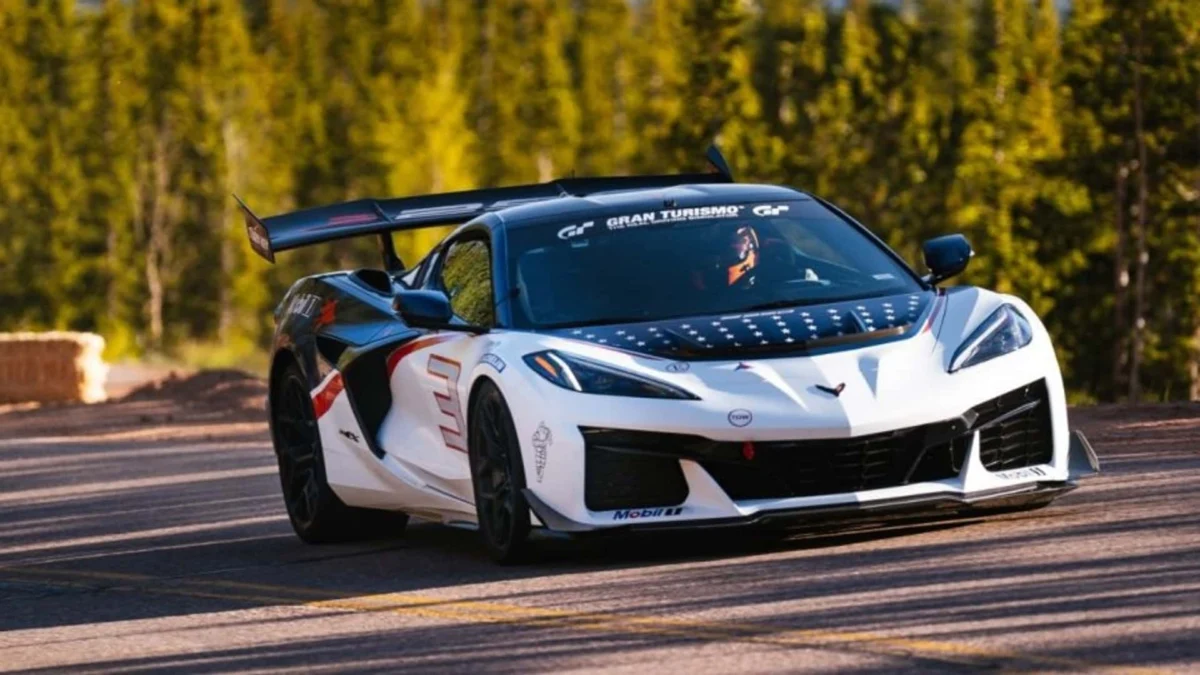
The Pikes Peak International Hill Climb (PPHIC), known globally as the "Race to the Clouds," has long served as the ultimate proving ground for automotive engineering. This past weekend, amidst perfect alpine conditions—clear blue skies, a total absence of precipitation, and a crisp Colorado atmosphere—the mountain bore witness to a historic performance. The 2027 Chevrolet Corvette ZR1X, a vehicle that blurs the line between street-legal performance and track-bred ferocity, did not just break the production car record; it obliterated it, setting a new benchmark that underscores a massive leap in modern performance technology.
The Mountain’s New Benchmark: A Chronology of the Run
The Pikes Peak course is a 12.42-mile monster, featuring 156 turns that wind their way up to a staggering 14,115 feet above sea level. At these altitudes, internal combustion engines typically struggle, starved of the oxygen required to produce their rated power. However, the 2027 Chevrolet Corvette ZR1X, piloted by the masterful JR Hildebrand, seemed immune to the thin air.
The challenge was set against a backdrop of intense competition. The previous production-car record, held by David Donner, stood at 9:53.541. While Donner had set that time under specific non-race-day conditions, his official race-day best had hovered significantly higher at 10:34.053.
The chronology of the record-breaking day was swift and decisive. Early in the event, David Donner delivered a valiant effort, clocking a 9:53.740, an impressive time that reaffirmed his status as a master of the mountain. Yet, his reign atop the leaderboard was short-lived. Just two runs later, Hildebrand and the ZR1X took to the asphalt. From the initial sector to the final, high-altitude sprint to the finish line, the car maintained a blistering pace, crossing the timing beam at 9:30.104. The result was not merely a record; it was a dominant statement of intent from the Chevrolet engineering team.
Engineering for the Clouds: The ZR1X Configuration
One of the most compelling aspects of the ZR1X’s performance is the relative "stock" nature of the vehicle. In an era where "production record" often involves stripped-out interiors, custom-tuned engines, and specialized aero-packages, Chevrolet opted for a more authentic approach.
According to official reports, the ZR1X that attacked the mountain utilized the standard carbon-fiber wheels paired with Michelin Pilot Sport Cup 2 R tires—the same rubber consumers can specify when ordering the car from a dealership. Beyond the mandatory safety equipment required by the PPHIC organizers—such as the full roll cage, racing harness, and an upgraded fuel cell—the car remained essentially as it would appear on a showroom floor.
This reliance on stock components highlights the extraordinary development of the C8 platform. The aerodynamics, chassis balance, and power delivery of the ZR1X have been optimized so effectively that they translate directly from the street to the most demanding hill climb in the world without requiring a complete mechanical overhaul.
The Implications: A Shift in Performance Paradigms
For decades, the "sub-ten-minute" barrier on Pikes Peak was the holy grail of automotive performance. In the past, this milestone was reserved exclusively for purpose-built, highly modified, and astronomically expensive race cars. Seeing a production-spec sports car dip into the 9:30 range represents a fundamental shift in the industry.
The implications for the automotive market are profound. Consumers are no longer looking at "track-ready" cars as mere marketing hyperbole; they are looking at vehicles capable of conquering the most hostile road environments on Earth. The ZR1X proves that the gap between a weekend track toy and a professional-grade race machine has narrowed to a sliver.
Furthermore, this performance changes the conversation regarding modern engineering. With the dirt-road sections of Pikes Peak now fully paved, the focus has shifted entirely to mechanical grip, aerodynamic downforce, and power-to-weight ratios. The ZR1X’s ability to manage these factors while navigating the extreme elevation changes of Colorado suggests that Chevrolet has mastered the art of "altitude-agnostic" performance.
Official Responses and Industry Context
The response from the automotive community has been one of shock and admiration. Chevrolet’s decision to pit a production-spec vehicle against the mountain is a high-stakes gamble; had the car failed to perform, the brand equity would have taken a significant hit. Instead, the triumph serves as a massive validation of the engineering hours poured into the ZR1X program.
David Donner, the former record holder, acknowledged the sheer pace of the new challenger. His own time of 9:53.740 was, by any historical measure, a world-class run. That he was surpassed by over 23 seconds by the ZR1X highlights the exponential nature of current performance gains.
For Chevrolet, this is more than just a trophy. It is a marketing cornerstone. As the company continues to refine the Corvette lineup, the "ZR1X" badge will now be synonymous with Pikes Peak dominance, providing a halo effect that will likely bolster sales and brand perception for years to come.
Looking Ahead: What the ZR1X Means for the Future
As we look toward the future of the Corvette lineage, the ZR1X performance at Pikes Peak sets a new "floor" for expectations. Enthusiasts and competitors alike are now asking: if a production car can hit 9:30, what is the theoretical limit?
Industry analysts suggest that we are reaching a plateau where tire technology and downforce efficiency will become the primary drivers of lap-time improvements, as internal combustion engine power reaches the limits of what a human driver can reliably control on a public road course. However, the ZR1X has shown that there is still room to extract performance through clever chassis calibration and sophisticated electronic assistance.
This record-breaking run also reignites the debate regarding the future of the internal combustion engine. In a world rapidly shifting toward electrification, the ZR1X stands as a triumphant swan song—or perhaps a defiant middle finger—to the notion that the age of the high-performance V8 is over. By utilizing advanced engineering to overcome the physical limitations of high-altitude racing, the ZR1X has secured its place in the history books.
Conclusion: A New Standard for Excellence
The 2027 Chevrolet Corvette ZR1X has redefined what we expect from a production vehicle. By conquering the Pikes Peak International Hill Climb with a time of 9:30.104, it has set a bar that will be difficult for any competitor to clear in the coming years.
The success of this run was a perfect storm of ideal environmental conditions, a world-class driver in JR Hildebrand, and a machine that is arguably one of the most capable performance cars ever produced by an American manufacturer. As the sun set over the peak this past weekend, it wasn’t just the record that was broken; it was the long-held belief that production cars belonged on the street and race cars belonged on the track.
The ZR1X has successfully bridged that divide, proving that on the right day, with the right engineering, the line between a factory-spec car and a mountain-slaying legend is thinner than ever. As the industry moves forward, the record set by the ZR1X will undoubtedly stand as a testament to the power of American automotive ingenuity and the relentless pursuit of speed.
For those who doubted that a production car could dance with the clouds, the 9:30.104 timestamp is a permanent, irrefutable answer. The mountain has been climbed, the record has been shattered, and the 2027 Corvette ZR1X has cemented its legacy in the thin air of the Colorado Rockies.