At 53, I have spent a lifetime adhering to the financial doctrine of "sensible" decision-making. I’ve driven the used economy cars, I’ve accepted the practical compromises, and I’ve treated vehicles as mere utilitarian tools to get from point A to point B. But recently, I found myself in a position that challenged every fiscal habit I had spent decades cultivating. This is the story of how a pandemic-era purchase turned into an accidental financial windfall, and why, for the first time, I decided to stop compromising and buy the car I actually wanted.
The "Maxi Cooper" Regret
In July 2020, at the height of the global pandemic, I found myself at a dealership. I had originally intended to replace my aging 2004 Mini Cooper with a newer iteration of the same model. Instead, I allowed myself to be steered toward a 2019 Mini Countryman SE All4. I paid $35,990 for it—a vehicle I quickly dubbed the "Maxi Cooper."
While the Countryman is objectively a capable machine, it was a profound mismatch for my personality. I am, and have always been, a "small-car guy." I value the intimacy of a nimble, low-slung vehicle. For two years, I tolerated the Maxi Cooper, driving a car that felt like an ill-fitting suit. It was a compromise born of indecision, and it served as a constant reminder that I had allowed someone else’s logic to override my own preferences.
An Unexpected Market Shift
The inflection point occurred last month during a routine oil change. While waiting for the service to be completed, a dealership representative approached me with an offer to buy the car back.
I was skeptical. In my experience, vehicles are depreciating assets that hemorrhage value the moment they leave the lot. However, the automotive landscape has shifted dramatically since 2020. According to data from the U.S. Federal Reserve, used vehicle prices have surged approximately 55% since July 2020. Even new vehicle prices have risen by roughly 18% due to global supply chain disruptions and semiconductor shortages.
When the dealer offered me $33,000 for a car I had purchased 26 months prior, the math was staggering. I reached out to a contact—a former car salesman named Jeremy—to verify my sanity.
"It’s not just a good deal," Jeremy told me. "It’s a miracle. You’ve essentially leased that car for $115 a month. You should take that offer immediately before they realize what they’re doing."
The Philosophy of Non-Compromise
With the sale of the Countryman confirmed, I faced a vacuum. I had not planned to be in the market for a new vehicle, which left me with a blank slate. For the first time, I made a promise to myself: I would not settle.
My history with car ownership has been defined by sacrifice. In my youth, it was a sacrifice of budget. In my middle years, it was a sacrifice of preference, opting for utility over driving engagement. This time, I employed a strategy I call "self-centered shopping." I asked myself: If money were not the sole barrier, what would bring me genuine delight?
I considered going car-free. I own a 1993 Toyota pickup for heavy lifting, and I live in Corvallis, Oregon—a city with excellent infrastructure for walking and cycling. Yet, I realized that I didn’t just want a method of transportation; I wanted an experience. I missed the agility of my 2004 Mini, but modern versions had grown too large and lost the mechanical charm I craved.
The Search for the "Magic" Machine
I spent an intense 24 hours in a research deep-dive. I utilized the Consumer Reports car finder tool to filter for vehicles that prioritized driver satisfaction and handling. My requirements were specific: manual transmission, compact dimensions, and high reliability.
The algorithm suggested several vehicles, including the Kia Niro Electric and the Ford Mustang Mach-E. I promptly ruled these out. The Tesla Model 3 was discarded due to high costs and inconsistent reliability ratings. Other options were rejected for being too similar to the "Maxi Cooper"—essentially just more SUVs.
That left one standout: the Mazda MX-5 Miata.
The Miata is the antithesis of the modern, bloated crossover. It is famously impractical—it seats two, has minimal cargo space, and offers a raw, intimate driving experience. Yet, professional reviewers and owners consistently rank it as one of the most satisfying cars on the market. Consumer Reports noted that the MX-5 "revives your senses" on a curvy road, a sentiment echoed by countless enthusiasts. When I watched a review from a prominent car-care channel that concluded, "It will bring joy to your heart every time you drive it," I knew my search was over.
The Negotiation and Acquisition
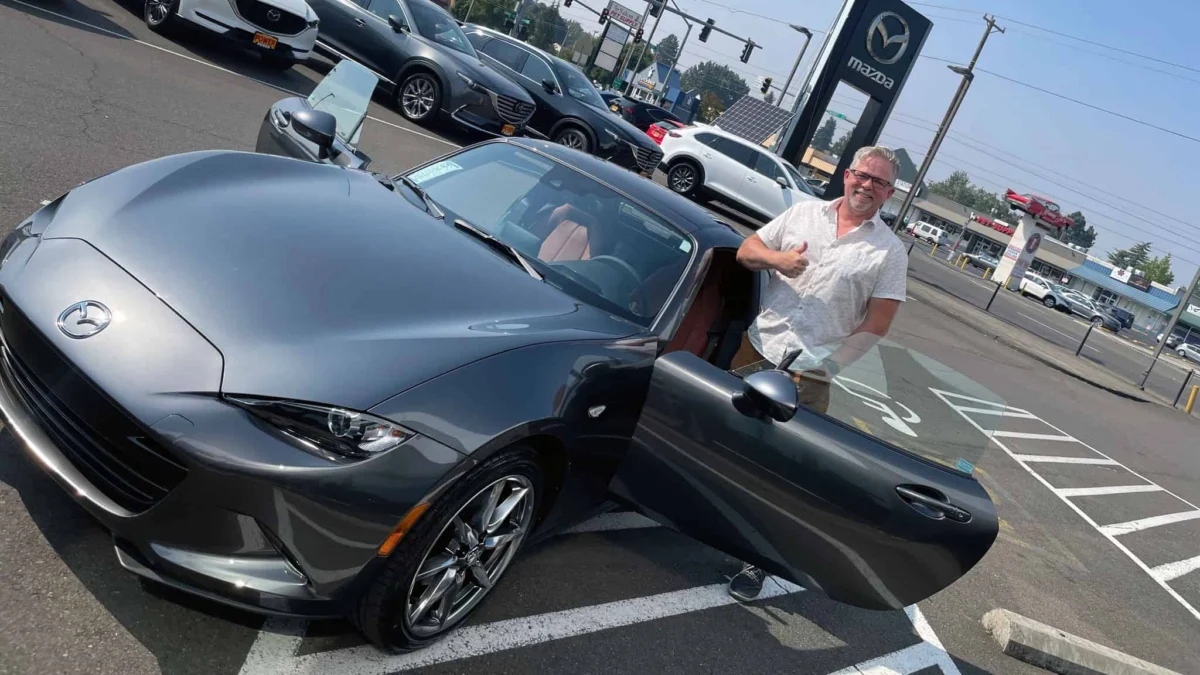
On the last Thursday of August, I traveled to Salem, Oregon, to visit a Mazda dealership. I arrived with the written offer for my Countryman in hand.
The negotiation process was a masterclass in modern dealership tactics. The salesman attempted the "four-square" method, a classic sales strategy designed to distract the buyer from the actual price of the car by focusing on monthly payments. I held firm. I was not there to be sold a car; I was there to purchase a specific machine.
When the salesman suggested I drive home in a red soft-top currently on the lot, I declined. I wanted a specific configuration—a gray hardtop with a manual transmission. We eventually reached a deal: they would match the $33,000 buy-back offer for my Mini, and I would pay the $39,245 sticker price for the Miata, inclusive of a $1,995 market adjustment. It wasn’t a "bargain" in the traditional sense, but in the context of my personal happiness, it was a sound investment.
The Implications of a "Rich Life"
Taking possession of a car with only five miles on the odometer was a surreal experience. As I drove from Salem to Corvallis, winding through the riverside roads with the top down, the wind in my hair and the engine humming beneath me, I realized this wasn’t just a vehicle purchase.
Growing up with limited means often leaves a permanent mark on one’s psychology. It creates a lingering guilt associated with spending money on "nice things." However, I have come to align my spending with the philosophy of Ramit Sethi: money should be used to build a "rich life." For some, that means travel; for others, it means security. For me, at 53, it meant finally allowing myself to stop compromising on the things that bring me daily, tangible joy.
Conclusion: The Road Ahead
Was this decision logical? By the strict, spreadsheet-driven standards of personal finance, perhaps not. I could have continued to drive my 1993 Toyota or bought a cheaper, more practical sedan. But logic is not the only metric by which a life should be measured.
The Miata serves as a reminder that we are permitted to prioritize our own satisfaction, provided we have done the work to afford it. I have traded a car I tolerated for a car I adore. In doing so, I have not only upgraded my daily commute; I have successfully challenged the narrative that my past, or my financial anxieties, must dictate my future. The road is now open, and for the first time in my life, I am exactly where I want to be.