The classic fable of "The Boy Who Cried Wolf" is a cautionary tale about the dangers of false alarms and the eventual, devastating arrival of the very threat we grew tired of fearing. In the financial markets, this story has played out repeatedly over the last decade. For years, seasoned analysts and market strategists have pointed to lofty stock valuations, warning that the bull market was overextended and ripe for a correction. Yet, time and again, the market defied these warnings, scaling new heights and rewarding those who remained fully invested.
However, the psychological toll of ignoring these warnings is dangerous. As the fable reminds us, the fact that the boy was wrong several times did not mean the wolf was a myth. It simply meant the wolf hadn’t arrived yet. Today, as we move through the middle of 2026, the financial landscape is showing signs that the "wolf" may finally be prowling near the gate.
The Data Tells a Story Worth Hearing
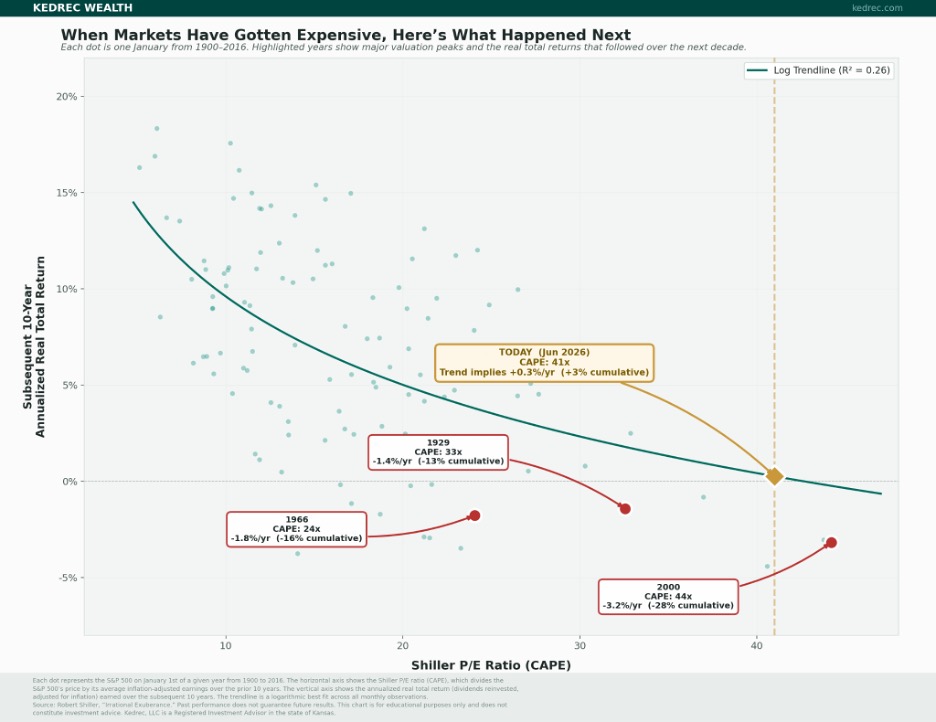
To understand why caution is currently warranted, one must look beyond the daily volatility of the ticker tape and examine long-term valuation metrics. The primary tool for this analysis is the Shiller Price-to-Earnings (P/E) ratio, also known as the Cyclically Adjusted Price-to-Earnings (CAPE) ratio. Developed by Nobel laureate Robert Shiller, this metric divides the S&P 500’s price by its average inflation-adjusted earnings over the preceding ten years, effectively smoothing out the "noise" of short-term economic cycles.
As of mid-2026, the CAPE ratio sits at approximately 41. To put that figure in historical perspective, this level has only been eclipsed once before—during the speculative fervor of the late 1990s dot-com bubble. When valuations reach these extremes, history shows that the following decade is rarely kind to investors.
Historical Chronology of Valuation Peaks
The data is stark. If we plot the S&P 500’s valuation at the beginning of a year against the real total returns earned over the subsequent decade, a clear pattern emerges.
- 1929: Preceding the Great Depression, markets were priced for perfection. The subsequent decade saw flat to negative real returns.
- 1966: After an era of post-war exuberance, the market entered a period of stagnation that lasted well into the early 1980s.
- 2000: The peak of the internet bubble led to a "lost decade" for the S&P 500, where the index struggled to break even in inflation-adjusted terms.
In each of these instances, the market didn’t necessarily collapse overnight, but it did enter a long, frustrating stretch of going nowhere. We are currently 16 years removed from the 2009 market bottom. Historically, the market tends to experience a period of flat performance roughly every 20 years. We are well within the "danger zone" of this cycle.
Innovation is Real: Bubbles Are, Too
A common counter-argument to valuation concerns is the undeniable pace of technological innovation. From the development of the transcontinental railroad in the 1840s to the rise of the automobile, and more recently, the birth of the internet and the explosion of Artificial Intelligence (AI), history is paved with revolutionary technologies that genuinely improved human productivity and economic output.

However, the problem is not the validity of the technology; it is the price investors are willing to pay for it. The railroads were indeed revolutionary, yet the railroad bubble of the 1840s decimated the portfolios of those who entered the market at the height of the frenzy. Similarly, the internet did change the world, yet the Nasdaq lost approximately 78% of its value between 2000 and 2002.
Good technology and bad timing are not mutually exclusive. The danger lies in the collective psychology of the market—when everyone wants to participate in the "next big thing" at the exact same time, prices detach from fundamental value.
The Flip Side: Cycles of Opportunity
It is equally important to acknowledge the inverse of this cycle. At the end of every "lost decade"—such as 1921, 1932, 1982, and 2009—valuations were deeply depressed. These troughs were the ultimate buy signals for patient, long-term investors. Those who stayed the course during these periods were rewarded with some of the most significant bull markets in financial history.
The takeaway is not to flee the market entirely, but to recognize the cyclical nature of asset prices. Retirement planning, in particular, requires a strategy that acknowledges the reality of these cycles. Too many retirees are currently relying on the "buy and hold" models that worked perfectly during the bull run of the last 15 years. If your retirement horizon spans 20 to 30 years, there is a statistical probability that you will encounter at least one, if not two, of these "flat-market" cycles.
Strategic Implications for the Modern Investor
What does this mean for the person who is currently approaching or already in retirement? It means moving away from a "hope-based" investment strategy—where you simply hope the market continues to go up—and toward a "structure-based" strategy.
1. Reevaluating Asset Allocation
The traditional 60/40 portfolio (60% stocks, 40% bonds) has been questioned in recent years due to the shifting correlation between asset classes. Investors should look to diversify beyond simple equities. Real estate, for instance, offers income and diversification that equities cannot replicate. However, this should ideally be tied to physical assets rather than just the stocks of real estate companies.
2. The Role of Guaranteed Income
Annuities, once dismissed as rigid, are seeing a resurgence as tools for financial stabilization. By securing a guaranteed stream of income, a retiree can "de-risk" their portfolio. This provides a floor of stability that allows them to remain invested in growth assets during market downturns without the panic-selling that often occurs when a portfolio’s value dips.
3. Exploring Alternative Strategies
Retail investors often ignore alternative investment strategies because they are not easily accessible through standard brokerage interfaces. However, incorporating private credit, managed futures, or other non-correlated assets can provide a buffer during equity market stagnation.
The Role of Fiduciary Advice
The most significant challenge for the individual investor is the "noise" of the modern financial media, which often encourages active trading or reactive behavior. This is where the value of a fiduciary financial planner becomes apparent. A fiduciary is legally obligated to act in your best interest, not to sell you products or push you toward high-fee, short-term trends.
Even if you prefer to manage your own investments, a one-time consultation with a fiduciary can help you build a comprehensive "if-then" plan. This plan should clearly define how you will react when the market enters a flat cycle, how you will draw income, and how you will rebalance your assets when valuations become stretched.
Conclusion: The Shepherd’s Mindset
The "wolf" of a stagnant or crashing market may or may not be at the door today. It might be tomorrow, or it might be years from now. But the investor who has a plan, who understands the reality of market valuations, and who has diversified their strategy is in a position of strength.
The shepherd who has a plan does not need to panic. They have built the fence, they have provided for the flock, and they have prepared for the reality that nature—like the market—moves in cycles. By shifting your focus from short-term performance to long-term structural integrity, you can ensure that your retirement remains secure, regardless of what the market does next.
Disclaimer: This article presents the views of a contributing advisor and does not constitute official financial advice from this publication. Investors are encouraged to verify advisor credentials through the SEC or FINRA databases and consult with a professional regarding their specific financial situation.