Washington D.C. – June’s traditional symphony of thunderstorms and fireworks now includes the anticipated seismic shifts from Supreme Court rulings, particularly one poised to dramatically reshape the landscape of campaign finance. As the nation holds its breath for a verdict that could redefine the interplay between political parties and candidates, the electoral gears continue to grind, with recent primaries offering a glimpse into the evolving dynamics of American politics.
The CQ Roll Call campaign team brings you this weekly analysis, diving deep into the news and implications from across the political spectrum.
By Mary Ellen McIntire and Daniela Altimari
Awaiting the Verdict: Supreme Court Poised to Reshape Campaign Finance Landscape
The Supreme Court is on the verge of delivering a decision in NRSC v. FEC, a case with profound implications for the intricate rules governing how much political party committees can coordinate with candidates. The outcome could significantly alter campaign strategies, potentially opening up a new frontier for political advertisements and lessening the reliance on independent expenditures by party committees.
The Core of the Challenge: NRSC v. FEC
At its heart, NRSC v. FEC is a challenge brought by the National Republican Senatorial Committee (NRSC), then-Ohio Senate candidate JD Vance, and former Ohio Representative Steve Chabot. They contend that existing restrictions, which limit how party committees can spend in conjunction with candidates, infringe upon their First Amendment rights to free speech and to support their chosen representatives. These restrictions have long been a cornerstone of campaign finance law, aiming to prevent unchecked influence and maintain a semblance of fairness in electoral contests.
Historical Context and Potential Ramifications
This case marks the latest in a series of high-profile legal battles over campaign finance limits, following landmark decisions such as Buckley v. Valeo (1976), which equated money to speech, and Citizens United v. FEC (2010), which allowed corporations and unions to spend unlimited amounts of money on independent political broadcasts. Should the Supreme Court side with the Republican plaintiffs, it would represent another significant rollback of campaign finance regulations, empowering political parties to a degree not seen in decades.
Our colleague Michael Macagnone reported following oral arguments in December that the justices offered a "mixed reception" to the case, signaling a deeply divided court grappling with the constitutional tension between free speech and the prevention of corruption or the appearance thereof. The potential ruling could redefine "coordination," allowing parties and campaigns to strategize more openly on ad content, timing, and placement. This increased synergy could also enable party committees to leverage the lower ad rates often available to candidates, making their collective spending more efficient and impactful.
Divergent Views: Free Speech vs. Donor Influence
The arguments presented highlight a fundamental ideological chasm. Republicans, led by the NRSC, frame the current restrictions as an undue burden on free speech, arguing that parties should have the uninhibited ability to champion their candidates. They assert that limiting coordinated expenditures stifles legitimate political expression and hinders the democratic process.
Conversely, Democrats, including Senator Andy Kim, have vehemently warned that overturning these restrictions could lead to an unprecedented surge in influence from wealthy donors. Their concern is that by loosening coordination rules, the distinction between party and candidate finances would blur, creating avenues for large individual or corporate contributions to directly shape campaign messaging without adequate transparency or accountability. This, they argue, would further tilt the scales of political power towards the affluent, eroding the principle of one person, one vote.
What’s at Stake: Coordination Limits and Ad Rates
Under current law, any expenditures coordinated between parties and campaigns are subject to strict spending limits. These caps vary significantly by race and state; for instance, most House races are capped at $63,600, while Senate races can range from a relatively modest $127,000 in Alaska to a staggering $3.9 million in California. These limits are designed to prevent any single entity from dominating the airwaves or overwhelming local campaigns with disproportionate spending.
A ruling in favor of the Republicans would dismantle these barriers, granting candidates and parties significantly more leeway to coordinate on advertising spending. This could lead to a strategic realignment within campaigns, potentially reducing the need for separate, often less efficient, independent expenditure arms. Furthermore, it could allow parties to directly benefit from the preferential ad rates typically offered to candidates, thereby maximizing the reach of their financial resources. The Supreme Court is expected to release additional opinions as early as Monday, leaving the political world in eager anticipation.
Shifting Tides: Key Primary Results and Emerging Battlegrounds
As the Supreme Court deliberates, the electoral process churns forward, with recent primaries providing critical insights into the evolving political landscape, setting the stage for high-stakes general elections.
Colorado’s Pivotal 8th District Primary Heats Up
The race for the Democratic nomination in Colorado’s 8th District, widely considered America’s most contested swing seat, presents a compelling ideological and generational clash. Voters will choose between former state Representative Shannon Bird, a pragmatic politician with deep local roots, and state Representative Manny Rutinel, the son of an immigrant single mother campaigning on a populist platform. Bird’s appeal lies in her experience and mainstream Democratic credentials, while Rutinel represents a more progressive, grassroots energy. The winner of Tuesday’s primary will face Republican freshman Representative Gabe Evans in what is expected to be a fiercely contested battle that could ultimately determine the balance of power in the House.
New York’s Progressive Surge and Incumbent Challenges
Tuesday proved to be a significant night for New York City Mayor Zohran Mamdani, whose endorsed House candidates celebrated a trio of primary victories. Notably, two of these progressive challengers successfully unseated Democratic incumbents Dan Goldman and Adriano Espaillat, sending shockwaves through the establishment. These victories underscore a growing appetite for left-flank candidates and a willingness among Democratic voters to challenge the status quo, even against well-funded incumbents.
In other key New York contests, state Assemblymember Micah Lasher is poised to succeed his former boss, Representative Jerrold Nadler, signaling continuity within a progressive framework. Meanwhile, Army veteran Cait Conley emerged victorious, setting her up to challenge GOP Representative Mike Lawler in what promises to be a hotly contested House race this fall. These results highlight the internal struggles within the Democratic party, balancing progressive enthusiasm with pragmatic electability.
Diverse Outcomes Across the Nation: From Maryland to Utah
Beyond New York, primaries across the nation yielded a mix of outcomes. In Maryland, Representative April McClain Delaney successfully fended off a challenge from her predecessor, former Representative David Trone, demonstrating the resilience of some incumbents even against familiar foes. Her victory secured her path to the general election, where she will defend her seat.
Out West, two House Republicans from Utah, Representatives Blake D. Moore and Celeste Maloy, also overcame primary challenges, solidifying their positions within the party and allowing them to focus on the broader electoral battle ahead. These wins suggest a degree of stability within the Republican ranks in Utah, despite internal party pressures.
The Ranked-Choice Factor: Maine’s 2nd District
In Maine, the Democratic nomination for the battleground 2nd District, an open seat following the retirement of Democrat Jared Golden, was decided by the state’s unique ranked-choice voting process. State Auditor Matt Dunlap ultimately triumphed, defeating the Democratic Congressional Campaign Committee (DCCC)-backed state Senator Joe Baldacci in the final round. Dunlap’s victory through ranked-choice voting highlights the system’s ability to produce candidates with broader appeal across the electorate, even if they aren’t the top first-choice vote-getter. He will now face former Governor Paul LePage, who ran unopposed in the Republican primary, setting up a high-profile general election contest.
The primaries also saw Colorado freshman Representative Jeff Crank recall an earlier stint on Capitol Hill as an aide to Republican Joel Hefley. Crank now holds an altered version of the seat once represented by Hefley, symbolizing a full-circle journey from staffer to elected member of Congress.
The Campaign Trail: Endorsements, Spending, and Strategic Maneuvers
The midterms are rapidly taking shape, with endorsements, strategic spending, and targeted advertising campaigns defining the early contours of key races.
Endorsement Roundup: Alignments and Divisions
The influence of endorsements continues to be a crucial element of campaign dynamics. Brady PAC, a prominent gun violence prevention group, rolled out a series of endorsements for Democratic House hopefuls, including Justin J. Pearson in Tennessee, Paige Cognetti in Pennsylvania, Christina Hines in Michigan, Sarah Trone Garriott in Iowa, Katy Padilla Stout in Texas, and Hilda Solis in California. These endorsements signal a concerted effort by advocacy groups to bolster candidates aligned with their core policy objectives, often providing critical financial and organizational support.
On the Senate side, Maryland Senator Chris Van Hollen endorsed Abdul El-Sayed in Michigan’s Democratic Senate primary, providing a significant boost to his progressive bid. In Minnesota, Representative Angie Craig secured the backing of Delaware Senator Chris Coons and former Michigan Senator Debbie Stabenow in her quest for the Democratic Senate nomination. Her rival, Lieutenant Governor Peggy Flanagan, countered with support from Representative Betty McCollum, illustrating the internal divisions and factional alignments within the Democratic Party.
Republicans are also consolidating support, with the political arm of the conservative Americans for Prosperity backing Alaska Senator Dan Sullivan. Sullivan faces a tough challenge from Democratic former Representative Mary Peltola, making AFP’s organizational and financial backing particularly valuable in a competitive state. These endorsements not only provide credibility but also unlock access to fundraising networks and volunteer bases, essential for a successful campaign.
Super PACs and the High-Stakes Ad War
The financial arms race continues unabated, with major Super PACs making substantial investments in key battleground states. The Congressional Leadership Fund (CLF), the primary Super PAC for House Republicans, announced an additional $22 million in fall ad reservations for Florida and Virginia. This move came just a week after its Democratic counterpart, House Majority PAC (HMP), made similar reservations in the same markets, highlighting the strategic and often reactive nature of Super PAC spending. These massive expenditures are designed to shape public opinion early, define opponents, and establish a narrative that favors their respective parties.

Broadening the Electoral Map: Targeted Campaigns
EMILY’s List Action, a powerful pro-choice PAC, announced a seven-figure digital ad and mail campaign targeting female voters in Colorado’s 5th District, Florida’s 13th, and Ohio’s 10th. These targeted spots criticize Republican incumbents over their support for former President Trump’s economic policies, aiming to mobilize a key demographic and broaden the battleground map. The focus on female voters and specific policy critiques demonstrates a refined strategy to peel off swing voters in competitive districts.
The Power of Messaging: Candidate Ad Strategies
Candidate advertising offers a window into campaign priorities and messaging strategies. Former New York Representative Chris Collins, now running for an open House seat in Florida, released his first campaign ad, heavily featuring Donald Trump and branding Collins as "the original Trump conservative." This ad explicitly targets the MAGA base, signaling a clear alignment with the former president.
Conversely, the NRSC released a digital ad slamming Michigan’s El-Sayed as "too radical for Michigan," attempting to define him negatively early in his Senate primary against Representative Haley Stevens and state Senator Mallory McMorrow. This preemptive attack strategy aims to deter moderate voters. In Arizona, Democrat JoAnna Mendoza, a retired Marine running for a battleground House seat, released her first ad, spotlighting veterans reflecting on their military service. This strategy seeks to connect with voters through shared values of service and patriotism, often a powerful appeal in competitive races.
Deeper Dives: Insights, Controversies, and Campaign Finance Realities
Beyond the daily headlines, deeper trends and underlying issues continue to shape the political narrative.
The Peril of Premature Victory Laps: Learning from Primary Upsets
Roll Call elections analyst Nathan L. Gonzales of Inside Elections offers a cautionary note: Republicans should think twice before celebrating the primary losses of DCCC-backed Democratic House candidates. History shows that more than a few upset primary winners, including several Republicans, have ultimately been elected to Congress. This phenomenon underscores the unpredictable nature of general elections and the potential for voters to embrace insurgent candidates, regardless of their party’s establishment backing. A primary victory, especially one against a party-favored incumbent, does not guarantee general election success, and can sometimes leave a party with a less electable candidate.
Unseen Hands: Allegations of Election Interference and Third-Party Influence
A recent report by The Washington Post unveiled a controversial incident involving Robert F. Kennedy Jr., who reportedly urged Libertarian candidates in Iowa to drop out of key races to boost Republican chances of maintaining control of the House. An audio recording obtained by the Post revealed Kennedy telling Rick Stewart, a Libertarian running in Iowa’s 2nd District, "I can’t go into specifics because there’s legal prohibitions about that… If it’s something that you want to talk about, you know, you and I can talk about specifics." Such alleged overtures raise serious ethical and potentially legal questions about coordination between campaigns and third parties, and the broader implications for election integrity and voter choice. It highlights the often-opaque world of political maneuvering aimed at influencing electoral outcomes through non-traditional means.
The Elephant in the Room: Social Security’s Unaddressed Crisis
Despite warnings from the program’s trustees that Social Security is merely six years away from insolvency, the issue has been conspicuously absent from most House and Senate campaigns this year. As The Washington Examiner points out, candidates largely shy away from discussing the program’s pending crisis, a testament to the political sensitivity of potential reforms. Addressing Social Security’s solvency would likely require unpopular decisions regarding benefits, taxes, or eligibility, making it a third rail in American politics. The long-term implications of this avoidance are significant, threatening the financial security of millions of Americans and underscoring a broader reluctance among politicians to tackle complex, politically fraught challenges.
Campaign Finance Transparency: Unveiling the Megadonors
The Washington Post provides a handy rundown of the megadonors who have collectively poured over $1.3 billion into the 2026 election cycle. This data offers crucial insight into the concentration of wealth in American politics, revealing that a relatively small number of individuals wield immense financial influence over electoral outcomes. The reliance on large individual contributions raises ongoing concerns about equitable representation and the potential for policy decisions to be swayed by the interests of a powerful few, rather than the broader electorate.
Incumbency Under Fire: A National Trend
The political climate this year has shown a notable trend: a vulnerability of incumbents, particularly within their own party primaries.
The Dynamics of Intra-Party Challenges
A fascinating statistic reveals that 23 current House incumbents initially came to Congress by unseating an incumbent from their own party—13 Democrats and 10 Republicans. This illustrates a recurring dynamic in American politics where ideological shifts, demographic changes, or simply a desire for fresh leadership can lead to successful intra-party challenges. Notably, two current senators, Oregon Democrat Ron Wyden and Kansas Republican Roger Marshall, also first entered Congress by ousting incumbents in House primaries.
This year, the trend appears to be accelerating, with six House incumbents—three from each party—having already lost reelection bids to non-incumbent challengers in their primaries. This is a significant number, underscoring a turbulent electoral environment.
New York City: A Microcosm of Incumbent Vulnerability
Heavily Democratic New York City has emerged as a prime example of this incumbent vulnerability. The recent losses of Representatives Espaillat and Goldman to Mamdani-backed challengers highlight a broader movement. The current House delegation from New York City includes four Democrats who took this very route to power: Nydia M. Velázquez, Alexandria Ocasio-Cortez, George Latimer, and Goldman himself. Interestingly, Goldman’s own path to Congress involved besting a 2022 primary field that included Representative Mondaire Jones, who had moved to the district after his upstate seat was redrawn. This suggests that even successful challengers can themselves become targets of future insurgent movements, perpetuating a cycle of intra-party contestation.
Spotlight Race: Colorado’s 1st Congressional District
As Colorado prepares for its primary on Tuesday, one race, in particular, captures the essence of this year’s Democratic intra-party struggles: the contest for the 1st Congressional District.
Generational Clash in a Deep-Blue Stronghold
Since her initial election three decades ago, Democratic Representative Diana DeGette, 68, has consistently secured reelection by comfortable margins in this deep-blue district. However, this year, she faces a formidable primary threat from two younger challengers: lawyer, doctoral student, and democratic socialist Melat Kiros, and University of Colorado Regent Wanda James. This race embodies several key themes coursing through contemporary Democratic politics, including a palpable push for generational change, significant rifts over the war in Gaza, and the rising political clout of the Democratic Socialists of America (DSA). Given the district’s reliably Democratic lean, the winner of Tuesday’s primary is almost certainly guaranteed victory in November.
Ideological Battlelines: Gaza, Medicare for All, and Progressive Agendas
The contest has grown increasingly heated, with Kiros sharply attacking DeGette as part of an "ineffectual old guard propped up by billionaires and corporations." In a recent ad, Kiros declared, "Establishment Democrats have failed us," articulating a populist critique that resonates with progressive voters. Her platform includes ambitious policies such as "Medicare for All," new taxes on individuals with a net worth above $50 million, and "an immediate and unconditional arms embargo on Israel." These stances place her squarely within the progressive wing of the party, challenging DeGette from the left.
DeGette, in response, has emphasized her long-standing efforts to combat former President Trump and his "MAGA Republican" allies, as well as her dedication to protecting access to abortion. She also stresses her own progressive bona fides, highlighting her co-sponsorship of legislation to establish "Medicare for All" and airing an ad featuring praise from New York Representative Alexandria Ocasio-Cortez, despite Ocasio-Cortez not having publicly endorsed a candidate in the race. This strategic use of Ocasio-Cortez’s image underscores DeGette’s effort to appeal to progressive voters.
Meanwhile, an ad by Project 218, a PAC affiliated with the Democratic group American Bridge 21st Century, paints Kiros as a newcomer to Denver who brought an "extreme agenda" that includes defunding the police and abolishing the Senate. This messaging attempts to cast Kiros as out of step with mainstream Democratic thought and highlights the internal ideological battles. Both Kiros and DeGette have largely focused their attacks on each other, largely ignoring James in the debate. James, for her part, has been endorsed by the Collective PAC, which supports progressive Black candidates, and former Senator and Interior Secretary Ken Salazar.
Campaign Finances and Key Backers
Financially, DeGette has maintained a significant lead, raising $1.4 million through June 10. Kiros, however, has demonstrated impressive fundraising capabilities for a challenger, bringing in $663,000 since launching her campaign. James reported a haul of $291,000, which includes an $18,000 candidate loan. DeGette enjoys the support of her Democratic colleagues in the Colorado delegation, the Congressional Progressive Caucus, and several major labor unions. Kiros received a notable boost from Vermont Senator Bernie Sanders and the political arm of the progressive group Justice Democrats, further cementing her progressive credentials.
The "Mamdani Effect" and its Rocky Mountain Echoes
The terrain of the 1st District, covering Denver and its surrounding metropolitan area, is rated Solid Democratic by Inside Elections. The wild card in this race is the potential for a "Mamdani effect," following the recent victories by left-flank candidates in three New York City congressional districts, which were largely attributed to the organizing power of Mayor Zohran Mamdani’s endorsements. The Democratic Socialists of America (DSA) took to social media, proclaiming, "Today, the East Coast, next week the Mountain West," signaling their hopes that the progressive momentum from New York will resonate in Colorado.
Looking Ahead: Upcoming Electoral Contests
The relentless pace of the 2026 election cycle continues, with more crucial decisions on the horizon.
Louisiana Runoffs and Colorado’s Final Primary Push
Louisiana voters will head to the polls this Saturday to pick their Senate nominees in primary runoffs, further narrowing the field for the general election. The month’s primary schedule will then conclude on Tuesday when Colorado votes, finalizing its slate of candidates for what promises to be a contentious fall campaign season across the state. These upcoming contests will complete the primary picture for several key races, allowing candidates to fully pivot to the general election and begin their final push for voter support.
Visualizing Democracy: A Glimpse into the Future
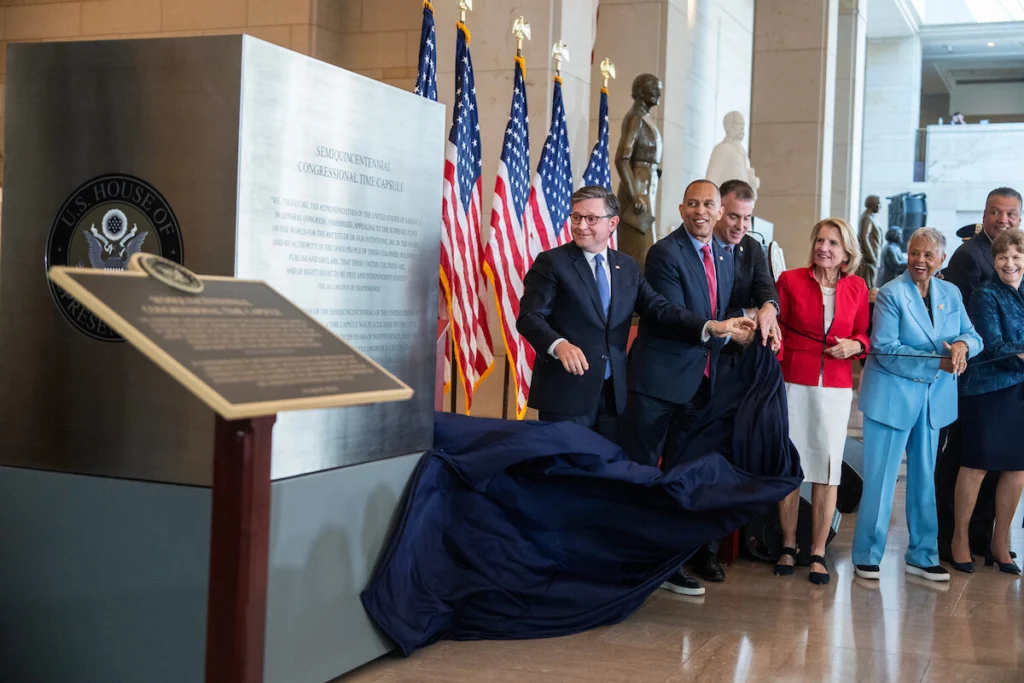
In a moment of bipartisan collaboration and historical reflection, Speaker Mike Johnson, House Minority Leader Hakeem Jeffries, and other lawmakers recently unveiled the Semiquincentennial Congressional Time Capsule during a Capitol Hill ceremony. This capsule, meticulously curated to represent the current era, is slated to be opened on July 4, 2276, offering future generations a tangible connection to the present. Our colleague Nina Heller has provided further details on this symbolic gesture, which underscores the enduring nature of democratic institutions and the constant flow of history. The image of the leaders together, marking a moment for posterity, stands as a visual counterpoint to the fierce political battles unfolding across the nation.
Stay Informed:
Subscribe now using this link so you don’t miss out on the best news and analysis from our team.