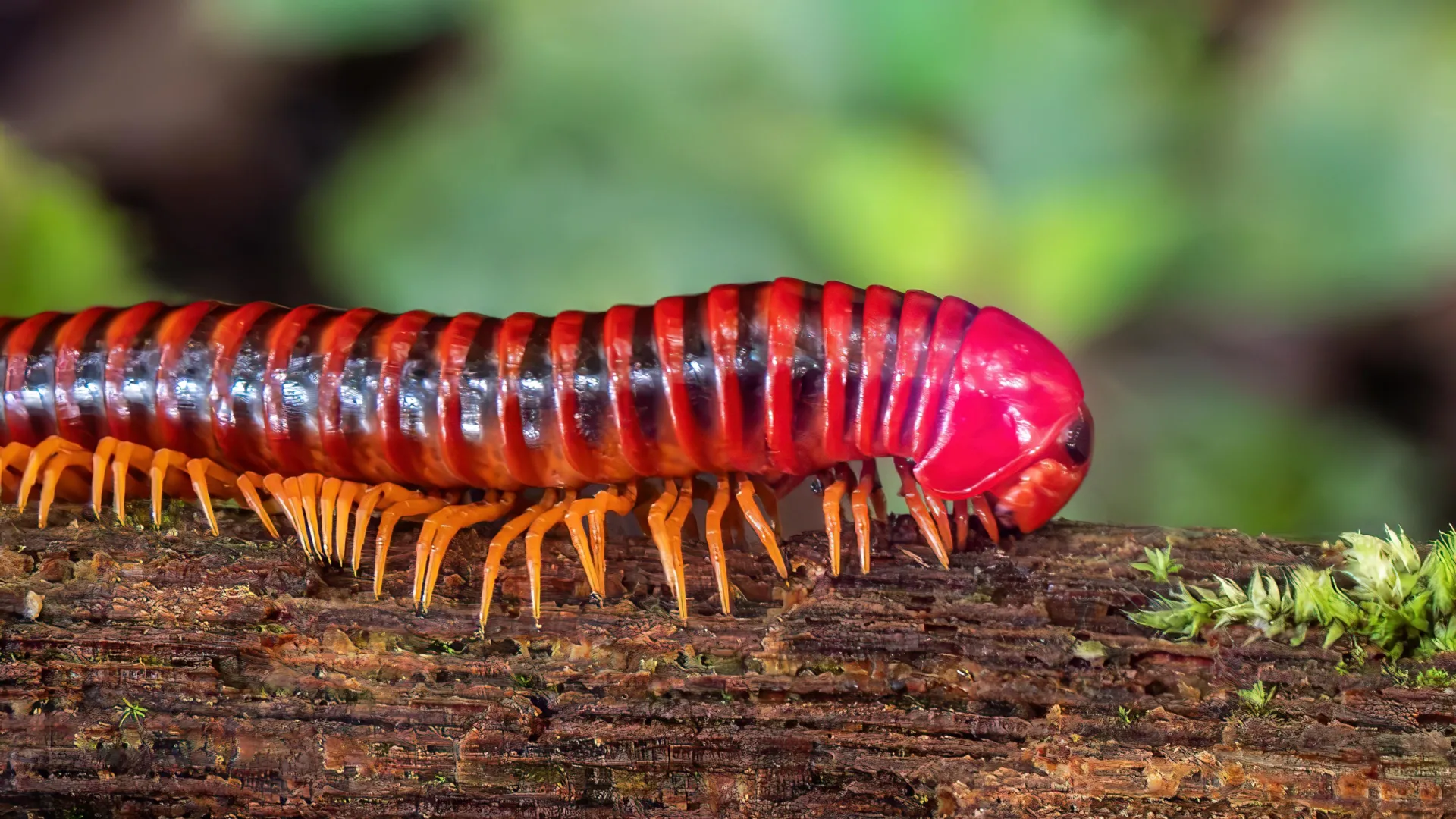
Long before the first vertebrates crawled from the primordial seas, and hundreds of millions of years before the first dinosaur footprint was pressed into the sediment, a humble, multi-legged pioneer was already hard at work shaping the surface of our planet. Millipedes, often overlooked as mere garden-variety detritivores, were the original architects of terrestrial life. Now, a groundbreaking international study led by researchers at Virginia Tech has finally reconstructed the complete evolutionary history of these creatures, filling in the final gaps of a family tree that dates back to the dawn of land-based ecosystems.
Published in the journal Current Biology, this comprehensive study integrates modern genomic sequencing with fossil evidence to push the origins of millipedes back to approximately 460 million years ago. By doing so, scientists have confirmed that these arthropods beat vertebrates onto land by a staggering 80 million years, serving as the essential ecosystem engineers that prepared the Earth for the complexity of life we see today.
Solving the "White Whale" Mystery: A Century of Taxonomic Uncertainty
For over a century, the millipede family tree contained two glaring "blind spots." Two rare and elusive groups, Siphoniulida and Siphonocryptida, had long confounded taxonomists. Because these creatures were incredibly difficult to locate in the wild and fresh specimens were nearly impossible to acquire, they remained the "white whales" of entomology. Without viable DNA, their precise place in the evolution of life remained a matter of speculation.
One of these groups consists of millipedes measuring less than a centimeter in length—tiny, cryptic organisms that spend their entire lives hidden deep underground. The other group is so rare that it is known to exist in only a handful of specific, isolated locations across the globe.
To resolve these mysteries, an international team led by Virginia Tech entomologist Paul Marek embarked on an ambitious global expedition. The hunt took researchers to the rugged terrain of Los Tuxtlas in Mexico and the volcanic landscapes of the Canary Islands in Spain. Their target: Siphoniulus neotropicus and Hirudicryptus canariensis.
The difficulty of the task cannot be overstated. Luisa "Fernanda" Vasquez-Valverde, the paper’s first author and a researcher in Marek’s lab, described the arduous process of field collection. "It took 10 people over a week just to find this one tiny 10-millimeter adult," she noted. "Finding them in the field was incredibly difficult because they look exactly like small, white nematodes. We didn’t know for sure if we had found a millipede until we brought them back to the lab and verified them under a microscope."
The Chronology of an Ancient Lineage
Once the rare specimens were secured, the team initiated a massive analytical effort. By sequencing the DNA of these two elusive groups and comparing hundreds of genes across 82 diverse millipede species, the researchers created a high-resolution map of millipede evolution. This genomic data was cross-referenced with physical evidence from 29 distinct fossils to anchor the timeline.
The results of this computational heavy-lifting, which utilized the vast resources of Virginia Tech’s Advanced Research Computing, provided several revelatory findings:
- The 460-Million-Year Milestone: The study suggests that millipedes emerged roughly 460 million years ago. This is 35 million years earlier than the oldest known millipede fossils previously suggested, placing them firmly in the Ordovician period.
- Taxonomic Reclassification: The data revealed that Siphonocryptida is not a separate, distinct order as scientists had long assumed. Instead, it is a nested lineage within an existing group. Siphoniulida was also successfully placed alongside its closest evolutionary cousins, finally tidying up a century-old taxonomic mess.
- The Dawn of Chemical Warfare: The study pinpointed the emergence of the millipede’s most iconic adaptation—their chemical defense systems—to approximately 260 million years ago. This confirms that these "little chemical factories" developed their sophisticated defense mechanisms long before many modern predators existed.
Supporting Data: Life Before the Vertebrates
The environment in which these early millipedes thrived was unrecognizable to the modern observer. During the era of their emergence, the Earth lacked the lush, green canopy that defines our current terrestrial landscape. There were no trees, no flowering plants, no seeds, and, crucially, no vertebrates.
"Millipedes were feeding on decaying mosses, decomposed slime, and primordial gunk on the surface of the Earth," said Paul Marek. In this barren, pre-forest landscape, millipedes functioned as the primary recyclers of nutrients. By breaking down the earliest forms of terrestrial organic matter, they accelerated soil formation and created the nutrient-rich substrate necessary for the evolution of more complex plant life. They were, in every sense, the "unsung engineers" of the terrestrial frontier.
Official Responses and Scientific Significance
The impact of this research extends far beyond the classification of a few rare species. By clarifying the evolutionary trajectory of millipedes, the team has provided a blueprint for how complex life successfully transitioned from aquatic to terrestrial environments.
"Millipedes really set the stage for later life on land, including humans and vertebrates," Marek explained. "It’s honestly puzzling that they play such a foundational role in the ecosystem, and yet they remain so poorly known to the general public."
The scientific community has lauded the study for its rigorous methodology and its success in combining diverse data sets. By involving a broad consortium of institutions—including the Field Museum of Natural History, the Australian National Insect Collection, and various global universities—the team ensured that the conclusions were robust and broadly applicable to evolutionary biology as a whole.
Implications for Future Exploration
The discovery that millipedes are far older than previously thought suggests that there is still much to learn about the "hidden" history of Earth’s surface. Even with over 14,000 described species, the researchers estimate that tens of thousands of millipede species remain undiscovered, waiting in leaf litter, caves, and deep soil across the planet.
For researchers like Vasquez-Valverde, the study serves as a call to action. "There is all this potential for discovery," she said. "It keeps me wondering what else we’re going to find." The team’s work has already expanded beyond the lab, with new species being identified in locations as varied as the Virginia Tech campus in Blacksburg and the urban sprawl of Los Angeles.
This research underscores a vital lesson: the most important creatures in the history of life are often the ones we walk over without a second glance. By filling in the gaps of the millipede family tree, the team has not only corrected the historical record but has also highlighted the enduring necessity of these tiny, ancient recyclers. As we continue to study the history of our planet, the humble millipede stands as a testament to the idea that the smallest organisms often leave the largest footprint on the evolution of life.
The project, funded by the National Science Foundation, marks a significant milestone in entomological research. It provides a definitive answer to a century of questions while opening new avenues for understanding how Earth’s earliest land-dwellers paved the way for the world we inhabit today. As the genomic data continues to be mined, one thing is clear: the history of life on land is far deeper, and far more connected to these "little chemical factories," than we ever dared to imagine.